
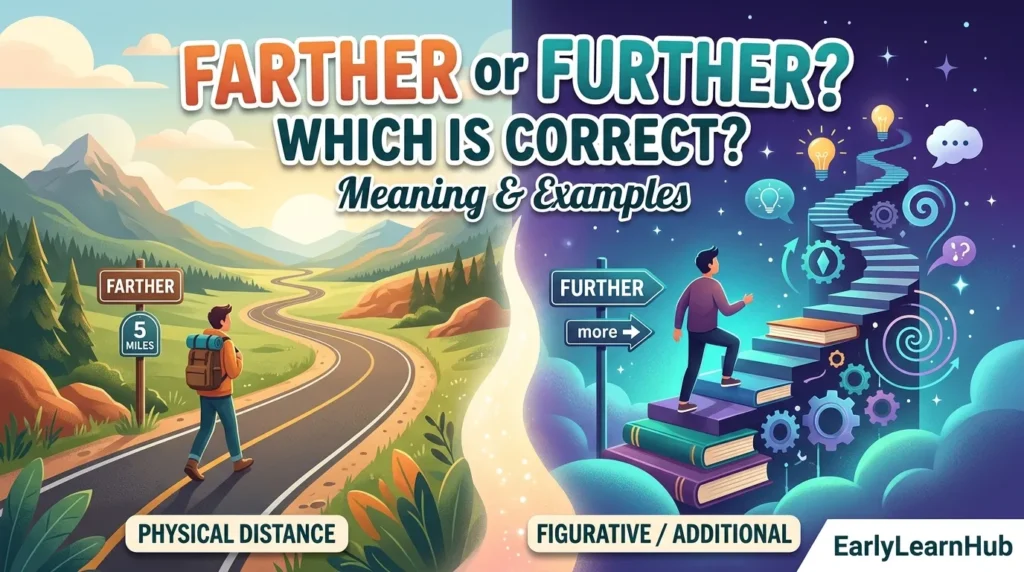
Farther and further are two commonly confused English words because they have similar meanings and are sometimes used interchangeably. Although both can describe distance, further also means additional or more. Understanding their differences will help you choose the correct word in writing and everyday conversations.
What Is the Difference Between Farther and Further?
The main difference between farther and further is how they are traditionally used in English.
Farther generally refers to a greater physical distance between two places or objects. It is commonly used when talking about measurable distances, such as miles, kilometers, or the distance someone travels.
Further can also refer to physical distance, but it has additional meanings. It is commonly used to describe something extra, additional, or happening to a greater extent. It can also mean to advance or promote something.
Here is a quick comparison:
| Farther | Further |
| Traditionally refers to physical distance. | Refers to additional amounts or greater extent. |
| Commonly used for measurable distances. | Commonly used for extra information or progress. |
| Usually preferred for physical distance in American English. | Used for physical and figurative distance, especially in British English. |
| Can function as an adjective or adverb. | Can function as an adjective, adverb, or verb. |
Examples:
- We walked farther than we planned.
- I need further information about the project.
- The school is farther from my house than the library.
- We should discuss this matter further.
Remember that further can also describe physical distance, so using it instead of farther is not necessarily incorrect.
For a better understanding, explore how to use Looser and Loser correctly through clear examples that demonstrate their meanings in different sentences and situations.
What Does Farther Mean?
Farther is the comparative form of far. It means at or to a greater distance from a particular place, person, or object.
It is commonly used as an adjective or adverb when describing physical distance.
Examples of farther:
- The grocery store is farther from my house than the pharmacy.
- We walked farther along the beach before stopping.
- How much farther do we need to travel?
- My new office is farther away than my previous one.
- She can throw the ball farther than her brother.
In these examples, farther describes a greater distance between locations or the distance covered by an action.
Farther as an adjective:
When used as an adjective, farther describes something that is more distant from a particular point.
Example: We could see the farther side of the river.
Farther as an adverb:
When used as an adverb, farther describes an action that extends over a greater distance.
Example: He ran farther than everyone else in the competition.
What Does Further Mean?
Further means additional, extra, or to a greater degree or extent. It can also refer to a greater distance, just like farther.
Unlike farther, further has several uses and can function as an adjective, adverb, or verb.
Examples of further:
- Please contact us if you need further assistance.
- We need further information before making a decision.
- She decided to further her education by attending university.
- Let’s discuss this issue further during the meeting.
- The company plans to further improve its services.
In these examples, further refers to something additional, continued discussion, or progress rather than simply physical distance.
Further as an adjective:
Further describes something additional or extra.
Example: Do you have any further questions about the assignment?
Further as an adverb:
Further describes something happening to a greater extent or degree.
Example: We need to investigate the matter further.
Further as a verb:
Further means to advance, promote, or help something develop.
Example: He took several courses to further his career.
When Should You Use Farther?
Use farther when you want to describe a greater physical distance between two places, objects, or people.
In American English, farther is generally the preferred choice when referring to measurable physical distance.
Consider these situations:
1. When comparing distances
Use farther when comparing how distant two locations are.
Example: New York is farther from Los Angeles than Chicago is.
2. When describing travel distance
Use farther when explaining how much distance someone has traveled or needs to travel.
Example: We cannot drive any farther because the road is closed.
3. When describing physical separation
Use farther when explaining that something is located at a greater physical distance.
Example: The hotel is farther away from the airport than we expected.
4. When talking about measurable distances
Use farther when discussing miles, kilometers, meters, or other distance measurements.
Example: The second runner traveled five meters farther than the first runner.
When Should You Use Further?
Use further when you mean additional, extra, or to a greater degree. It is also appropriate when discussing progress, development, or continuing an activity.
Here are some common situations:
1. When requesting additional information
Use further when asking for more details or information.
Example: Please send me further information about the course.
2. When discussing something in greater detail
Use further when you want to continue a conversation or examine a subject more deeply.
Example: We will discuss the proposal further next week.
3. When describing progress or development
Use further as a verb when referring to advancing a goal, career, or cause.
Example: She joined the training program to further her professional development.
4. When referring to additional items
Use further when describing something extra or additional.
Example: The teacher provided further instructions before the examination.
5. When using formal expressions
Further is commonly used in professional communication and formal writing.
Example: The office will remain closed until further notice.
Farther vs Further: Examples in Sentences
Understanding how these words work in sentences makes it easier to identify the correct choice.
Here are some examples showing how to use farther and further correctly.
| Farther Examples | Further Examples |
| We walked farther than yesterday. | I need further information. |
| The airport is farther from here. | Do you have any further questions? |
| She can swim farther than me. | We should investigate this further. |
| How much farther is the station? | The company wants to further its growth. |
| The house is farther down the road. | Further details will be provided soon. |
| He threw the ball farther than I did. | Let’s discuss the matter further. |
| The village is farther away. | We need further assistance. |
| They traveled farther than expected. | She wants to further her education. |
More examples using both words:
- The library is farther away, so we need to drive there.
- We need further research before publishing the results.
- How much farther can you walk without taking a break?
- The manager requested further clarification about the report.
- The mountains looked farther away than they actually were.
Farther vs Further: Are They Interchangeable?
Yes, farther and further can sometimes be used interchangeably, particularly when referring to physical distance.
For example:
- We walked farther down the road.
- We walked further down the road.
Both sentences are grammatically acceptable and communicate the same general meaning.
However, further has additional meanings that farther does not normally express.
For example:
- I need further explanation.
- I need farther explanation.
The first sentence is correct because further means additional. Farther does not normally work in this context.
There is also a regional difference in usage. American English generally prefers farther for physical distance, while British English commonly uses further for both physical and figurative distance.
Therefore, although the words overlap in meaning, they are not interchangeable in every situation.
Farther vs Further: Farthest vs Furthest
Farthest and furthest are the superlative forms of far. They describe the greatest distance or degree among three or more things.
Farthest is traditionally preferred when discussing physical distance in American English.
Examples:
- This is the farthest I have ever traveled.
- Which house is farthest from the school?
- She lives in the farthest village from the city.
Furthest is commonly used for additional amounts, greater degrees, or progress. It can also describe physical distance.
Examples:
- This is the furthest we have progressed with the project.
- Which student has gone the furthest in the competition?
- We need to investigate this issue furthest before deciding.
For physical distance, both farthest and furthest can be correct. Farthest is generally preferred in American English, while furthest is more common in British English.
You can also explore the difference between Excel and Accel to clarify why one word is correct in standard English while the other is commonly misspelled.
Easy Tricks to Remember Farther vs Further
If you often confuse these words, a simple memory trick can help you choose the correct one.
1. Remember the A in Farther
Think of the letter A in farther as standing for actual distance. Use farther when referring to physical distance.
Example: We traveled farther than we expected.
2. Remember Further Means Extra
Think of further as meaning more or additional. Use it when discussing extra information, assistance, questions, or details.
Example: Please provide further details about the event.
3. Use Further for Progress
When talking about advancing a career, education, or goal, use further.
Example: She wants to further her education.
4. Remember That Both Can Describe Distance
Do not assume further is always incorrect when referring to physical distance. Both words can describe distance, depending on regional preference and writing style.
Common Mistakes to Avoid When Using Farther and Further
Although these words have similar meanings, using them incorrectly can make sentences confusing.
Here are some common mistakes to avoid:
| Incorrect Usage | Correct Usage | Explanation |
| I need farther information. | I need further information. | Further means additional information. |
| We walked more farther. | We walked farther. | Avoid using more before the comparative form. |
| She wants to farther her career. | She wants to further her career. | Further can function as a verb meaning advance. |
| Do you have farther questions? | Do you have further questions? | Further means additional questions. |
| How much more farther is it? | How much farther is it? | The comparative word already expresses greater distance. |
The easiest way to avoid these mistakes is to consider whether you are talking about physical distance or something additional.
Summary: Farther or Further, Which Is Correct?
Both farther and further are correct English words, but they are used in different contexts.
Farther is traditionally preferred when describing physical distance, especially in American English. Further is used to mean additional, extra, or to a greater degree. It can also describe physical distance and function as a verb meaning to advance or promote something.
Here is a simple way to remember the difference:
- Farther: Use it for physical distance.
- Further: Use it for additional information, greater extent, or progress.
- Farthest: Traditionally preferred for the greatest physical distance in American English.
- Furthest: Commonly used for the greatest degree or extent, and also for physical distance.
Remember that further can also describe physical distance, particularly in British English. Choosing the right word depends on the meaning, context, and variety of English you are using.
FAQs
Is farther or further correct?
Both farther and further are correct. Farther is traditionally preferred for physical distance, while further is commonly used for additional information, greater extent, and progress. Both can describe physical distance.
What is the main difference between farther and further?
The main difference is that farther generally refers to physical distance, whereas further can mean additional, extra, or to a greater degree. Further can also refer to physical distance.
Can farther and further be used interchangeably?
Yes, they can sometimes be used interchangeably when referring to physical distance. However, further should be used when you mean additional information, extra items, or advancing something.
Is further more formal than farther?
Further is frequently used in formal and professional writing, especially in expressions such as further information, further assistance, and further notice. However, farther is also appropriate in formal writing when describing physical distance.
Is it farther away or further away?
Both farther away and further away are grammatically correct. Farther away is traditionally preferred in American English when describing physical distance, while further away is common in British English.
Is it further information or farther information?
Further information is correct because further means additional or extra. Farther information is incorrect in this context because farther generally refers to distance.
Is it farther down the road or further down the road?
Both farther down the road and further down the road are correct. They describe a location at a greater distance along a road.
What are the comparative and superlative forms of far?
Farther and further are comparative forms of far. Farthest and furthest are their superlative forms. These words describe greater or greatest distances and degrees, depending on the context.
Can further be used as a verb?
Yes, further can be used as a verb meaning to advance, promote, or help something develop. For example, “She took additional courses to further her career.”
What is a simple trick to remember farther and further?
Remember that farther is traditionally associated with actual physical distance, while further means additional or more. This simple distinction can help you choose the correct word in most situations.

Grace Holloway is a Creative Learning Designer with more than 9 years of experience producing visually engaging educational resources for preschool and kindergarten children. She specializes in combining educational principles with creative design to develop worksheets that encourage learning through play, exploration, and creativity.