
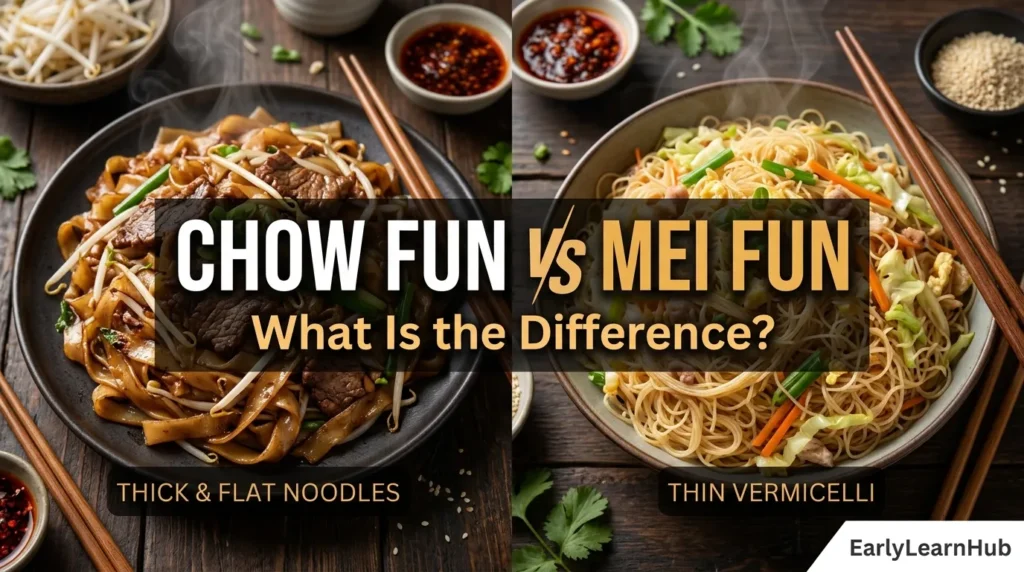
Chow Fun and Mei Fun are two popular Chinese noodle dishes that may look similar on a restaurant menu, but they have noticeable differences in their appearance, texture, ingredients, and preparation. Both are commonly made with rice noodles, yet Chow Fun uses wide, flat noodles, while Mei Fun features thin, delicate rice vermicelli. Understanding the difference can help you choose the right dish, recognize each noodle type, and order exactly what you prefer.
What Is the Difference Between Chow Fun and Mei Fun?
The main difference between Chow Fun and Mei Fun is the shape and thickness of their noodles.
- Chow Fun: Made with wide, flat rice noodles that have a soft, chewy texture. They are commonly stir-fried with vegetables, meat, and savory sauces.
- Mei Fun: Made with thin rice vermicelli noodles that have a delicate, light texture. They are often stir-fried with vegetables, meat, eggs, and seasonings.
Chow Fun noodles are broader and thicker, making them more substantial and chewy. Mei Fun noodles are much thinner, allowing them to absorb seasonings easily and create a lighter noodle dish.
Both dishes can contain chicken, beef, shrimp, pork, or vegetables, depending on the recipe and restaurant.
What Is Chow Fun?
Chow Fun is a popular Chinese noodle dish made with wide, flat rice noodles. It is especially associated with Cantonese cooking and is commonly served stir-fried with meat, seafood, or vegetables.
The noodles are typically soft, slippery, and slightly chewy. Their broad shape allows them to hold savory seasonings while maintaining a satisfying texture.
You can learn more about Everyday vs Every Day to understand the difference between these commonly confused expressions and when to use each one correctly.
Common Ingredients in Chow Fun
Depending on the recipe, Chow Fun may include:
- Wide, flat rice noodles
- Beef, chicken, pork, or shrimp
- Bean sprouts
- Green onions or scallions
- Onions and other vegetables
- Soy sauce
- Oyster sauce
- Garlic and cooking oil
One well-known version is Beef Chow Fun, which combines wide rice noodles with tender beef, bean sprouts, and scallions. It is often cooked over high heat to develop a smoky, savory flavor.
How Is Chow Fun Cooked?
Chow Fun is commonly prepared by stir-frying softened rice noodles in a hot wok. The cook adds the meat, vegetables, and seasonings, then combines everything quickly.
A popular preparation is dry-fried beef chow fun, known for its smoky wok flavor and relatively light coating of sauce.
What Is Mei Fun?
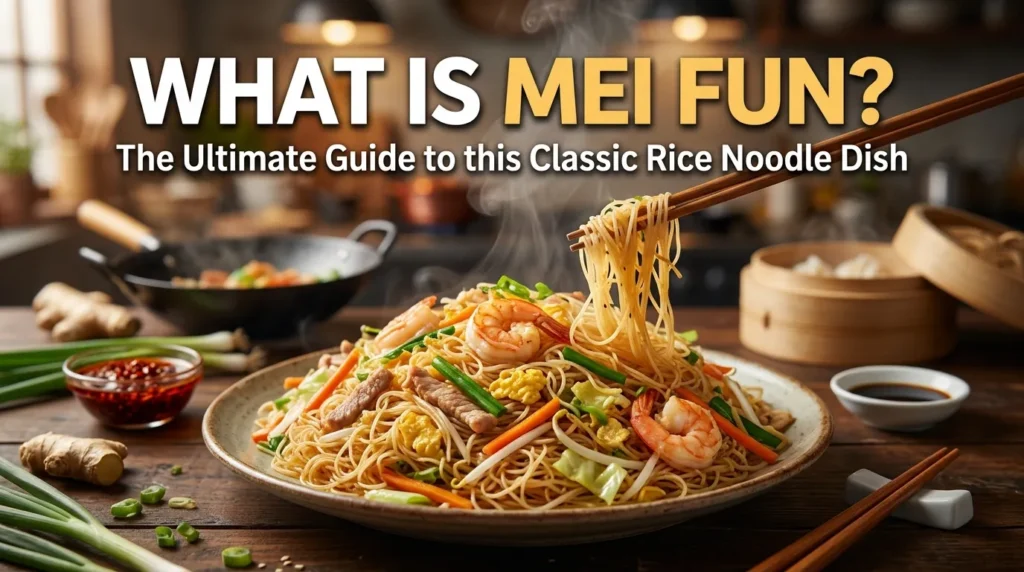
Mei Fun is a Chinese noodle dish made with thin rice vermicelli. These noodles are much narrower than Chow Fun noodles and have a delicate, thread-like appearance.
Mei Fun is popular in Chinese restaurants and takeout menus, where it is often stir-fried with meat, seafood, eggs, and vegetables.
Because the noodles are thin, they absorb seasonings easily and create a lighter texture than wide rice noodles.
Common Ingredients in Mei Fun
Mei Fun recipes commonly include:
- Thin rice vermicelli noodles
- Chicken, beef, pork, or shrimp
- Eggs
- Cabbage
- Carrots
- Bean sprouts
- Green onions
- Soy sauce and other seasonings
The ingredients vary depending on the restaurant and regional preparation.
How Is Mei Fun Cooked?
Mei Fun is usually prepared by soaking or briefly cooking dried rice vermicelli until softened. The noodles are then stir-fried with vegetables, protein, eggs, and seasonings.
The cook generally cuts the accompanying ingredients into smaller pieces so they mix evenly with the delicate noodles.
One popular variety is Singapore Mei Fun, which typically includes curry seasoning, vegetables, eggs, and meat or seafood. However, not every Mei Fun dish contains curry.
Chow Fun vs Mei Fun: Key Differences
The following table highlights the most important differences between these two Chinese noodle dishes.
| Feature | Chow Fun | Mei Fun |
| Noodle type | Wide, flat rice noodles | Thin rice vermicelli |
| Shape | Flat ribbons | Fine, round strands |
| Thickness | Broad and relatively thick | Very thin |
| Texture | Soft, slippery, chewy | Delicate and light |
| Main ingredient | Rice | Rice |
| Common preparation | Stir-fried | Stir-fried or used in other preparations |
| Popular variety | Beef Chow Fun | Singapore Mei Fun |
| Typical ingredients | Beef, sprouts, scallions | Chicken, shrimp, eggs, vegetables |
| Appearance | Wide noodle strips | Thin noodle strands |
| Eating experience | Hearty and chewy | Light and delicate |
The most important distinction is the noodle shape. Chow Fun uses wide, flat rice noodles, whereas Mei Fun uses thin rice vermicelli.
Chow Fun vs Mei Fun: Difference in Taste and Texture
Although both dishes use rice noodles, their textures create different eating experiences.
Chow Fun has a soft, slippery, and chewy texture. Its wide noodles provide a substantial bite, making the dish feel hearty and satisfying. The flavor often comes from savory sauces, meat, vegetables, and the smoky taste produced by high-heat wok cooking.
Mei Fun has a lighter and more delicate texture. Its thin strands mix easily with other ingredients and absorb the seasonings throughout the dish. Depending on the recipe, it can taste savory, mildly sweet, spicy, or curry-flavored.
If you enjoy thick, chewy noodles, Chow Fun may be the better choice. If you prefer thin noodles with a lighter texture, Mei Fun may suit your taste.
Chow Fun vs Mei Fun: Difference in Ingredients
Both dishes can contain similar ingredients, but their noodle types are different.
Chow Fun generally uses fresh or refrigerated wide rice noodles. These noodles are often combined with beef, bean sprouts, scallions, onions, and savory sauces.
Mei Fun commonly uses dried rice vermicelli that is softened before cooking. It is frequently combined with chicken, shrimp, pork, eggs, cabbage, carrots, and seasonings.
The protein and vegetables are not fixed requirements for either dish. Restaurants can offer several variations, including vegetarian, chicken, beef, and seafood versions.
Chow Fun vs Mei Fun: Difference in Cooking Methods
Chow Fun and Mei Fun are both frequently prepared in a wok, but their noodles require different handling.
Chow Fun noodles are delicate despite their broad shape. They can break or stick together if handled roughly. Cooks typically stir-fry them quickly over high heat to maintain their shape and develop a smoky flavor.
Mei Fun noodles are usually dried before preparation. They need to be soaked or softened before being added to the wok. Since they are thin, they can become mushy if overcooked or soaked for too long.
The main difference is that Chow Fun requires careful handling of broad, soft noodles, while Mei Fun requires controlling the moisture and cooking time of thin vermicelli.
What Do Chow Fun and Mei Fun Mean?
The names Chow Fun and Mei Fun come from Chinese food terminology. Understanding their meanings makes it easier to distinguish the two dishes.
Chow Fun: The word “chow” refers to stir-frying in Cantonese food terminology, while “fun” refers to rice noodles. Chow Fun is commonly associated with stir-fried wide rice noodles.
Mei Fun: Mei Fun refers to thin rice vermicelli noodles. These noodles are also known as rice sticks or rice vermicelli in English.
When the word “chow” is added to Mei Fun, as in Chow Mei Fun, it describes thin rice noodles prepared by stir-frying.
Therefore, Chow Fun and Mei Fun are not alternative spellings of the same dish. They identify different noodle styles and preparations.
Discover why Meanwhile vs Meantime confusion occurs and learn how to avoid common mistakes when choosing between these two expressions.
Chow Fun vs Mei Fun: Examples of Popular Dishes
Both noodle varieties can be prepared with different proteins, vegetables, and seasonings. Here are some popular examples that help explain their differences.
Examples of Chow Fun
- Beef Chow Fun: Wide rice noodles stir-fried with beef, bean sprouts, scallions, and savory sauces.
- Chicken Chow Fun: Flat rice noodles cooked with chicken, vegetables, and seasonings.
- Shrimp Chow Fun: Wide noodles combined with shrimp, vegetables, and garlic-based seasonings.
- Vegetable Chow Fun: Flat rice noodles stir-fried with cabbage, bean sprouts, onions, and other vegetables.
Examples of Mei Fun
- Chicken Mei Fun: Thin rice vermicelli stir-fried with chicken, vegetables, and savory seasonings.
- Singapore Mei Fun: Rice vermicelli prepared with curry seasoning, vegetables, eggs, and often shrimp or pork.
- Shrimp Mei Fun: Thin rice noodles combined with shrimp, eggs, and vegetables.
- Xiamen Mei Fun: A regional preparation featuring thin rice vermicelli, often with barbecue pork, shrimp, ham, and eggs.
These examples demonstrate that the noodle shape is the main difference, while the ingredients and seasonings can vary.
Chow Fun vs Mei Fun: Which One Should You Choose?
Choosing between Chow Fun and Mei Fun depends on your preferred noodle texture, flavor, and eating experience.
Choose Chow Fun if:
- You enjoy wide, flat rice noodles.
- You prefer soft and chewy textures.
- You like hearty stir-fried noodle dishes.
- You enjoy savory beef or chicken noodle dishes.
- You prefer noodles with a substantial bite.
Choose Mei Fun if:
- You prefer thin rice vermicelli.
- You enjoy delicate and lighter noodle textures.
- You like noodles mixed with finely chopped vegetables.
- You enjoy Singapore-style curry noodles.
- You prefer fine strands that absorb seasonings easily.
Both are delicious options, so your choice ultimately depends on your personal preference.
Is Chow Fun or Mei Fun Correct?
Both Chow Fun and Mei Fun are correct food terms. However, they do not mean the same thing and should not be used interchangeably when describing noodle dishes.
Use Chow Fun when referring to a dish made with wide, flat rice noodles, such as Beef Chow Fun.
Use Mei Fun when referring to thin rice vermicelli noodles, such as Chicken Mei Fun or Singapore Mei Fun.
For example:
- Correct: I ordered Beef Chow Fun for dinner.
- Correct: She prefers Chicken Mei Fun because the noodles are thinner.
- Correct: Singapore Mei Fun is usually prepared with curry seasoning.
Remember that neither term is a misspelling of the other. They refer to different Chinese rice noodle styles.
Summary
Chow Fun and Mei Fun are two popular Chinese rice noodle dishes with different shapes, textures, and preparation styles. Chow Fun features wide, flat rice noodles that are soft and chewy, while Mei Fun uses thin rice vermicelli with a delicate and lighter texture.
Both can be prepared with chicken, beef, shrimp, pork, vegetables, and savory seasonings. However, Chow Fun is commonly associated with dishes such as Beef Chow Fun, while Mei Fun is popular in preparations such as Singapore Mei Fun.
The easiest way to remember the difference is that Chow Fun means wide, flat rice noodles, while Mei Fun means thin rice vermicelli.
Frequently Asked Questions (FAQs)
Is Chow Fun the same as Mei Fun?
No, Chow Fun and Mei Fun are different Chinese noodle dishes. Chow Fun uses wide, flat rice noodles, while Mei Fun uses thin rice vermicelli. Both can be stir-fried with meat, seafood, vegetables, and seasonings.
Which is thicker, Chow Fun or Mei Fun?
Chow Fun noodles are thicker and wider than Mei Fun noodles. They have a flat, ribbon-like shape, whereas Mei Fun consists of very thin, round rice strands.
Is Mei Fun healthier than Chow Fun?
Neither is automatically healthier than the other. Both are commonly made from rice, and their nutritional value depends on portion size, cooking oil, sauces, protein, and vegetables used in the recipe.
Is Chow Fun made with rice noodles?
Yes, Chow Fun is traditionally made with wide, flat rice noodles. These noodles have a soft, slippery, and slightly chewy texture.
Is Mei Fun made with rice or wheat?
Mei Fun is traditionally made with rice flour and water. It consists of thin rice vermicelli rather than conventional wheat-based noodles. However, check packaged products for additional ingredients.
Is Singapore Mei Fun the same as regular Mei Fun?
No, Singapore Mei Fun is a particular preparation of Mei Fun. It typically includes curry seasoning, vegetables, eggs, and meat or seafood. Regular Mei Fun does not necessarily contain curry.
Can I substitute Chow Fun for Mei Fun?
You can substitute one for the other in some recipes, but the texture and final result will change. Chow Fun creates a wider, chewier bite, while Mei Fun produces a lighter dish with thin noodle strands.
Are Chow Fun and Mei Fun gluten-free?
Rice noodles are naturally gluten-free when made from rice and water. However, the complete dishes may contain gluten through soy sauce, oyster sauce, marinades, or cross-contamination. Check the ingredients and restaurant preparation before ordering.
What is the difference between Chow Fun and Chow Mei Fun?
Chow Fun generally refers to a stir-fried dish made with wide, flat rice noodles. Chow Mei Fun refers to stir-fried thin rice vermicelli. The difference is primarily the shape and thickness of the noodles.
Which tastes better, Chow Fun or Mei Fun?
It depends on your taste preferences. Chow Fun is ideal for people who enjoy wide, chewy noodles, while Mei Fun is a good choice for those who prefer thin, delicate noodles with seasonings distributed throughout.

Daniel Foster is the founder and content creator of EarlyLearnHub, a website dedicated to providing free printable worksheets, coloring pages, and educational resources for preschool and kindergarten children. He creates engaging learning materials that help young learners build essential skills in literacy, numeracy, handwriting, problem-solving, and creativity.