
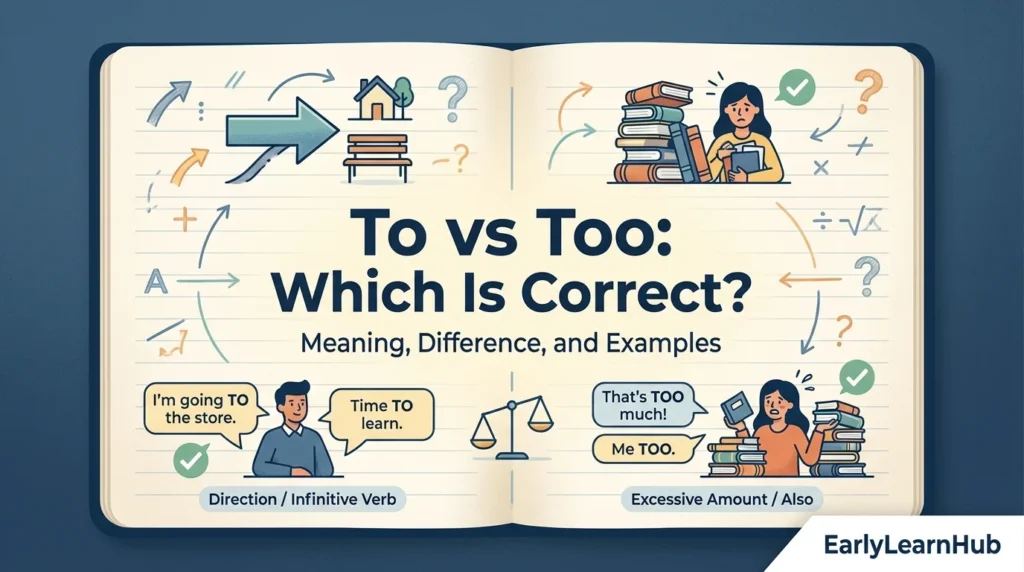
To and too are two of the most commonly confused words in English. They sound the same in standard pronunciation, but they have different meanings, grammatical functions, and spellings. To is commonly used for direction, relationships, and before verbs in the infinitive form, while too usually means “also” or “more than necessary.”
To vs Too: Which Is Correct?
Both to and too are correct words. The correct choice depends on what you want to say.
- Use to for direction, destination, or before a verb.
- Use too when you mean also, as well, or more than is necessary or desirable.
- To and too are homophones because they are pronounced alike but have different spellings and meanings.
Examples:
- I am going to school.
- I want to learn English.
- I want to come too.
- This coffee is too hot.
So, neither word is universally “correct.” The meaning and grammatical function determine which one you should use.
What Is the Difference Between To and Too?
The main difference between to and too is their grammatical function.
| Word | Part of Speech | Main Meaning | Example |
| to | Preposition / infinitive marker | Direction, destination, relationship, or before a verb | I went to school. |
| too | Adverb | Also, excessively, or more than enough | I want to go too. |
| too | Adverb | More than necessary or desirable | It is too cold. |
Oxford identifies to as both a preposition and an infinitive marker. It can indicate direction, destination, purpose, or introduce the base form of a verb.
Too, on the other hand, is an adverb. Cambridge and Oxford explain that it can mean “also” or indicate that something is more than necessary, suitable, or desirable.
What Does To Mean?
To is commonly used as a preposition to indicate movement, direction, or a relationship between people or things.
To for Direction or Destination
Use to when someone or something moves toward a place or destination.
Examples:
- We walked to the park.
- She drove to work.
- They are traveling to London.
- He went to the store.
- Give this letter to Sarah.
In these examples, to connects the action or relationship with a destination or recipient.
To Before a Verb
To is also used as an infinitive marker before the base form of a verb.
Examples:
- I want to learn.
- She needs to study.
- They decided to leave.
- He hopes to win.
- We plan to travel.
Oxford specifically describes this use of to as marking the infinitive form of a verb.
To for Purpose
To can also introduce a purpose.
Examples:
- I went to the store to buy milk.
- She studies hard to pass the exam.
- He called me to ask a question.
- We arrived early to get good seats.
Here, to tells us why an action was performed.
What Does Too Mean?
Too is an adverb with two major everyday meanings.
Too Meaning “Also”
Use too when you mean also, as well, or in addition.
Examples:
- I want to come too.
- She likes chocolate too.
- He is coming too.
- I enjoyed the movie too.
- “I love English.” “Me too.”
Cambridge notes that too meaning “also” is especially common at the end of a clause or sentence.
Too Meaning “More Than Necessary”
Use too when something is excessive or more than is wanted, needed, suitable, or possible.
Examples:
- The soup is too hot.
- This bag is too heavy.
- The test was too difficult.
- You are driving too fast.
- This shirt is too expensive.
Cambridge gives the same basic grammatical pattern, using too before adjectives and adverbs to express an excessive degree.
To vs Too Examples
Here are some simple examples that show the difference clearly.
Examples With To
- I am going to school.
- She wants to learn Spanish.
- He gave the book to me.
- We drove to the airport.
- I need to finish my homework.
- They went to the beach.
- She came to help us.
- He decided to stay.
Examples With Too
- I want to go too.
- She likes pizza too.
- It is too cold outside.
- The box is too heavy.
- He arrived too late.
- The coffee is too hot.
- I am too tired to work.
- There are too many people here.
Sentences Using To and Too Together
It is possible to use to and too in the same sentence because they have different functions.
- It is too late to call him.
- I want to go too.
- She is too tired to study.
- He went to the store too.
- It is too expensive to buy.
- We need to leave too.
Notice the difference in:
It is too difficult to understand.
The first too means “more than is manageable,” while to introduces the verb understand.
This combination is also recognized in standard grammar patterns such as too + adjective + to-infinitive.
To vs Too: Common Mistakes
Because to and too sound the same, writers sometimes choose the wrong spelling.
Mistake 1: Using To Instead of Too
Incorrect: I want to come to.
Correct: I want to come too.
Here, too means “also.”
Mistake 2: Using Too Instead of To
Incorrect: I want too go home.
Correct: I want to go home.
Here, to introduces the verb go.
Mistake 3: Confusing Too With To Before an Adjective
Incorrect: The water is to cold.
Correct: The water is too cold.
The word too means the water is excessively cold.
Mistake 4: Writing “Me To”
Incorrect: “I love this song.” “Me to.”
Correct: “I love this song.” “Me too.”
Me too means “I also do” or “I feel the same way.” Cambridge specifically identifies me too as the normal informal response in this situation.
How to Remember the Difference Between To and Too
A simple memory trick is to think about the extra O in too.
Too has an extra O because it can indicate something extra.
For example:
- I want to come too. = I want to come also.
- It is too expensive. = It is more expensive than acceptable.
If you can replace too with also, as well, or excessively, you probably need too.
Quick test:
- “I want to come ___.” → “I want to come also.” → too
- “It is ___ expensive.” → “It is excessively expensive.” → too
- “I want ___ leave.” → “I want also leave.” ❌ → to
This substitution approach is also recommended by grammar references as a practical way to distinguish the words.
To vs Too vs Two
There is a third word that sounds exactly like to and too: two.
These three words are homophones, but their meanings are different.
| Word | Meaning | Example |
| to | Direction, destination, or infinitive marker | I went to school. |
| too | Also or excessively | I want to go too. |
| two | The number 2 | I have two books. |
Examples
- I have two brothers.
- I want to meet them.
- They want to come too.
Remember:
To = direction or verb
Too = also or excessive
Two = number 2
Is Too Always at the End of a Sentence?
No. Too often appears at the end of a sentence when it means “also,” but it can occur in other positions.
For example:
- I want to come too.
- She likes the movie too.
- Too many people attended the event.
- It is too expensive.
- He is too tired to continue.
When too means “also,” it is commonly placed at the end of a clause. When it expresses excess, it commonly appears before an adjective, adverb, or quantity expression.
Is “Too Much” Correct?
Yes. Too much means more than is necessary or desirable.
Use too much with uncountable nouns.
- There is too much sugar in the tea.
- You spend too much money.
- We have too much work.
- He drinks too much coffee.
For countable plural nouns, use too many:
- There are too many people here.
- She bought too many books.
- We made too many mistakes.
Cambridge specifically distinguishes too much, too many, too few, and too little when discussing quantities.
Is “To” Used Before a Verb?
Yes. One of the most common uses of to is before the base form of a verb to create an infinitive.
Examples include:
- to eat
- to sleep
- to read
- to write
- to learn
- to play
- to work
- to understand
For example:
I want to learn English.
Not:
I want too learn English.
Oxford identifies this as the infinitive-marker use of to.
To vs Too: Quick Comparison
| Question | Answer |
| Are to and too pronounced the same? | Yes, in standard English they are homophones. |
| Is to a preposition? | Yes. |
| Can to introduce a verb? | Yes, as an infinitive marker. |
| Is too an adverb? | Yes. |
| Can too mean “also”? | Yes. |
| Can too mean “excessively”? | Yes. |
| Can too mean “very” in some contexts? | Yes, though this use depends on context. |
| Is “me too” correct? | Yes. |
| Is “too much” correct? | Yes. |
| Is “to much” correct? | No, when you mean excessive quantity. |
Summary
The difference between to and too is mainly about meaning and grammatical function.
Use to for direction, destination, relationships, purpose, and before a verb in the infinitive form.
Use too when you mean also, as well, or more than necessary or desirable.
A useful memory trick is to associate the extra o in too with something extra. If also, as well, or excessively fits the sentence, too is usually the correct choice.
The three words to, too, and two sound alike, but two refers to the number 2.
FAQs
Is “to” or “too” correct?
Both are correct words, but they are used differently. To is commonly used for direction or before a verb, while too means “also” or “more than necessary.”
What is the easiest way to remember to vs too?
Remember that too has an extra o. Think of the extra o as representing something extra, such as “also” or “excessively.”
Does too mean also?
Yes. Too can mean “also” or “as well.”
Example: I want to come too.
Does too mean very?
Sometimes. Too can be used with a meaning close to “very” in certain informal or contextual uses, although its core meanings are “also” and “more than necessary.”
Should I write “I want to go to” or “I want to go too”?
If you mean I also want to go, write:
I want to go too.
If another destination follows, to may be correct:
I want to go to the park.
Is “me too” correct?
Yes. Me too is a common informal expression meaning “I also do” or “I feel the same way.”
Is “too much” or “to much” correct?
Too much is correct when you mean more than necessary or wanted.
Example: There is too much water in the glass.
Is “too expensive” correct?
Yes. Too expensive means that something costs more than is acceptable or affordable in the context.
Example: That car is too expensive for me.
Can to and too be used in the same sentence?
Yes.
Example: It is too late to call her.
The first too expresses excess, while the second to introduces the verb call.
Are to, too, and two homophones?
Yes. To, too, and two are pronounced alike but have different spellings and meanings.

Ethan Richardson is an Educational Content Editor with more than 10 years of experience reviewing and developing educational materials for young learners. His expertise includes improving worksheet accuracy, readability, and instructional quality while ensuring learning resources meet modern educational standards.