
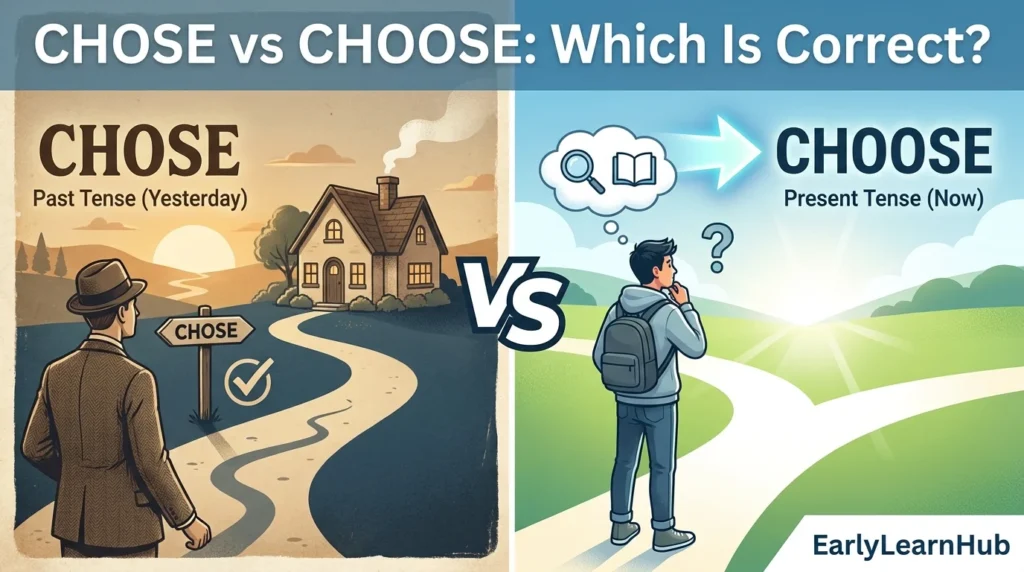
Chose and choose are both correct words, but they are used in different situations. Choose is the present-tense form, while chose is the simple past tense of the verb choose. The past participle is chosen, which is used with helping verbs such as have, has, had, or was.
What Is the Difference Between Chose and Choose?
The main difference between chose and choose is tense.
- Choose is the present tense and refers to a choice being made now, regularly, or in the future.
- Chose is the simple past tense and refers to a choice that was made in the past.
- Chosen is the past participle and normally requires a helping verb.
| Word | Verb form | When to use it | Example |
| Choose | Present | Now, generally, or future | I choose the blue one. |
| Chose | Simple past | A completed past action | I chose the blue one yesterday. |
| Chosen | Past participle | With a helping verb | I have chosen the blue one. |
Oxford lists the verb forms as choose, chose, chosen, choosing, while Cambridge also identifies chose as the past simple and chosen as the past participle.
Choose Meaning
Choose means to decide which person, thing, or option you want from several possibilities. Merriam-Webster defines it as selecting freely after consideration or deciding on an option.
Choose is used when the choice is happening in the present or is generally true.
Examples of Choose
- I choose the red dress.
- Please choose one of these options.
- We can choose where to eat tonight.
- She usually chooses healthy food.
- You can choose between tea and coffee.
- They will choose a new leader tomorrow.
For example, in “Which color do you choose?”, the choice is being made now, so choose is correct.
Chose Meaning
Chose is the simple past tense of choose. It describes a decision or selection that happened in the past. Cambridge and Oxford both identify chose as the past form of choose.
Examples of Chose
- I chose the red dress yesterday.
- She chose the blue car.
- We chose a different restaurant last night.
- He chose to stay home.
- They chose Sarah as their captain.
- My parents chose this house many years ago.
In “She chose the blue dress yesterday,” the word yesterday clearly places the action in the past, so chose is required.
Choose vs Chose Pronunciation
Although choose and chose look very similar, their vowel sounds are different.
- Choose: /tʃuːz/, rhymes approximately with news
- Chose: /tʃoʊz/ in American English, approximately like those
Cambridge gives the American pronunciation of choose as /tʃuz/ and chose as /tʃoʊz/, while Oxford lists the corresponding British pronunciations as /tʃuːz/ and /tʃəʊz/.
When to Use Choose
Use choose when talking about a current, habitual, or future choice.
Present Choice
I choose chocolate ice cream.
The choice is being made now.
General or Habitual Choice
She always chooses the window seat.
This describes something she regularly does.
Future Choice
You can choose your seat tomorrow.
The choice will happen in the future.
After “Will,” “Can,” or “Should”
Use the base form choose after modal verbs.
- You should choose carefully.
- We can choose another option.
- They will choose a winner.
- You may choose any book.
When to Use Chose
Use chose when describing a completed choice in the past.
- I chose the first option.
- She chose the red shoes.
- They chose to leave early.
- He chose a different career.
- We chose that hotel last year.
A useful clue is a past-time expression such as yesterday, last week, last year, earlier, or two days ago.
We chose the blue sofa last week.
Chose vs Chosen
One of the most common mistakes is confusing chose with chosen.
Chose is the simple past:
She chose the red dress.
Chosen is the past participle:
She has chosen the red dress.
You generally cannot use chosen by itself as the simple past:
❌ She chosen the red dress yesterday.
✅ She chose the red dress yesterday.
Merriam-Webster lists the forms as choose, chose, chosen, choosing, confirming this distinction.
Chose vs Choose Examples
Here are some examples that make the difference clear:
- I choose tea every morning.
This is a regular or habitual choice. - I chose tea yesterday.
This is a completed choice in the past. - Which dress will you choose?
This refers to a future choice. - Which dress did you choose?
This asks about a past choice. - She chooses the cheapest option.
This describes her usual behavior. - She chose the cheapest option yesterday.
This describes a past decision. - We can choose any restaurant.
Choose follows the modal verb can. - We chose a restaurant last night.
The choice happened in the past. - They have chosen a new leader.
Chosen is the past participle used with have. - He was chosen for the team.
Chosen is used with was in the passive construction.
Common Mistakes With Chose and Choose
Incorrect: I choose the blue one yesterday.
The word yesterday indicates a completed past action.
Correct: I chose the blue one yesterday.
Incorrect: She chose this option every day.
If you are describing a current habit, use chooses.
Correct: She chooses this option every day.
Incorrect: We have chose a new name.
After have, use the past participle chosen.
Correct: We have chosen a new name.
Incorrect: They chosen the winner last night.
For a simple past action, use chose.
Correct: They chose the winner last night.
Easy Trick to Remember Chose vs Choose
Remember these three forms:
Choose → Chose → Chosen
Think of them as:
- Choose = present
- Chose = past
- Chosen = past participle
A simple example is:
Today I choose.
Yesterday I chose.
I have chosen already.
This pattern can help you quickly identify the correct form when writing.
Is Chose or Choose Correct?
Both chose and choose are correct, but they are not interchangeable.
Use choose for the present, habitual actions, and many future constructions:
I choose the blue one.
Use chose for a completed action in the past:
I chose the blue one yesterday.
Use chosen as the past participle:
I have chosen the blue one.
So, if you are asking “Which is correct, chose or choose?”, the answer depends on the tense of your sentence.
Summary
Choose is the present-tense form of the verb meaning to select or decide between possibilities. Chose is its simple past form, used for a choice that happened in the past. Chosen is the past participle and is normally used with a helping verb.
The easiest way to remember the difference is:
Choose = present
Chose = past
Chosen = past participle
For example, “I choose this one” describes a present choice, while “I chose this one yesterday” describes a past choice.
Frequently Asked Questions
Is chose the past tense of choose?
Yes. Chose is the simple past tense of choose.
Is choose present or past tense?
Choose is the present-tense form. For example, “I choose the blue shirt.”
What is the past tense of choose?
The past tense of choose is chose.
What is the past participle of choose?
The past participle is chosen. For example, “She has chosen a new dress.”
Is it I choose or I chose?
Use I choose for a present or general choice. Use I chose for a completed past choice.
Is it chose or chosen?
Use chose as the simple past and chosen as the past participle. For example, “I chose it yesterday” but “I have chosen it already.”
Can I say “I have chose”?
No. The correct form is “I have chosen.”
Can I use choose for the past?
No. Choose is not the simple past form. The correct past form is chose.
What is the difference between choose, chose, and chosen?
Choose is present, chose is simple past, and chosen is the past participle.
How do you remember choose vs chose?
Remember the sequence choose, chose, chosen. Think choose = now, chose = before, and chosen = used with a helping verb.

Grace Holloway is a Creative Learning Designer with more than 9 years of experience producing visually engaging educational resources for preschool and kindergarten children. She specializes in combining educational principles with creative design to develop worksheets that encourage learning through play, exploration, and creativity.
1 thought on “Chose vs Choose: Which Is Correct? Meaning & Examples”