
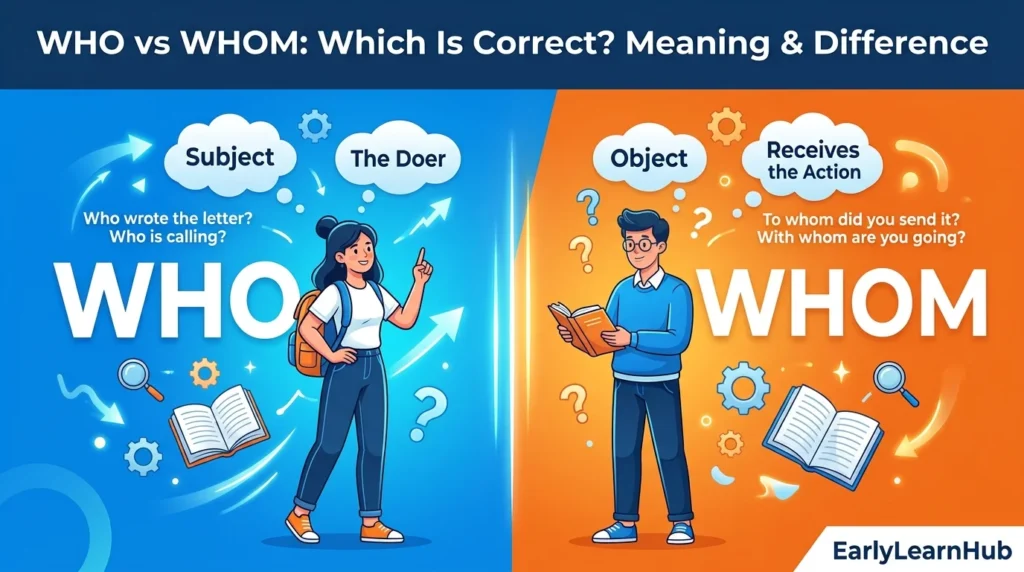
Who and whom both refer to people, but they have different grammatical roles. The key difference is that who traditionally functions as a subject, while whom functions as an object. In modern English, however, who is also widely used as an object, especially in everyday speech
Improve your English grammar by learning when to use Chose or Choose in different sentences and contexts.
Who vs Whom: Which Is Correct?
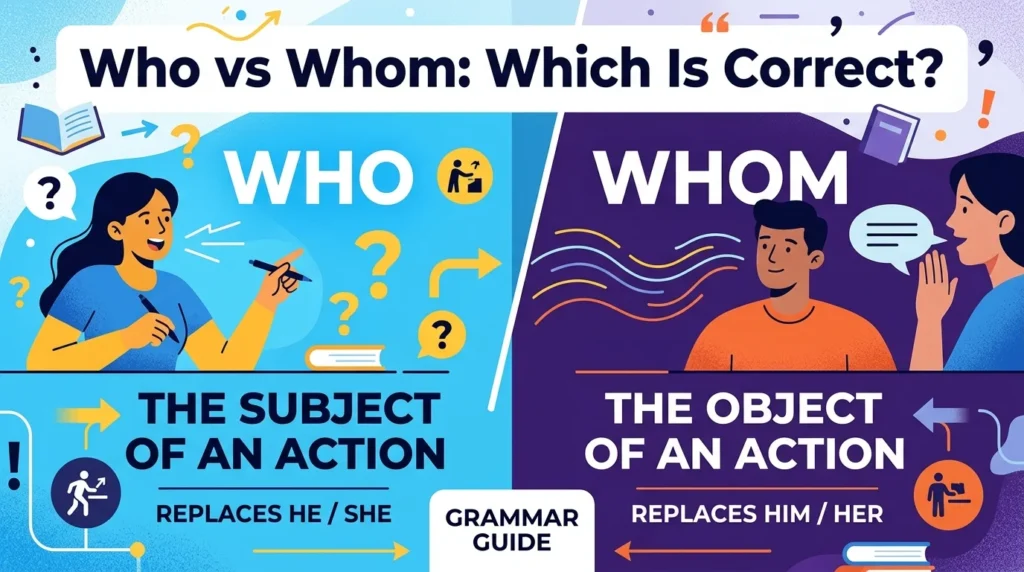
Both who and whom are correct words. The correct choice depends on how the pronoun functions in the sentence.
Use who when the person is the subject of the verb:
- Who called you?
- Who wrote this letter?
- Who is coming to dinner?
Use whom when the person is the object of a verb or preposition, particularly in formal writing:
- Whom did you invite?
- Whom did you meet?
- To whom should I send the email?
Modern English often uses who instead of whom, especially in conversation. Cambridge and Oxford both note that whom is formal and much less common in ordinary speech.
What Is the Difference Between Who and Whom?
The traditional grammatical distinction is based on subject and object.
| Word | Traditional role | Common use | Example |
| Who | Subject | Everyday and formal English | Who called you? |
| Whom | Object | Formal or careful writing | Whom did you call? |
A useful way to remember the distinction is:
Who = he/she/they
Whom = him/her/them
For example:
- Who called Sarah? → She called Sarah.
- Whom did Sarah call? → Sarah called her.
This substitution test works because who corresponds to subject pronouns such as he and she, while whom corresponds to object pronouns such as him and her. The subject-object distinction is also reflected in standard grammar references.
Who Meaning and Definition
Who is a pronoun used to ask about or identify a person or people. It can function as a subject and, in modern English, it can also function as an object.
Examples:
- Who is that person?
- Who opened the door?
- Who did you see?
- I know who called.
- The woman who lives next door is a doctor.
Oxford defines who as a pronoun used to ask about the identity or function of people and to identify or provide additional information about people.
Whom Meaning and Definition
Whom is the traditional object form of who. It refers to a person who is the object of a verb or follows a preposition.
Examples:
- Whom did you invite?
- Whom are you helping?
- To whom should I speak?
- The person whom I contacted replied quickly.
- She is the colleague with whom I worked.
Whom is generally considered formal, and it is more common in writing than in everyday conversation
Clarify the distinction with If Time Permits or If Time Allows and choose the natural expression for your sentence.
When to Use Who
Use who when the person is performing the action or otherwise functioning as the subject.
Who as the subject
- Who broke the window?
- Who made this cake?
- Who wants some coffee?
- Who knows the answer?
In each sentence, who is connected to the person performing the action:
- Who broke the window?
- Who made the cake?
- Who wants coffee?
Here, replacing who with he or she makes the grammatical role clear:
- She broke the window.
- He made the cake.
When to Use Whom
Use whom when the person is the object of a verb or preposition, especially in formal writing.
Examples:
- Whom did you invite?
- Whom did the manager hire?
- Whom are you calling?
- To whom should I address this letter?
- With whom did you travel?
The pronoun receives the action rather than performing it.
For example:
The manager hired him.
Therefore:
Whom did the manager hire?
Oxford specifically notes that whom is often replaced by who in spoken English, while whom remains common in formal constructions involving prepositions.
Who or Whom in Questions
Questions are where the difference is most noticeable.
Use who when it is the subject
- Who called you?
- Who sent the message?
- Who ate the last cookie?
- Who invited them?
Here, who performs the action.
Use whom when it is the object
- Whom did you call?
- Whom did you invite?
- Whom did she meet?
- Whom are they interviewing?
Here, another person performs the action.
Compare:
Who called John?
John was called by the person identified by who.
Whom did John call?
John performed the action, and whom received it.
Cambridge recognizes this traditional distinction but also notes that who is commonly used as an object in modern English, including in questions.
Who vs Whom After Prepositions
Whom is especially traditional after a preposition.
Examples:
- To whom did you speak?
- With whom are you traveling?
- For whom is this gift?
- About whom were they talking?
- From whom did you receive the letter?
These constructions are grammatically standard but can sound formal.
In everyday English, speakers commonly move the preposition to the end and use who:
- Who did you speak to?
- Who are you traveling with?
- Who is this gift for?
- Who were they talking about?
- Who did you receive the letter from?
Both patterns can be grammatical, but the whom + preposition construction is more formal.
Who vs Whom in Relative Clauses
Both words can appear in relative clauses referring to people.
Use who when it is the subject:
- The woman who called me is my teacher.
- The man who lives here is a doctor.
Use whom when it is the object in formal writing:
- The woman whom I called is my teacher.
- The man whom we interviewed was experienced.
However, in modern English, who is frequently used instead of whom:
- The woman who I called is my teacher.
- The man who we interviewed was experienced.
In defining relative clauses, the object pronoun can sometimes be omitted:
- The woman I called is my teacher.
- The man we interviewed was experienced.
Oxford and Cambridge both recognize this modern flexibility.
Who vs Whom Examples
Here are some examples showing the difference clearly:
Who as subject
- Who opened the door?
- Who wants to go first?
- Who wrote this report?
- Who knows the answer?
- Who is coming with us?
Whom as object
- Whom did you invite?
- Whom did she call?
- Whom did they choose?
- Whom are you waiting for?
- To whom did you send the package?
Modern English with who
In ordinary conversation, these are very natural:
- Who did you invite?
- Who did she call?
- Who did they choose?
- Who are you waiting for?
- Who did you send the package to?
These sentences use who where traditional grammar might recommend whom. This usage is widely accepted in contemporary English.
The He/Him Test for Who and Whom
The easiest traditional test is to replace the pronoun with he/she or him/her.
If he or she works, use who.
If him or her works, use whom.
Example 1
Who/Whom called you?
Answer:
She called me.
Because she works, the traditional form is:
Who called you?
Example 2
Who/Whom did you call?
Answer:
I called her.
Because her works, the traditional form is:
Whom did you call?
Example 3
Who/Whom did they hire?
Answer:
They hired him.
Therefore:
Whom did they hire?
This test is useful, although modern English often chooses who even where the traditional test points to whom.
Is Whom Still Used?
Yes. Whom is still a correct English word, particularly in formal writing, academic contexts, official communication, and constructions following prepositions.
For example:
- To whom it may concern
- The candidate whom we selected
- The person with whom I worked
- Whom did you consult?
However, whom is considerably less common in everyday speech. Oxford describes whom as formal and notes that who is normally preferred as the object pronoun in spoken English.
Is Who Correct as an Object?
Yes. In contemporary English, who is widely used as an object, particularly in conversation and informal writing.
For example:
Who did you meet?
Traditional grammar would prefer:
Whom did you meet?
But Who did you meet? is normal, natural modern English. Cambridge explicitly gives who as both subject and object in questions, while noting that whom remains available for formal usage.
Common Mistakes With Who and Whom
Mistake 1: Using whom as the subject
Incorrect:
Whom called you?
Traditional correction:
Who called you?
The person represented by the pronoun is performing the action of calling, so who is the appropriate subject form.
Mistake 2: Assuming whom must always follow a preposition
Not every sentence containing a preposition requires whom in modern English.
Formal:
To whom did you speak?
Natural everyday English:
Who did you speak to?
Both constructions are acceptable, with the first being more formal.
Mistake 3: Thinking who is always informal or incorrect
Who is not an incorrect substitute simply because the traditional grammar rule would select whom. Modern standard English frequently uses who as an object.
Mistake 4: Choosing whom just to sound formal
Using whom everywhere can make a sentence sound unnecessarily stiff.
For everyday conversation, Who did you talk to? is usually more natural than To whom did you speak?
Who vs Whom: Quick Comparison
| Question | Traditional answer | Modern natural English |
| ___ called you? | Who | Who |
| ___ did you call? | Whom | Who is very common |
| ___ did she invite? | Whom | Who is very common |
| ___ is coming? | Who | Who |
| To ___ did you speak? | Whom | To whom, formal |
| Who did you speak to? | Who | Who, natural |
| The person ___ called me | Who | Who |
| The person ___ I called | Whom | Who or omitted pronoun |
The important point is that whom has not become incorrect, but its use has become more limited and formal in contemporary English.
Who or Whom: Which Should You Use?
Use this simple guideline:
Use who for the subject and for most everyday questions and conversations.
Use whom for the object when you want traditional grammatical precision, especially in formal writing or after a preposition.
For example:
- Everyday: Who did you speak to?
- Formal: To whom did you speak?
Both communicate the same basic meaning, but their levels of formality differ.
Summary
Who and whom both refer to people, but traditionally they have different grammatical roles. Who is the subject form, while whom is the object form.
Use who in sentences such as “Who called you?” because the pronoun performs the action. Use whom in formal constructions such as “Whom did you call?” because the pronoun receives the action.
In modern English, however, who is widely accepted as an object pronoun, especially in conversation. Whom remains correct and useful in formal writing, particularly after prepositions.
FAQs
Is “who” or “whom” correct?
Both are correct. Traditionally, who is the subject form and whom is the object form. In modern English, who is also commonly used as an object.
Is “whom” still grammatically correct?
Yes. Whom is still grammatically correct and is particularly common in formal writing and after prepositions.
Is “Who did you call?” grammatically correct?
Yes. Who did you call? is standard modern English. The more traditional formal version is Whom did you call?
Is “Whom did you call?” correct?
Yes. Whom did you call? follows the traditional subject-object distinction because whom is the object of call.
What is the easiest way to remember who vs whom?
Use the he/him test. If you could answer with he or she, use who. If you could answer with him or her, use whom.
Should I use who or whom in formal writing?
Use whom when it functions as an object, especially after a preposition, if you want a formal or traditional style. However, who is also accepted in many modern constructions.
Can who be used as an object?
Yes. Modern English commonly uses who as an object, especially in questions such as “Who did you meet?”
Which is more common, who or whom?
Who is much more common, particularly in everyday speech. Whom is more formal and occurs more frequently in formal writing.
Is “to whom” more formal than “who … to”?
Yes. To whom did you speak? is more formal than Who did you speak to? Both are used in standard English, with the latter being more natural in everyday conversation.
What is the difference between who and whom?
The traditional difference is grammatical case: who is the subject form, while whom is the object form. In contemporary English, however, who often replaces whom as an object.

Grace Holloway is a Creative Learning Designer with more than 9 years of experience producing visually engaging educational resources for preschool and kindergarten children. She specializes in combining educational principles with creative design to develop worksheets that encourage learning through play, exploration, and creativity.