
The words looser and loser are both correct English words, but they have different meanings and uses. Looser describes something that is less tight, while loser refers to someone who loses a game, competition, or contest. Because these words differ by only one letter, they are easy to confuse when writing.
Understanding the difference between looser and loser will help you choose the correct spelling, improve your English grammar, and avoid common mistakes in everyday writing.
What Is the Difference Between Looser and Loser?
The main difference between looser and loser is their meaning and grammatical use. Looser is the comparative form of the adjective loose, meaning less tight or less firmly attached. Loser is a noun that describes a person, team, or participant who does not win.
| Word | Part of speech | Meaning | Example |
| Looser | Comparative adjective | Less tight or less restrictive | This shirt is looser than mine. |
| Loser | Noun | Someone who loses | The loser of the match congratulated the winner. |
Remember that looser comes from loose, while loser comes from lose. This simple distinction makes it easier to spell and use each word correctly.
Learn the correct spelling and meaning of Excel vs Accel to avoid confusing these similar-looking words in everyday writing.
What Does Looser Mean?
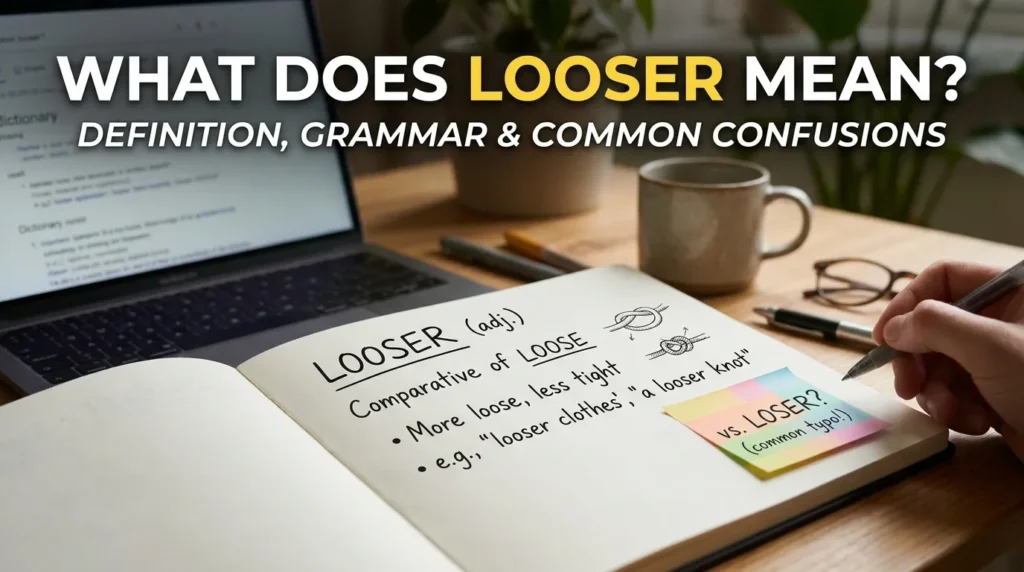
Looser is the comparative form of the adjective loose. It describes something that is less tight, less secure, or less restrictive than something else.
Use looser when comparing two things based on how tightly they fit, how firmly they are attached, or how strictly something is controlled.
Examples of Looser in Sentences
- These jeans are looser than the pair I bought last week.
- I prefer wearing looser clothing during summer.
- The new rules are looser than the previous regulations.
- This knot is looser than the one you tied yesterday.
- Her ponytail became looser as the day went on.
When Should You Use Looser?
Use looser when you are comparing the degree of tightness or restriction.
- Clothing: These trousers are looser around the waist.
- Rules: The school introduced looser restrictions on uniforms.
- Physical objects: The screw has become looser over time.
- Control: The manager adopted a looser approach to supervision.
A useful spelling tip is that looser contains two letter o’s after the initial l, just like loose. Adding -r creates the comparative form.
What Does Loser Mean?
Loser is a noun formed from the verb lose. It refers to a person, team, or participant who fails to win a game, competition, election, or other contest.
The word can also be used informally as an insult to criticize someone’s behavior or abilities. In that context, it can sound rude or hurtful.
Examples of Loser in Sentences
- The loser of the final match shook hands with the winner.
- Every competition has a winner and a loser.
- Our team was the loser in yesterday’s tournament.
- Nobody likes being called a loser.
- She accepted the result gracefully instead of blaming the other team.
When Should You Use Loser?
Use loser when referring to someone or something that loses.
- Sports: The loser of the match congratulated the winning team.
- Competitions: Each loser received a participation certificate.
- Elections: The losing candidate thanked supporters for their efforts.
- Informal conversation: He jokingly called himself a loser after forgetting his keys.
Remember that loser has one letter o between the l and s? More precisely, it is spelled l-o-s-e-r, with one o and one s before the final -er. It comes from lose, spelled l-o-s-e.
Looser vs. Loser: Key Differences
The easiest way to distinguish these words is to look at their base words and meanings.
Dictionary.com
+2
| Feature | Looser | Loser |
| Base word | Loose | Lose |
| Part of speech | Comparative adjective | Noun |
| Meaning | Less tight or restrictive | Someone who loses |
| Opposite or related word | Tighter | Winner |
| Example | The belt is looser now. | The loser accepted the result. |
How to Remember Looser or Loser
Use these simple tips to remember the correct spelling:
- Looser = loose + r. Think of loose clothing that is less tight.
- Loser = lose + r. Think of someone who loses a competition.
- Looser has two o’s, just like the word loose.
- Loser has one o, just like the word lose.
You can also remember this example: “The loser wore a looser shirt.” Here, both words are correct, but each has a different meaning.
Looser or Loser: Common Mistakes to Avoid
Because the words look similar, writers sometimes use one when they mean the other. Here are common mistakes and their corrections.
| Incorrect sentence | Correct sentence | Why? |
| He is such a looser. | He is such a loser. | The sentence refers to a person using an insult. |
| These pants are loser than mine. | These pants are looser than mine. | The sentence compares how tightly the pants fit. |
| The looser of the game went home. | The loser of the game went home. | The sentence refers to someone who did not win. |
| I want a loser fit for my shirt. | I want a looser fit for my shirt. | The sentence describes a less tight fit. |
Both words are valid English words, so spell-checking software may not catch the mistake. Always check the intended meaning before choosing the spelling.
Learn when to write Even Though or Eventhough to avoid common spelling mistakes in everyday English.
Looser or Loser: Pronunciation and Usage
Looser and loser are pronounced similarly, but the middle consonant sound differs in standard English.
- Looser: Usually pronounced “LOO-sər,” with an /s/ sound, as in snake.
- Loser: Usually pronounced “LOO-zər,” with a /z/ sound, as in zebra.
Meaning, Definition & Examples
+1
In everyday conversation, the distinction can be subtle, especially when people speak quickly. In writing, however, the extra letter o in looser helps distinguish the two meanings.
Summary
Looser and loser are both correct spellings, but they cannot be used interchangeably. Use looser when describing something that is less tight or less restrictive. Use loser when referring to someone who loses a competition or fails to win.
The easiest way to remember the difference is to connect looser with loose and loser with lose. Choosing the correct word will make your writing clearer and help you avoid a common English spelling mistake.
Frequently Asked Questions
Is it looser or loser?
Both are correct words. Use looser to mean less tight and loser to mean someone who loses a contest, game, or competition.
Is looser a real word?
Yes. Looser is the comparative form of loose. For example, “This jacket is looser than my old one.”
How do you spell loser correctly?
The correct spelling is loser, L-O-S-E-R. It comes from the verb lose and refers to someone who loses or fails to win.
Why do people confuse looser and loser?
People confuse them because they look and sound similar, differing by only one letter. Their meanings and grammatical roles are different, however.
Does looser mean more loose?
Yes. Looser means more loose or less tight. For example, “The knot became looser after I pulled the rope.”
Is calling someone a loser rude?
It can be. Although loser can describe someone who loses a competition neutrally, it is also commonly used as an insult. The tone and context determine how offensive it sounds.
What is the difference between loose, lose, looser, and loser?
Loose means not tight, while lose means to misplace something or fail to win. Looser means less tight, and loser refers to someone who loses.
Can I use looser to describe rules?
Yes. Looser can describe rules that are less strict or restrictive. For example, “The company introduced looser workplace policies.”

Grace Holloway is a Creative Learning Designer with more than 9 years of experience producing visually engaging educational resources for preschool and kindergarten children. She specializes in combining educational principles with creative design to develop worksheets that encourage learning through play, exploration, and creativity.
1 thought on “Which Is Correct? Looser or Loser: Meaning and Differences”