
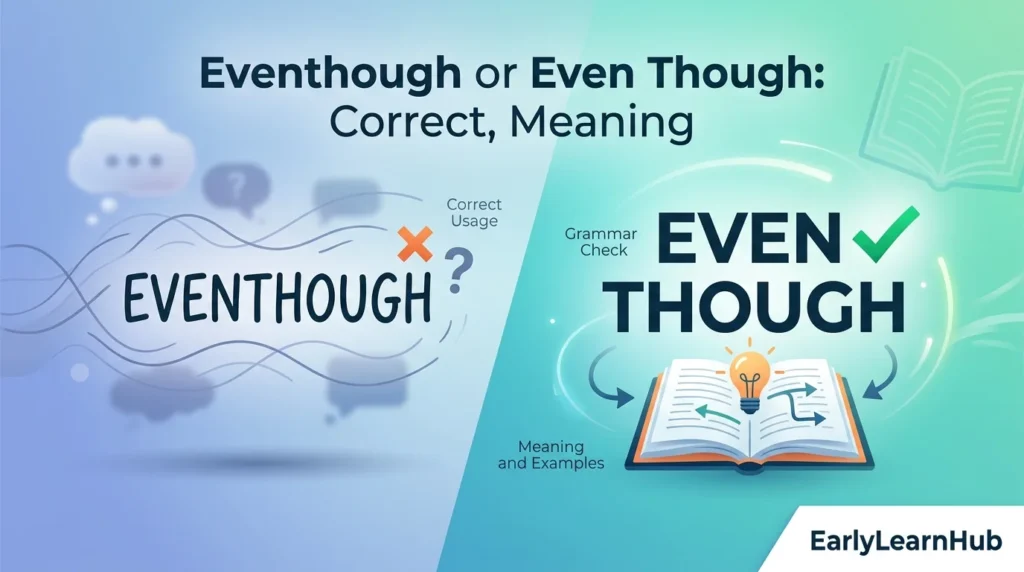
If you are unsure whether “eventhough” or “even though” is correct, the answer is straightforward: even though is the standard English form. It is written as two separate words and is used to introduce a contrast or an unexpected result.
Eventhough or Even Though: Which Is Correct?
Even though is correct.
Eventhough is not the standard spelling of the expression. It is generally a spelling mistake caused by combining the two words because they can sound connected in natural speech.
| Form | Correct? | Usage |
| even though | Yes | Standard English |
| eventhough | No | Incorrect spelling |
| even-though | No | Incorrect spelling |
For example:
Correct: Even though it was raining, we went outside.
Incorrect: Eventhough it was raining, we went outside.
Incorrect: Even-though it was raining, we went outside.
Cambridge Dictionary defines even though as meaning “although” or “despite the fact that.” Cambridge also identifies it as a conjunction used to introduce a contrasting subordinate clause.
Build stronger grammar skills by learning when to use Live In, Live At, or Live On in natural English sentences.
What Does “Even Though” Mean?
Even though means although, despite the fact that, or in spite of the fact that.
It introduces a fact that contrasts with, or makes the result in the main clause somewhat unexpected.
For example:
Even though Sarah was tired, she finished her homework.
Here, Sarah was tired, so you might expect her to stop working. However, she finished her homework anyway.
Another example:
Even though the restaurant was expensive, we enjoyed the meal.
The high price might have been a negative factor, but it did not prevent the speakers from enjoying the meal.
Cambridge explains that even though adds emphasis to the contrast and can be stronger than simply using although or though.
What Does “Eventhough” Mean?
Eventhough does not have a separate standard-English meaning. It is normally a misspelling of even though.
If you write:
Eventhough I was busy, I helped him.
The intended meaning is understandable, but the spelling should be corrected to:
Even though I was busy, I helped him.
The important point is that even though is a two-word expression. Major dictionary and grammar references use the two-word form.
What Is the Difference Between “Eventhough” and “Even Though”?
There is no difference in meaning because eventhough is not the standard form of the expression.
The actual distinction is spelling and grammatical correctness:
- Even though is the correct two-word expression.
- Eventhough is a misspelling.
- Even though functions as a conjunction.
- Eventhough should not be used in standard written English.
- Even though can be used in casual, academic, professional, and formal writing.
The confusion often occurs because even though is pronounced as a connected phrase, making it easy to perceive it as one word when speaking.
How to Use “Even Though” in a Sentence
Even though normally introduces a subordinate clause containing a subject and verb.
The basic structure is:
Even though + subject + verb, main clause.
Examples:
- Even though I was tired, I continued working.
- Even though she studied hard, she found the test difficult.
- Even though it was cold, they went swimming.
- Even though he was nervous, he gave a great presentation.
You can also put the main clause first:
Main clause + even though + subordinate clause.
Examples:
- I continued working even though I was tired.
- They went swimming even though it was cold.
- He gave a great presentation even though he was nervous.
When the even though clause comes first, a comma normally separates it from the main clause. When it follows the main clause, a comma is generally unnecessary.
Learn how these phrases differ in everyday communication with the difference between To Me and For Me.
Even Though vs Although
Even though and although have very similar meanings. Both can introduce a contrast or concession.
Compare:
Although it was raining, we went for a walk.
Even though it was raining, we went for a walk.
The second sentence places more emphasis on the unexpected contrast. Cambridge specifically notes that even can be used with though for emphasis.
In many sentences, either form can be used without changing the basic meaning.
Examples
- Although he was tired, he kept working.
- Even though he was tired, he kept working.
- Although the car was old, it ran well.
- Even though the car was old, it ran well.
Even Though vs Even If
Even though and even if are not always interchangeable.
Use even though when referring to a fact or situation that is presented as real or established.
Even though it was raining, we went outside.
The sentence presents the rain as a fact.
Use even if for a possible or hypothetical situation.
Even if it rains tomorrow, we will go outside.
The rain has not necessarily happened. It is a possibility.
Cambridge distinguishes even though from even if in essentially this way: even though refers to an existing or stated fact, while even if introduces a possible condition.
Even Though vs Despite
Both expressions can communicate contrast, but their grammatical structures are different.
Use even though before a clause:
Even though she was tired, she continued working.
Use despite before a noun, pronoun, or gerund phrase:
Despite her tiredness, she continued working.
Despite being tired, she continued working.
A common mistake is:
Despite she was tired, she continued working.
A better construction is:
Even though she was tired, she continued working.
Or:
Despite being tired, she continued working.
Common Mistakes With “Even Though”
Writing “Eventhough”
Incorrect:
Eventhough I was sick, I went to work.
Correct:
Even though I was sick, I went to work.
Writing “Even-Though”
Incorrect:
Even-though he was late, we waited.
Correct:
Even though he was late, we waited.
The expression is normally written as two separate words, without a hyphen.
Using “Even Though” and “But” Together
In standard sentence construction, avoid combining even though with but to create a double conjunction.
Incorrect:
Even though I was tired, but I finished the work.
Correct:
Even though I was tired, I finished the work.
Or:
I was tired, but I finished the work.
Confusing “Even Though” With “Even If”
Incorrect when describing a future possibility:
Even though it rains tomorrow, we will go.
Better:
Even if it rains tomorrow, we will go.
The choice depends on whether the situation is presented as a fact or a possibility.
“Even Though” Examples
Here are some examples showing natural usage:
- Even though it was raining, we went for a walk.
- She finished the project even though she was exhausted.
- Even though he had little experience, he performed well.
- I enjoyed the movie even though it was very long.
- Even though they arrived late, they found their seats.
- He continued playing even though his team was losing.
- Even though the store was crowded, we found what we needed.
- She smiled even though she was nervous.
- Even though I had studied, the exam was difficult.
- They went ahead with the trip even though the weather was poor.
How to Remember the Correct Spelling
A simple way to remember the spelling is:
Even + though = even though
Keep the two words separate.
You can also replace even though with although as a quick check:
Even though she was tired, she worked.
Although she was tired, she worked.
If the sentence makes sense with although, you are probably using even though in its normal grammatical role.
The key rule is simple: never combine “even” and “though” into “eventhough” in standard English writing.
Is “Even Though” Formal or Informal?
Even though is acceptable in both everyday and formal English.
It can appear in:
- Everyday conversations
- Emails
- Academic writing
- Business writing
- Essays
- Articles
- Professional communication
For example:
Even though the results were unexpected, the researchers continued their analysis.
There is no need to replace even though simply because the writing is formal.
Is “Eventhough” Ever Correct?
For standard English writing, use even though, not eventhough.
A search may occasionally find eventhough used online, but that does not make it the standard spelling. Current dictionary and grammar references recognize even though as the standard expression.
If you are writing an essay, email, article, application, report, or other edited text, write even though.
Summary
Even though is the correct form, while eventhough is a misspelling. The expression is written as two separate words and means although, despite the fact that, or in spite of the fact that.
Use even though to introduce a factual or stated situation that contrasts with the result in the main clause. Use even if when referring to a possible or hypothetical situation. When the even though clause comes first, a comma normally follows it.
Is “eventhough” one word?
No. Eventhough is not the standard spelling. Write even though as two words.
Is “even though” correct?
Yes. Even though is the standard and grammatically correct form.
What does “even though” mean?
Even though means although, despite the fact that, or in spite of the fact that.
Should I use “even though” or “eventhough”?
Use even though. It is the standard form in English.
Is “even-though” correct?
No. Even-though with a hyphen is not the standard form. Write even though.
What is an example of “even though”?
Even though I was tired, I finished my homework.
What is the difference between “even though” and “even if”?
Even though generally introduces a fact or established situation, while even if introduces a possible or hypothetical condition.
Is “even though” the same as “although”?
They have very similar meanings, but even though can add stronger emphasis to the contrast.
Can “even though” be used at the beginning of a sentence?
Yes. For example:
Even though it was late, we continued working.
When the introductory even though clause comes first, it is normally followed by a comma.

Olivia Bennett is an Early Childhood Curriculum Specialist with more than 11 years of experience creating educational resources for preschool and kindergarten learners. She specializes in developing engaging worksheets that strengthen early literacy, numeracy, handwriting, fine motor skills, and problem solving through age appropriate activities.