
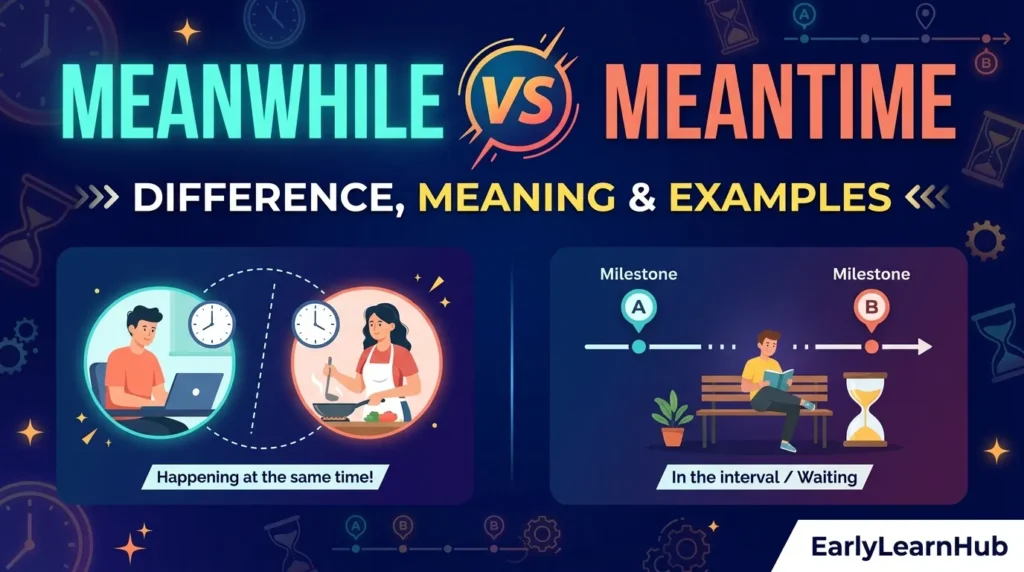
“Meanwhile” and “meantime” both refer to a period when something else is happening or when you are waiting for another event. However, they are used differently in sentences. Meanwhile is commonly used as an adverb to describe what is happening at the same time, while meantime usually appears in the phrase “in the meantime,” meaning during the waiting period before something else happens.
Understanding the difference between meanwhile and meantime can help you write clearer sentences, improve your English grammar, and avoid common usage mistakes.
What Is the Difference Between Meanwhile and Meantime?
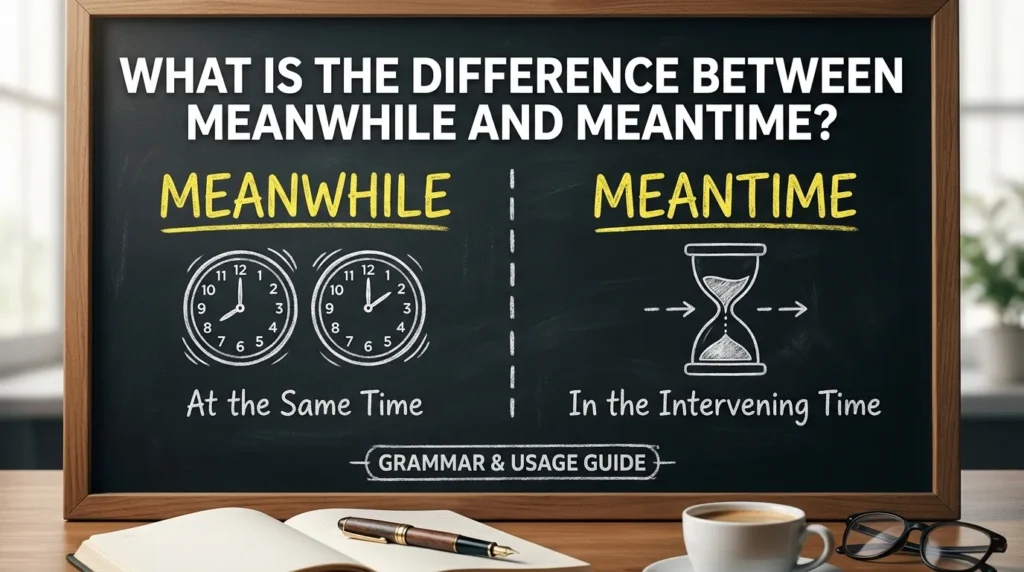
The main difference between “meanwhile” and “meantime” is how they are typically used in a sentence. Both can refer to the interval between events, but “meanwhile” is especially useful for connecting two actions that happen at the same time. “Meantime” is most natural in the expression “in the meantime.”
| Feature | Meanwhile | Meantime |
| Part of speech | Primarily an adverb | Primarily a noun |
| Main meaning | During the same period or at the same time | The period between two events |
| Common expression | Meanwhile, … | In the meantime, … |
| Sentence position | Often at the beginning or middle of a sentence | Commonly after “in the” |
| Example | Meanwhile, I prepared dinner. | In the meantime, I prepared dinner. |
1. When to Use Meanwhile
Use “meanwhile” when you want to describe what is happening during the same period as another activity or event. It is also useful for shifting attention from one person, place, or situation to another.
Examples:
- Sarah was studying for her exam. Meanwhile, her brother was playing video games.
- The chef prepared the main course. Meanwhile, the waiter arranged the tables.
- It was raining in London. Meanwhile, the weather in Madrid was sunny.
- The manager attended a meeting. Meanwhile, the employees continued their work.
- My package is on its way. Meanwhile, I will finish another task.
In these examples, “meanwhile” connects activities or situations that occur during overlapping periods.
Improve your grammar confidence by learning when to use To Many or Too Many correctly in everyday English.
2. When to Use Meantime
Use “meantime” most commonly in the phrase “in the meantime” when referring to the period before an expected event or between two events.
Examples:
- The doctor will arrive shortly. In the meantime, please take a seat.
- My new laptop will arrive on Friday. In the meantime, I will use my old one.
- The repair may take two days. In the meantime, you can use the spare room.
- Our results will be published next week. In the meantime, we will review the data.
- Dinner is not ready yet. In the meantime, you can prepare the drinks.
The phrase “in the meantime” emphasizes what happens during the waiting period.
3. Can Meanwhile and Meantime Be Used Interchangeably?
Sometimes, yes. Both expressions can describe activities that occur during the interval between two events. However, they are not always interchangeable because “meanwhile” can emphasize simultaneous actions, while “in the meantime” often emphasizes the intervening period.
Compare these examples:
Example 1
- Meanwhile, I will prepare the food.
- In the meantime, I will prepare the food.
Both are correct. The first presents the action as happening alongside another situation, while the second emphasizes the period before something else happens.
Example 2
- He was working in the office. Meanwhile, his wife was shopping.
- He was working in the office. In the meantime, his wife was shopping.
Both can be grammatical, but “meanwhile” is more direct when contrasting two simultaneous activities.
Example 3
- The bus will arrive in 20 minutes. In the meantime, let’s get some coffee.
- The bus will arrive in 20 minutes. Meanwhile, let’s get some coffee.
Both sentences are natural. The first is especially common when describing what to do while waiting.
The key is to consider whether you want to emphasize simultaneous events or the time before something happens.
Meanwhile vs. Meantime Examples in Sentences
Here are more examples to help you understand the difference in everyday English.
| Meanwhile | Meantime |
| The children played outside. Meanwhile, their mother cooked dinner. | The children are waiting for dinner. In the meantime, they can read a book. |
| John drove to work. Meanwhile, his colleagues prepared for the meeting. | The meeting starts at noon. In the meantime, please review the agenda. |
| The company launched a new product. Meanwhile, its competitors improved their services. | The company is developing a new product. In the meantime, it will continue selling its current products. |
| The teacher explained the lesson. Meanwhile, the students took notes. | The teacher will return shortly. In the meantime, finish the exercise. |
| The sun was shining in one city. Meanwhile, another city experienced heavy rain. | The train leaves in an hour. In the meantime, we can have lunch. |
Remember that “meantime” is most commonly used with “in the.” Although “meantime” can occasionally function as an adverb on its own, “in the meantime” is generally the safer choice for everyday writing.
If regional spelling variations confuse you, understand the difference between Cancelled and Canceled in American and British English.
Common Mistakes to Avoid
Avoid these common mistakes when using “meanwhile” and “meantime.”
Mistake 1: Leaving out “in the” before meantime
Incorrect: Meantime, I will wait for your response.
Better: In the meantime, I will wait for your response.
“Meantime, …” can occur in some varieties and styles of English, but “in the meantime” is the more conventional expression.
Mistake 2: Using meanwhile when the sentence needs a noun
Incorrect: During the meanwhile, we waited for the results.
Better: In the meantime, we waited for the results.
Mistake 3: Assuming both words always have exactly the same meaning
“Meanwhile” can highlight two things happening at the same time, even in different places. “In the meantime” more commonly describes what happens while waiting for a future event.
Mistake 4: Using incorrect punctuation
Incorrect: The train is late meanwhile we will wait here.
Better: The train is late. Meanwhile, we will wait here.
You can also write: “The train is late, so in the meantime, we will wait here.”
When “meanwhile” connects two independent clauses, use appropriate punctuation, such as a period or a semicolon before it.
Tips for Remembering the Difference
- Meanwhile = at the same time: Think about two activities happening simultaneously.
- In the meantime = while waiting: Think about the interval before an expected event.
- Use meanwhile for contrast: It can shift attention between two people, places, or situations.
- Use in the meantime for everyday writing: It is a reliable choice when discussing what happens before something else occurs.
- Check the sentence structure: “Meanwhile” commonly works as an adverb, while “meantime” usually appears in the phrase “in the meantime.”
Summary
“Meanwhile” and “meantime” are related words that describe overlapping periods of time, but their typical usage differs. “Meanwhile” is primarily an adverb used to describe simultaneous activities or connect different situations. “Meantime” is primarily a noun, most commonly used in the phrase “in the meantime” to describe the interval before something else happens.
For everyday English, use “meanwhile” to connect simultaneous events and “in the meantime” to explain what happens while waiting. Both expressions can be correct in many similar contexts, so choose the one that best communicates your intended meaning.
Frequently Asked Questions
1. Is meanwhile or meantime correct?
Both are correct English words. “Meanwhile” is primarily an adverb, while “meantime” is primarily a noun used in the expression “in the meantime.”
2. What is the main difference between meanwhile and meantime?
“Meanwhile” commonly describes simultaneous activities or events. “Meantime” refers to the interval between events, especially in the phrase “in the meantime.”
3. Is in the meantime grammatically correct?
Yes. “In the meantime” is a standard English expression meaning during the period before something expected happens or while another activity is underway.
4. Can I start a sentence with meanwhile?
Yes. You can begin a sentence with “meanwhile” to connect it to a previous statement or introduce another event happening at the same time.
Example: “The team continued working. Meanwhile, the manager contacted the client.”
5. Can I use meantime without in the?
Yes, “meantime” can sometimes be used without “in the,” particularly in certain styles or varieties of English. However, “in the meantime” is the more common and broadly reliable expression.
6. Is meanwhile formal or informal?
“Meanwhile” is appropriate in both formal and informal English. It is commonly used in academic writing, news reports, business communication, and everyday conversation.
7. What are synonyms for meanwhile and meantime?
Depending on the context, alternatives include “at the same time,” “in the interim,” “during this period,” and “while waiting.” These expressions are not always interchangeable, so consider the meaning of your sentence.
8. Which is better for academic writing, meanwhile or meantime?
Both are acceptable in academic writing. Use “meanwhile” to connect simultaneous events or developments, and “in the meantime” to refer to an interval before a later event.

Ethan Richardson is an Educational Content Editor with more than 10 years of experience reviewing and developing educational materials for young learners. His expertise includes improving worksheet accuracy, readability, and instructional quality while ensuring learning resources meet modern educational standards.