
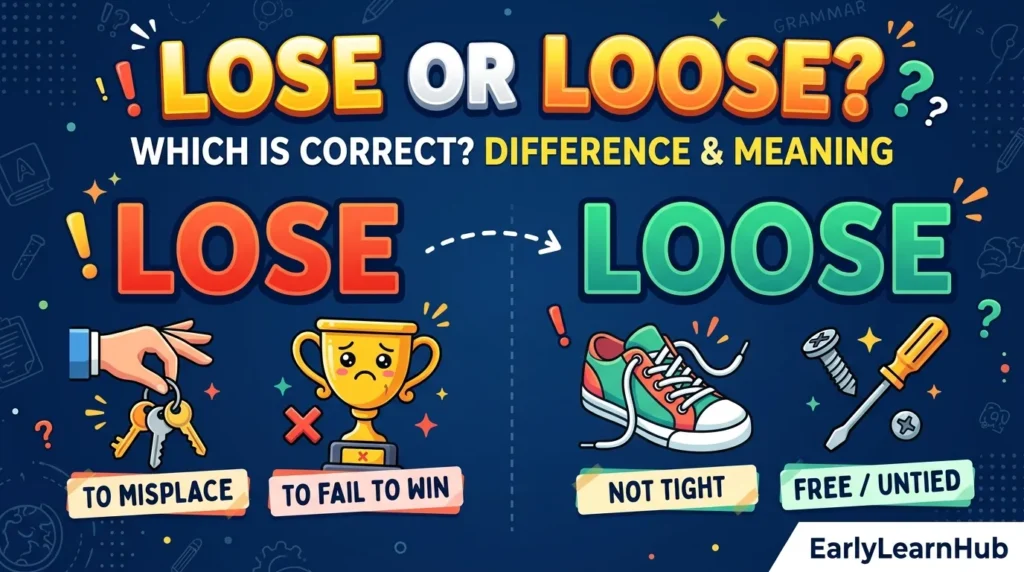
“Lose” and “loose” are commonly confused because they look almost identical, but they have different meanings, grammatical roles, and pronunciations. Lose is primarily a verb meaning to misplace something, no longer have something, or fail to win. Loose is usually an adjective meaning not tight, not firmly attached, or free from restraint.
Lose or Loose: Which Is Correct?
Both lose and loose are correct English words, but they are not interchangeable.
Use lose when you mean to misplace something, stop having something, fail to win, or have less of something.
- I do not want to lose my phone.
- Our team may lose the game.
- She wants to lose weight.
Use loose when you mean not tight, not firmly attached, or free.
- My shoes are too loose.
- The button is loose.
- The dog got loose.
Therefore, the correct word depends on what you are trying to say.
What Is the Difference Between Lose and Loose?
The main difference between lose and loose is their meaning and grammatical function.
| Word | Part of Speech | Meaning | Example |
| Lose | Verb | To misplace, no longer have, or fail to win | I might lose my keys. |
| Loose | Usually an adjective | Not tight, fixed, or restrained | My shirt is loose. |
Lose describes an action or change, while loose generally describes a condition or state.
A simple way to remember the distinction is:
Lose = loss
Loose = not tight
Improve your grammar by understanding when to use lets and let’s in different contexts.
What Does Lose Mean?

Lose is a verb with several common meanings. It can mean to no longer have something, to be unable to find something, to fail to win, or to have less of something.
Lose Meaning: Misplace Something
When you cannot find something you previously had, you use lose.
- I always lose my keys.
- Do not lose your passport.
- She lost her phone yesterday.
Lose Meaning: Fail to Win
Lose can also mean to be defeated in a game, competition, election, or other contest.
- Our team might lose the match.
- They lost the game yesterday.
- Nobody wants to lose the competition.
Lose Meaning: No Longer Have Something
You can use lose when someone no longer has something they previously possessed.
- He lost his job.
- She does not want to lose her opportunity.
- They lost their home in the fire.
Lose Meaning: Have Less of Something
Lose can also mean to have less of something, such as weight, blood, money, or speed.
- She is trying to lose weight.
- The car began to lose speed.
- He lost a lot of money.
These uses are all consistent with lose functioning as a verb.
What Does Loose Mean?
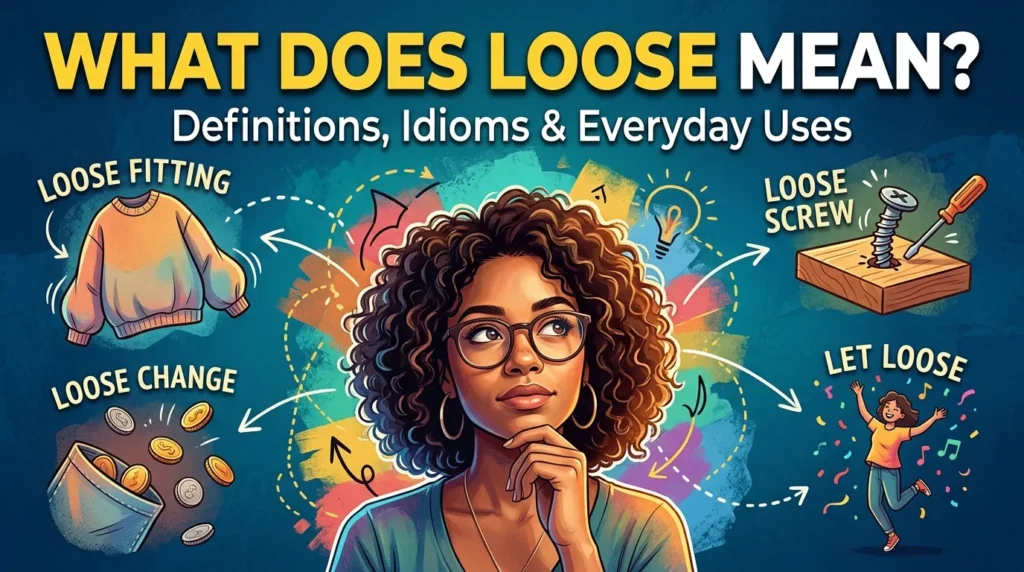
Loose is usually an adjective. It describes something that is not tight, not firmly attached, not held together, or free from restraint.
Loose Meaning: Not Tight
Use loose for clothes or other things that do not fit tightly.
- This shirt is too loose.
- She prefers loose clothing.
- My shoes feel loose.
Loose Meaning: Not Firmly Attached
Something can be loose when it is not securely fixed.
- The door handle is loose.
- There is a loose wire behind the computer.
- One of the buttons on my shirt is loose.
Loose Meaning: Free From Restraint
Loose can also describe someone or something that is no longer restrained or confined.
- The dog got loose.
- The horse broke loose from the fence.
- Someone accidentally left the animals loose.
Loose Meaning: Not Strict or Exact
The word can also have a figurative meaning.
- The rules are fairly loose.
- That is a loose interpretation of the agreement.
- The movie is a loose adaptation of the novel.
Cambridge also notes that loose can describe something that does not closely follow an original or is not exact.
Lose vs Loose Pronunciation
Although the two words look very similar, their final sounds are different.
- Lose = /luːz/, ending with a z sound
- Loose = /luːs/, ending with an s sound
Cambridge lists these pronunciations as /luːz/ for lose and /luːs/ for loose.
You can remember the sounds by comparing them with familiar rhyming words:
- Lose rhymes with choose, shoes, and news.
- Loose rhymes with goose, moose, and juice.
The vowel sound is the same, but the final consonant changes.
Lose or Loose in Common Sentences
Here are some common examples that show the difference clearly:
- I do not want to lose my wallet.
- My jacket is too loose.
- Be careful not to lose your keys.
- The screw is loose.
- Our team could lose the match.
- She prefers loose clothing.
- He does not want to lose his job.
- The dog was running loose in the neighborhood.
- I am trying to lose weight.
- One of the wires is loose.
The context determines which spelling is correct.
Lose or Loose Weight: Which Is Correct?
The correct expression is lose weight, not loose weight.
Lose is the verb used to describe reducing your weight.
- I want to lose weight.
- She is trying to lose weight.
- He has lost weight recently.
Loose weight is incorrect when you mean reducing body weight.
Improve your vocabulary with examples of axle used in English to recognize its proper meaning in everyday writing.
Lose or Loose a Game: Which Is Correct?
The correct phrase is lose a game.
Because lose is a verb meaning to fail to win, you can say:
- We might lose the game.
- They lost the match.
- Our team does not want to lose.
You should not write loose a game when you mean to be defeated.
Lose or Loose Your Keys: Which Is Correct?
The correct expression is lose your keys.
Use lose when you cannot find something or no longer have it.
- I always lose my keys.
- Did you lose your keys?
- She lost her keys this morning.
Loose your keys is incorrect in this context.
Losing or Loosing: Which Is Correct?
The correct form is usually losing, not loosing, when you are using the -ing form of lose.
- I am losing weight.
- She is losing her patience.
- They are losing the game.
- He keeps losing his phone.
Loosing does exist, but it comes from the less common verb loose, meaning to release or set something free. Oxford lists loose as a verb with meanings including releasing something or making something loose.
For everyday uses such as losing weight, losing a game, or losing your keys, losing is the correct form.
Common Mistakes With Lose and Loose
One of the most common mistakes is adding an extra o to lose.
❌ I do not want to loose my phone.
✅ I do not want to lose my phone.
Another common mistake is using lose when describing something that is not tight.
❌ My shoes are too lose.
✅ My shoes are too loose.
The same distinction applies to other common expressions:
- lose weight, not loose weight
- lose a game, not loose a game
- lose your keys, not loose your keys
- loose clothing, not lose clothing
- a loose button, not a lose button
Oxford specifically identifies lose and loose as commonly confused words with completely different meanings.
How to Remember Lose vs Loose
A simple memory trick is:
Lose has one “o” because you lose one “o” from loose.
You can also connect each word with its main idea:
Lose → loss
Think about losing your keys, losing a game, or losing weight.
Loose → looseness
Think about loose clothes, a loose button, or something that has come loose.
Another useful trick is to remember the pronunciation:
Lose = /z/
Loose = /s/
This helps distinguish the words when speaking as well as writing.
Summary
Lose and loose are both correct words, but they have different meanings.
- Lose is primarily a verb meaning to misplace, no longer have, or fail to win something.
- Loose is usually an adjective meaning not tight, not firmly attached, or free from restraint.
- Lose is pronounced /luːz/.
- Loose is pronounced /luːs/.
- The correct phrase is lose weight.
- The correct phrase is lose a game.
- The correct phrase is lose your keys.
- The correct description is loose clothing.
- Losing is the normal -ing form of lose.
- Loosing is a less common form related to the verb loose, meaning to release or set free.
The easiest rule is: lose means to suffer a loss, while loose means not tight or not firmly fixed.
Is “lose” or “loose” correct?
Both are correct words, but they have different meanings. Lose means to misplace, no longer have, or fail to win. Loose usually means not tight or not firmly attached.
What is the difference between lose and loose?
Lose is primarily a verb, while loose is usually an adjective. You can lose your keys or lose a game, but you can have loose clothing or a loose button.
Is it “lose weight” or “loose weight”?
The correct phrase is lose weight. Lose is the verb used when talking about reducing body weight.
Is it “lose a game” or “loose a game”?
The correct phrase is lose a game because lose means to fail to win a game or competition.
Is it “lose your keys” or “loose your keys”?
The correct phrase is lose your keys because lose means to be unable to find something.
Is “losing” or “loosing” correct?
For the usual meaning of lose, losing is correct. Loosing is a separate, uncommon verb form of loose that can mean releasing or setting something free.
How do you pronounce lose and loose?
Lose is pronounced /luːz/, with a final z sound. Loose is pronounced /luːs/, with a final s sound.
Does loose mean free?
Yes. Loose can describe someone or something that is free from restraint or confinement. For example, “The dog got loose.”
Can loose be a verb?
Yes, although it is much less common. As a verb, loose can mean to release something, set something free, or make something loose.

Sophia Reed is an accomplished Fact-Checking Editor with more than 11 years of experience ensuring the accuracy, credibility, and integrity of digital content. She specializes in verifying facts, reviewing sources, assessing editorial reliability, and maintaining high publishing standards across a wide range of online publications.