
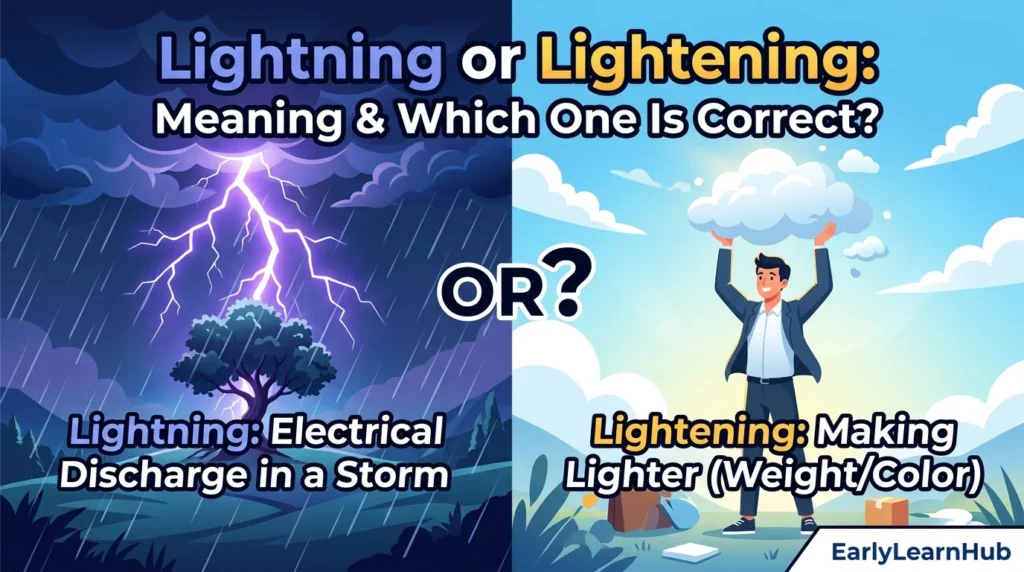
Both “lightning” and “lightening” are correct English words — but they mean completely different things and are not interchangeable. The confusion happens because they look almost identical and sound similar when spoken quickly, but they come from different roots and serve different grammatical roles.
- Lightning (no “e” after the “n”) is a noun referring to the electrical flash in the sky during a storm.
- Lightening (with an “e” after the “n”) is a verb — the present participle / gerund form of “to lighten,” meaning to make something lighter in weight or color, or to reduce a burden.
If you remember one rule: lightning has no “e,” just like the flash — it’s fast and doesn’t wait around for an extra letter.
The Core Difference
| Feature | Lightning | Lightening |
| Part of speech | Noun (sometimes adjective) | Verb (gerund/present participle of “lighten”) |
| Root word | Old English “lightnen” (to illuminate) | “Lighten” + “-ing” |
| Meaning | Natural electrical discharge in the sky | Making something lighter (weight, color, mood, burden) |
| Spelling | No “e” between “n” and “ing” | Has an “e” between “n” and “ing” |
| Example use | “Lightning struck the tree.” | “She is lightening her hair.” |
Meaning of “Lightning”
“Lightning” refers to the bright flash of light produced by an electrical discharge between clouds, or between a cloud and the ground, usually during a thunderstorm. It’s almost always used as a noun, though it also appears as an adjective in phrases like “lightning speed” or “lightning round,” meaning something extremely fast.
Examples:
- The lightning lit up the entire sky for a split second.
- He answered the question with lightning speed.
- Thunder always follows lightning because sound travels slower than light.
- The lightning strike knocked out power across the neighborhood.
Meaning of “Lightening”
“Lightening” is the “-ing” form of the verb “lighten,” which means to make something less heavy, less dark, or less burdensome. It describes an ongoing action or process.
Examples:
- She is lightening the mood by cracking jokes during the meeting.
- The sky was lightening slowly as dawn approached.
- He’s lightening his backpack before the hike by removing unnecessary items.
- The stylist is lightening my hair color for summer.
- Lightening the workload for the team helped everyone meet the deadline.
Why People Mix Them Up
The mix-up happens for a few simple reasons:
- Visual similarity — both words share nine letters and differ by only one “e.”
- Pronunciation overlap — in fast, casual speech, the difference between the two can be subtle.
- Autocorrect and spellcheck — some tools don’t flag “lightening” as wrong even when “lightning” was intended, because both are valid dictionary words.
- Thematic closeness — a storm can involve both a “lightening” sky (as it gets brighter before/after a storm) and “lightning” (the electrical flash), which adds to the confusion in weather-related writing.
How to Remember Which Is Which
- Lightning = the storm flash. Think: “Lightning is quick — too quick to fit in an extra ‘e.'”
- Lightening = making lighter. Think: “Lightening has ‘lighten’ hiding inside it — if you can replace the word with ‘lighten,’ ‘brighten,’ or ‘reduce,’ you need the ‘e.'”
- A quick test: if you can rephrase your sentence using “lighten” (e.g., “lightening the load” → “lighten the load”), use the version with the “e.” If you’re talking about a thunderstorm, drop the “e.”
Summary
“Lightning” and “lightening” are two distinct, correctly spelled English words that are often confused due to their similar appearance. Lightning is a noun describing the flash of light during a storm, while lightening is a verb form describing the act of making something lighter — whether in weight, color, mood, or burden. Getting them right comes down to remembering that lightning (the storm phenomenon) has no “e,” while lightening (from “lighten”) always does.
Frequently Asked Questions
Is “lightening” a real word?
Yes. “Lightening” is a real, correctly spelled word. It’s the present participle (the “-ing” form) of the verb “lighten,” used to describe the ongoing act of making something lighter in weight, color, or intensity.
Is “lightning” spelled with an “e”?
No. “Lightning,” referring to the electrical flash during a storm, is spelled without an “e” between the “n” and the “ing.” Adding an “e” changes it into a different word, “lightening.”
Which one do you use for a thunderstorm?
Use “lightning” (no “e”) for anything related to a thunderstorm, such as lightning strikes, lightning bolts, or lightning storms.
Which one do you use for skin or hair color?
Use “lightening” (with an “e”) when referring to processes that make skin, hair, or other things lighter in color, such as skin lightening creams or hair lightening treatments.
Can “lightning” be used as an adjective?
Yes. “Lightning” is often used as an adjective to describe something extremely fast, such as “lightning speed,” “lightning reflexes,” or a “lightning round” in a quiz or game.
Do “lightning” and “lightening” have the same pronunciation?
They are close but not identical. “Lightning” is typically pronounced as two syllables (“LITE-ning”), while “lightening” is often pronounced with three syllables (“LITE-en-ing”), though casual speech can blur this difference.
What is the root word of “lightening”?
“Lightening” comes from the verb “lighten,” which itself comes from “light” (meaning not heavy, or bright), plus the “-en” suffix that turns an adjective into a verb, and the “-ing” ending that makes it a gerund or present participle.

Daniel Foster is the founder and content creator of EarlyLearnHub, a website dedicated to providing free printable worksheets, coloring pages, and educational resources for preschool and kindergarten children. He creates engaging learning materials that help young learners build essential skills in literacy, numeracy, handwriting, problem-solving, and creativity.