
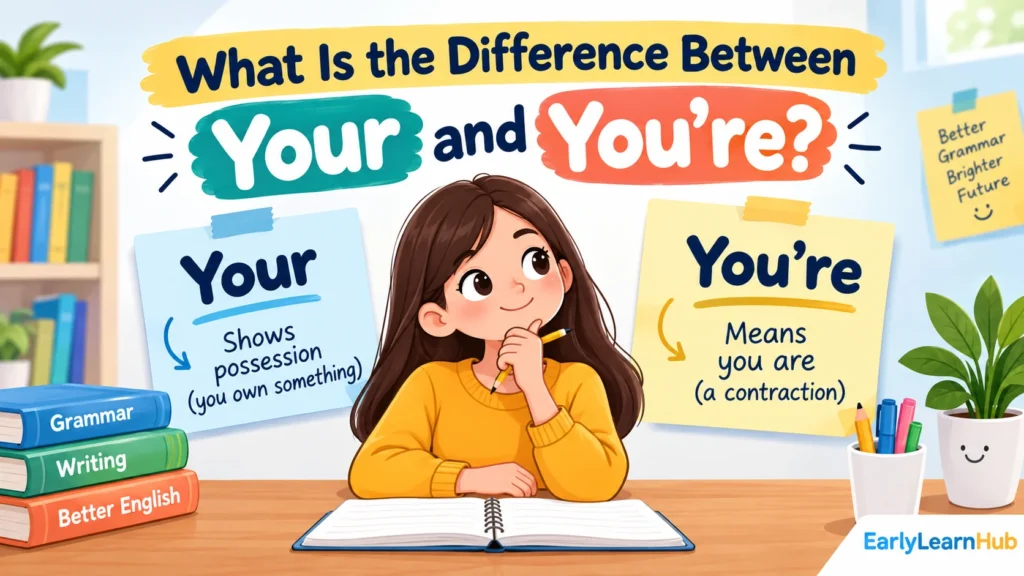
“Your” and “you’re” are commonly confused because they sound the same when spoken, but they have different meanings and grammatical functions. Your shows possession or a connection to someone, while you’re is the contraction of you are.
What Is the Difference Between Your and You’re?
The main difference between your and you’re is their grammatical function.
Your is a possessive determiner. It shows that something belongs to, relates to, or is associated with the person being addressed.
You’re is a contraction of you are. The apostrophe indicates that letters have been omitted from the two-word expression.
| Word | Meaning | Use | Example |
| Your | Belonging or relating to you | Shows possession or association | Your phone is ringing. |
| You’re | You are | Describes a person or their state/action | You’re very kind. |
A simple way to remember the difference is:
Your = belonging to you
You’re = you are
Is Your or You’re Correct?
Both your and you’re are correct words, but they cannot be used interchangeably.
Use your when you are talking about something belonging to or associated with someone.
- Your book is on the table.
- I like your new shoes.
- Where is your sister?
- Your answer is correct.
Use you’re when you mean you are.
- You’re very helpful.
- You’re doing a great job.
- I think you’re right.
- You’re ready to leave.
The correct choice depends on what you want the sentence to mean.
What Does Your Mean?
Your is a possessive determiner used before a noun or noun phrase. It indicates that something belongs to, relates to, or is connected with the person or people being addressed.
For example:
- Is this your bag?
- I like your idea.
- Where is your car?
- Please bring your notebook.
- What is your name?
In “your bag,” your tells us that the bag belongs to or is associated with the person being spoken to.
Your Meaning
The basic meaning of your is:
Your = belonging to you or associated with you
It can express ownership, relationship, association, or connection.
For example:
- Your house = the house belonging to or associated with you
- Your opinion = the opinion you have
- Your teacher = the teacher connected with you
- Your name = the name associated with you
What Does You’re Mean?
You’re is a contraction of you are.
The apostrophe in you’re represents omitted letters from the original phrase. Whenever you’re is used, you should be able to expand it to you are.
For example:
- You’re happy. = You are happy.
- You’re late. = You are late.
- You’re learning quickly. = You are learning quickly.
- You’re my best friend. = You are my best friend.
- You’re going home. = You are going home.
You’re Meaning
The basic meaning of you’re is:
You’re = you are
It can be followed by an adjective, a verb phrase, or another complement.
- You’re right.
- You’re kind.
- You’re working.
- You’re a good friend.
- You’re going to enjoy this.
Your vs. You’re Examples
Seeing the two words side by side makes the difference easier to understand.
Examples With Your
- I like your new jacket.
- Where did you leave your phone?
- Is that your car?
- Please finish your homework.
- I agree with your opinion.
- What is your favorite movie?
- Your dog is very friendly.
- Don’t forget your keys.
In each sentence, your connects the following noun or noun phrase to the person being addressed.
Examples With You’re
- You’re very talented.
- You’re going to love this book.
- I think you’re correct.
- You’re doing well.
- You’re late for class.
- You’re my best friend.
- You’re working very hard.
- I know you’re tired.
In each sentence, you’re can be replaced by you are.
Your or You’re: The Easy Test
The easiest way to decide between your and you’re is the “you are” test.
Replace the word with you are.
If the sentence still makes sense, use you’re.
If the sentence does not make sense, use your. This substitution test is also recommended by the MLA Style Center.
Example 1
___ going to be late.
Try replacing the blank with you are:
You are going to be late.
The sentence makes sense, so the correct answer is:
You’re going to be late.
Example 2
Is this ___ book?
Try:
Is this you are book?
That does not make sense.
Therefore:
Is this your book?
The correct word is your.
Example 3
I like ___ new shoes.
Try:
I like you are new shoes.
That does not make sense, so use your:
I like your new shoes.
Common Mistakes With Your and You’re
Because the two words usually sound alike, they are frequently confused in writing. They are homophones, meaning they have the same or nearly the same pronunciation but different spellings and meanings.
Mistake 1: Your Welcome
❌ Your welcome.
✅ You’re welcome.
The correct version means:
You are welcome.
Mistake 2: Your Right
❌ Your right.
✅ You’re right.
Here, you’re means you are.
Mistake 3: You’re Car
❌ You’re car is outside.
✅ Your car is outside.
Here, your shows that the car belongs to or is associated with the person being addressed.
Mistake 4: Your Going
❌ Your going to miss the bus.
✅ You’re going to miss the bus.
The correct version means:
You are going to miss the bus.
Mistake 5: You’re Name
❌ What is you’re name?
✅ What is your name?
Here, your describes the noun name.
Your vs. You’re in Questions
The same rule applies when your and you’re appear in questions.
Use your when it shows possession or association:
- What is your name?
- Where is your house?
- Is this your phone?
- Did you bring your passport?
Use you’re when it means you are:
- You’re coming with us?
- Are you sure you’re ready?
- Why you’re so quiet? ❌
- Why are you so quiet? ✅
Notice that you’re cannot replace every occurrence of you are if the sentence structure itself requires a different word order. The key is to use the contraction only where you are would grammatically fit.
How to Remember Your and You’re
Use these two memory tricks:
Your = possession
Think:
- your book
- your house
- your idea
- your friend
- your name
If the word refers to something belonging to or associated with someone, choose your.
You’re = you are
Think:
- you’re happy = you are happy
- you’re right = you are right
- you’re ready = you are ready
- you’re learning = you are learning
Another useful trick is to remember that your works similarly to other possessive words such as my, his, her, our, and their.
Your or You’re: Which One Should You Use?
Use your when the sentence is about something belonging to or associated with the person you are addressing.
Example:
I like your new computer.
Use you’re when you can replace it with you are.
Example:
You’re very good at using computers.
A quick comparison:
| Sentence | Correct Word | Reason |
| I like ___ dress. | your | The dress is associated with you. |
| ___ very kind. | you’re | You are very kind. |
| Where is ___ car? | your | The car belongs to or is associated with you. |
| ___ going home. | you’re | You are going home. |
| Is this ___ book? | your | The book belongs to or is associated with you. |
| I know ___ tired. | you’re | You are tired. |
The most reliable rule is simple: if “you are” works, use “you’re”; otherwise, use “your.”
Summary
Your and you’re are both correct, but they have different grammatical roles.
- Your shows possession or association and is generally used before a noun or noun phrase.
- You’re is the contraction of you are.
- Your does not contain an apostrophe.
- You’re contains an apostrophe because it is a contraction.
- Use the “you are” test when you are unsure.
- Your book is correct because the book is associated with you.
- You’re ready is correct because it means you are ready.
Once you remember your = belonging to you and you’re = you are, choosing the correct word becomes much easier.
Frequently Asked Questions
Is “your” or “you’re” correct?
Both are correct words, but they are used differently. Your shows possession or association, while you’re means you are.
What is the difference between your and you’re?
Your is a possessive determiner, while you’re is a contraction of you are. For example, “your book” shows possession, while “you’re reading” means “you are reading.”
Is “you’re” short for “you are”?
Yes. You’re is the standard contraction of you are.
For example:
You’re correct. = You are correct.
Is “your” a possessive word?
Yes. Your is a possessive determiner that indicates something belongs to or is associated with the person being addressed.
How can I remember the difference between your and you’re?
Replace you’re with you are. If the sentence still makes sense, you’re is correct. If it does not, use your.
Is “your welcome” correct?
No. The standard expression is “You’re welcome” because it means “You are welcome.”
Is “your right” correct?
Usually, no, if you mean that someone is correct. The correct form is “You’re right,” meaning “You are right.”
Is “you’re” possessive?
No. You’re is not possessive. It is a contraction meaning you are. Your is the possessive form.
Do your and you’re sound the same?
In standard English pronunciation, your and you’re commonly sound the same or very similar, which is one reason they are frequently confused in writing.
Can you use “your” before a verb?
Not in the same way as you’re. Your normally introduces a noun or noun phrase, such as your car, your answer, or your decision. When you mean you are before a verb phrase, use you’re, as in you’re working.

Olivia Bennett is an Early Childhood Curriculum Specialist with more than 11 years of experience creating educational resources for preschool and kindergarten learners. She specializes in developing engaging worksheets that strengthen early literacy, numeracy, handwriting, fine motor skills, and problem solving through age appropriate activities.