
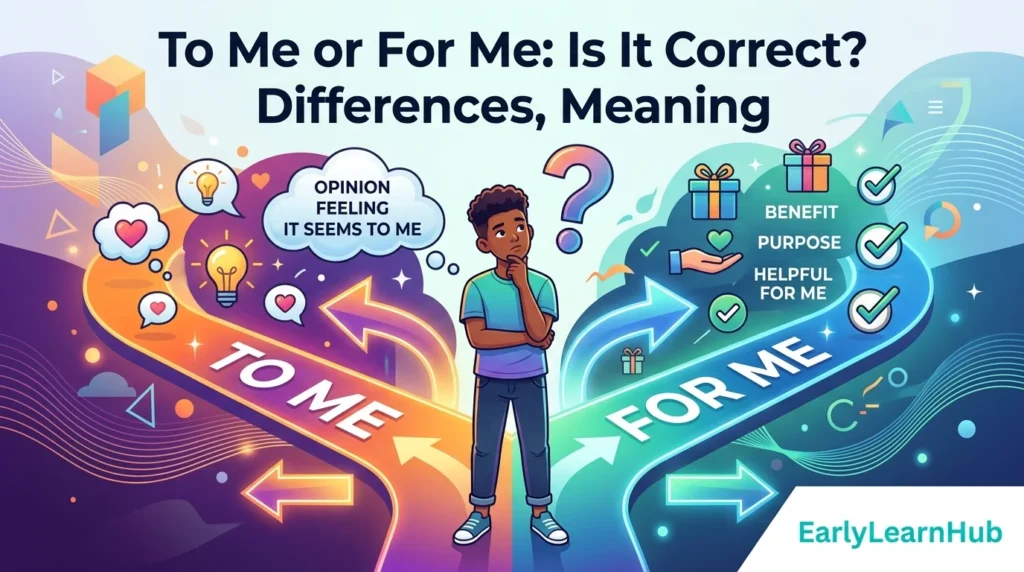
Both “to me” and “for me” are correct English expressions, but they are not always interchangeable. The right choice depends on what you want to express. “To me” commonly focuses on perception, opinion, or something directed toward you, while “for me” often expresses benefit, suitability, purpose, or an action done on your behalf.
Young fans can enjoy free Pikachu coloring pages for children designed for simple, enjoyable coloring sessions.
Is “To Me” Correct?
Yes. “To me” is a standard and very common English expression. It can show that something is directed toward you, received by you, or represents your personal perception or opinion.
For example:
- She explained the problem to me.
- This movie seems boring to me.
- To me, the answer is obvious.
- That sounds strange to me.
- He gave the letter to me.
In sentences such as “That sounds strange to me,” “to me” identifies the person experiencing the impression. When used at the beginning of a sentence, it can also introduce the speaker’s viewpoint.
Is “For Me” Correct?
Yes. “For me” is also completely correct. It commonly indicates that something is intended for your benefit, suitable for you, done on your behalf, or relevant to your situation.
Examples include:
- Could you carry this bag for me?
- This gift is for me.
- That job is difficult for me.
- This schedule works well for me.
- For me, this is the best option.
The phrase can therefore describe an action performed to help you or something considered in relation to your needs, circumstances, or interests.
To Me vs. For Me: Main Difference
The simplest way to remember the difference is:
| Expression | Common meaning | Example |
| To me | My perception, opinion, or something directed toward me | That sounds strange to me. |
| For me | My benefit, needs, situation, or something done on my behalf | Could you do this for me? |
However, this is a general guide rather than an absolute rule. The prepositions “to” and “for” have many uses, and some adjectives or expressions naturally take one preposition rather than the other.
When to Use “To Me”
1. To Express an Opinion or Personal Perception
Use “to me” when you are explaining how something appears, sounds, feels, or seems from your perspective.
Examples:
- To me, this plan seems reasonable.
- That answer sounds incorrect to me.
- This painting looks beautiful to me.
- He seems nervous to me.
- The explanation is confusing to me.
Compare:
To me, he looks tired.
This presents your personal observation or impression.
Young fans may especially like these free Eevee coloring pages for children for creative play and imaginative coloring.
2. To Show That Something Is Directed Toward You
“To” can indicate the recipient or direction of an action.
Examples:
- She sent the email to me.
- He spoke to me after the meeting.
- Please give the book to me.
- They explained the rules to me.
- She read the story to me.
In these sentences, “me” is the person receiving the communication, object, or action.
3. To Describe Personal Importance or Relationship
Some expressions naturally use “to me” when describing personal significance or a relationship.
Examples:
- You are very important to me.
- She is like a sister to me.
- This place means a lot to me.
- His friendship is valuable to me.
- That memory is special to me.
Here, “to me” describes the relationship or significance something has from the speaker’s perspective.
When to Use “For Me”
1. To Show Benefit
Use “for me” when something is done to help you or provide a benefit to you.
Examples:
- Could you open the door for me?
- She made some tea for me.
- He saved a seat for me.
- Can you print this document for me?
- They bought a ticket for me.
The action is performed for your benefit.
2. To Show That Something Is Suitable or Relevant to You
“For me” can describe whether something works well in your particular circumstances.
Examples:
- This schedule is perfect for me.
- That job is not suitable for me.
- This exercise is too difficult for me.
- Working from home is better for me.
- This option is more convenient for me.
3. To Mean “On My Behalf” or “Instead of Me”
“For me” can also indicate that someone performs an action in your place.
Examples:
- Could you sign the form for me?
- Can you attend the meeting for me?
- She answered the phone for me.
- He picked up the package for me.
- Could you make the reservation for me?
In these cases, the other person is doing something on your behalf.
“Read It to Me” vs. “Read It for Me”
These two sentences are both grammatical, but they can express different ideas.
Could you read it to me?
This means, “Could you read it aloud so that I can hear it?” The reading is directed toward you.
Could you read it for me?
This can mean, “Could you read it on my behalf?” or “Could you help me by reading it?”
The same distinction appears in other sentences:
- Bring the book to me. = Bring it here so that I receive it.
- Bring the book for me. = Bring it on my behalf or instead of me bringing it.
- Make a copy for me. = Make a copy that benefits me.
- Explain it to me. = Give me the explanation.
“Important to Me” vs. “Important for Me”
Both expressions can be correct, but they can carry different shades of meaning.
This is important to me.
This usually means the subject has personal significance or matters personally to you.
This is important for me.
This usually means the subject is beneficial, necessary, or relevant to your situation.
For example:
- My family is important to me.
- Getting enough sleep is important for me.
The first emphasizes personal significance. The second emphasizes personal need or benefit.
“Good to Me” vs. “Good for Me”
These expressions can also differ.
She has always been good to me.
This means she has treated me well.
Exercise is good for me.
This means exercise benefits me.
The preposition changes the relationship between the adjective and the person. “Good to” often concerns treatment or behavior toward someone, while “good for” commonly concerns benefit or effect.
“For Me” and “To Me” Can Sometimes Both Work
There are situations where both expressions are possible, particularly when discussing personal judgments or experiences.
For example:
- For me, this is the best choice.
- To me, this is the best choice.
Both can be grammatical, although the emphasis can differ slightly. “To me” more naturally presents something as your perception or viewpoint, while “for me” can emphasize your individual circumstances, preference, or suitability.
Consider:
To me, the movie was boring.
This emphasizes your opinion or impression.
For me, the movie was difficult to watch.
This can emphasize your personal experience or circumstances.
Common Mistakes
Incorrect: Can you explain this for me?
This sentence is not necessarily wrong. It can mean “Can you explain this as a favor to me?” However, if you mean that you want someone to communicate an explanation directly to you, “Can you explain this to me?” is usually the natural choice.
Correct: Can you explain this to me?
Here, “to me” identifies the person receiving the explanation.
Correct: Can you do this for me?
Here, “for me” means “on my behalf” or “as a favor to me.”
Incorrect Meaning: This sounds strange for me.
If you mean that something seems strange from your perspective, the more natural expression is:
This sounds strange to me.
But “for me” can be correct in a different meaning, such as:
This situation is difficult for me.
The first describes perception, while the second describes personal effect or difficulty.
Easy Rule to Remember
Use “to me” when you are thinking about:
- Opinion
- Perception
- Something said or explained to you
- Something given or directed toward you
- Personal significance or relationship
Use “for me” when you are thinking about:
- Benefit
- Help
- Suitability
- Personal circumstances
- Something done on your behalf
- Something intended for you
A useful comparison is:
That sounds strange to me.
Your perception is that it sounds strange.
That is difficult for me.
The situation presents difficulty for you.
More Examples of “To Me”
- This idea seems practical to me.
- She explained everything to me.
- That color looks better to me.
- His answer sounds convincing to me.
- Please send the document to me.
- This song is very meaningful to me.
- To me, honesty is extremely important.
- He has always been kind to me.
More Examples of “For Me”
- Could you wait for me?
- She bought lunch for me.
- This chair is too small for me.
- That plan works well for me.
- Could you check this for me?
- Exercise is good for me.
- For me, mornings are the best time to study.
- He completed the task for me.
Summary
“To me” and “for me” are both correct, but they serve different purposes. Use “to me” when expressing your perception, opinion, personal significance, or when something is directed or communicated toward you. Use “for me” when expressing benefit, suitability, personal circumstances, or an action performed on your behalf.
A quick memory tip is:
To me = my perception or something directed toward me.
For me = my benefit, needs, circumstances, or something done on my behalf.
FAQs
Is “to me” grammatically correct?
Yes. “To me” is a standard English phrase used to express personal perception, opinion, direction, communication, or personal significance.
Is “for me” grammatically correct?
Yes. “For me” is also standard English. It commonly expresses benefit, suitability, personal circumstances, or an action performed on your behalf.
What is the main difference between “to me” and “for me”?
“To me” commonly focuses on perception, opinion, or something directed toward you. “For me” commonly focuses on benefit, suitability, or something done on your behalf.
Should I say “important to me” or “important for me”?
Both can be correct. “Important to me” usually means something has personal significance, while “important for me” often means something is beneficial or necessary for you.
Should I say “good to me” or “good for me”?
It depends on the meaning. “Good to me” often describes how someone treats you, while “good for me” usually means something benefits you.
Is “read it to me” correct?
Yes. “Read it to me” means read it aloud so that you can hear it.
Is “read it for me” correct?
Yes, but it can have a different meaning. It can mean reading something on your behalf or helping you by doing the reading.
Can “to me” and “for me” both be used to express an opinion?
Sometimes. For example, both “To me, this is the best option” and “For me, this is the best option” can be correct. “To me” more strongly presents a personal viewpoint, while “for me” can emphasize personal preference or circumstances.
Which is correct, “explain it to me” or “explain it for me”?
“Explain it to me” is the natural choice when you want someone to give you an explanation. “Explain it for me” can be used when the idea is that someone is explaining something on your behalf or as a favor, depending on context.
Which is correct, “do it to me” or “do it for me”?
They have very different meanings. “Do it for me” normally means do it on my behalf or as a favor. “Do it to me” means perform an action directed at me and can have a completely different meaning depending on the context.

Grace Holloway is a Creative Learning Designer with more than 9 years of experience producing visually engaging educational resources for preschool and kindergarten children. She specializes in combining educational principles with creative design to develop worksheets that encourage learning through play, exploration, and creativity.