
Afterward and afterwards are both correct English words. They are adverbs that mean “at a later time” or “after something has happened.” The main difference is regional preference: afterward is more common in American English, while afterwards is mainly used in British English.
Afterward or Afterwards: Which Is Correct?
Both afterward and afterwards are correct.
The choice usually depends on the variety of English you are using:
- Afterward is the usual choice in American English.
- Afterwards is mainly preferred in British English.
- Both words have the same basic meaning.
- Both function as adverbs.
- Neither form is inherently more formal or grammatically correct than the other.
For example:
We went home afterward.
We went home afterwards.
Both sentences mean that the speakers went home after the event previously mentioned.
Cambridge Dictionary identifies afterward as a US form and afterwards as mainly UK usage.
What Does Afterward Mean?
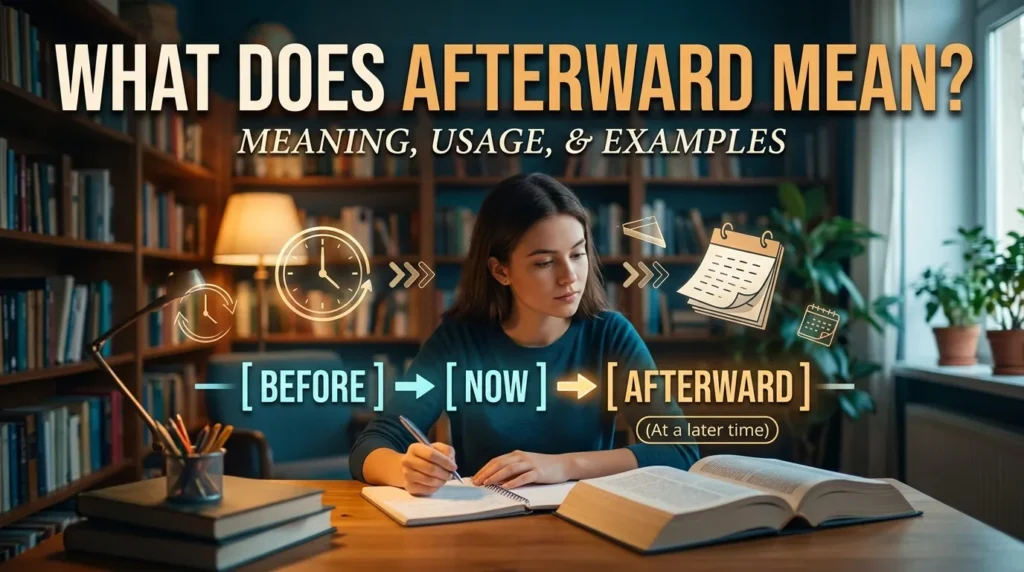
Afterward is an adverb meaning at a later time, after that, or following something that has already happened.
For example:
- We had dinner and went for a walk afterward.
- She called me afterward.
- I realized my mistake shortly afterward.
- They discussed the problem afterward.
In each sentence, afterward refers to something happening later than an event already mentioned or understood.
Cambridge defines afterward as “after the time mentioned.”
Learn how to distinguish Excel vs Accel so you can recognize the correct spelling and avoid confusing these similar-looking words.
What Does Afterwards Mean?
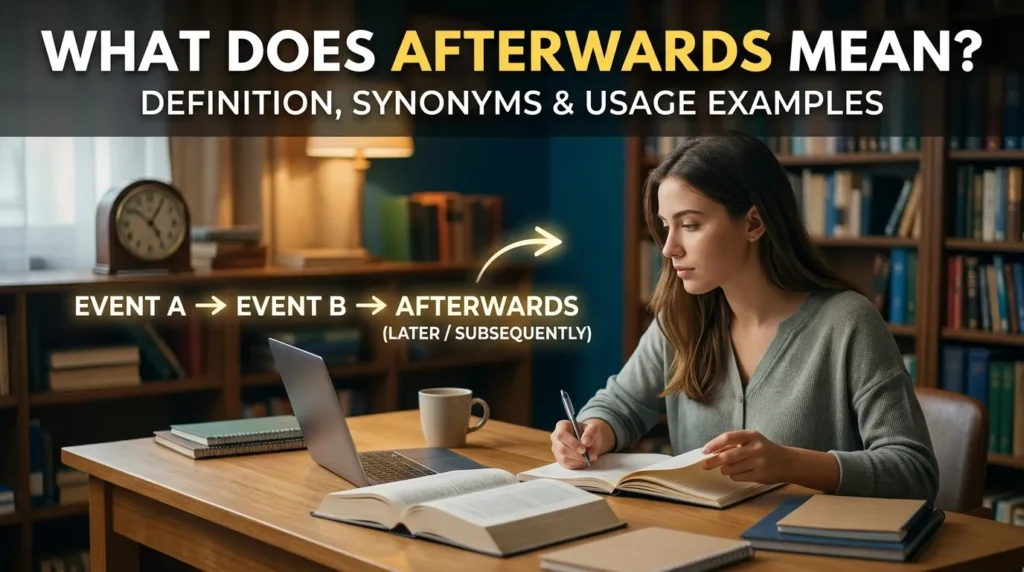
Afterwards has the same basic meaning as afterward. It means at a later time or after something else has happened.
Examples include:
- We had dinner and went for a walk afterwards.
- She called me afterwards.
- I realized my mistake shortly afterwards.
- They discussed the problem afterwards.
Cambridge lists afterwards as mainly UK usage and notes that US English usually uses afterward.
What Is the Difference Between Afterward and Afterwards?
There is no significant difference in meaning between afterward and afterwards.
The primary difference is regional usage.
| Word | Meaning | Common usage |
| Afterward | At a later time | American English |
| Afterwards | At a later time | British English |
| Afterward(s) | Later or after that | Same basic meaning |
For example:
American English:
We went to the restaurant afterward.
British English:
We went to the restaurant afterwards.
The meaning does not change. The extra s in afterwards does not create a different meaning. Cambridge’s dictionary and thesaurus both support this distinction between US and UK usage.
Afterward vs. Afterwards in American English
In American English, afterward is generally the more natural choice.
Examples:
- We talked about it afterward.
- She apologized afterward.
- I’ll call you afterward.
- They left shortly afterward.
- He regretted his decision afterward.
Afterwards is also understandable and can occur in American English, but afterward is the usual preference. Cambridge’s Essential American English Dictionary lists afterward as the US form and notes that afterwards is also used.
Afterward vs. Afterwards in British English
In British English, afterwards is especially common.
Examples:
- We went for coffee afterwards.
- She apologized afterwards.
- I’ll speak to him afterwards.
- They went home shortly afterwards.
- He regretted his decision afterwards.
British speakers may also use afterward, so it is not incorrect in British English. However, afterwards is the more typical regional form.
When Should You Use Afterward?
Use afterward when you want to say that something happens later, particularly when writing in American English.
Examples of Afterward
- We finished the meeting and went to lunch afterward.
- She called her parents afterward.
- I felt much better afterward.
- They discussed the results afterward.
- He apologized shortly afterward.
- We can talk about the details afterward.
- The children went outside afterward.
- I understood the situation better afterward.
In each example, afterward means something similar to later or after that.
When Should You Use Afterwards?
Use afterwards when you want to express the same idea, especially when following British English conventions.
Examples of Afterwards
- We finished the meeting and went to lunch afterwards.
- She called her parents afterwards.
- I felt much better afterwards.
- They discussed the results afterwards.
- He apologized shortly afterwards.
- We can talk about the details afterwards.
- The children went outside afterwards.
- I understood the situation better afterwards.
The meaning remains the same as the corresponding sentences using afterward.
Afterward vs. Afterwards Examples
Here are some side-by-side examples:
| Afterward | Afterwards |
| We went home afterward. | We went home afterwards. |
| She called me afterward. | She called me afterwards. |
| He apologized afterward. | He apologized afterwards. |
| We talked about it afterward. | We talked about it afterwards. |
| They left shortly afterward. | They left shortly afterwards. |
Both columns are grammatically correct. Choose the version that matches your preferred variety of English.
Strengthen your English skills with practical examples of intra and inter that show how these prefixes work in commonly used words.
After vs. Afterward vs. Afterwards
Although after, afterward, and afterwards are related, they are not always used in the same grammatical position.
Use after when it is followed by a noun, pronoun, or clause:
- We left after dinner.
- She called me after the meeting.
- I’ll see you after work.
- We left after the movie ended.
Use afterward or afterwards when you mean later:
- We had dinner and left afterward.
- We had dinner and left afterwards.
So, you would say:
We went home after dinner.
But:
We had dinner and went home afterward.
This distinction helps prevent confusion between the forms.
Afterward or Afterwards in Formal Writing
Neither word is inherently more formal than the other.
The important consideration is regional consistency.
If your writing follows American English, afterward is usually the better choice.
The committee reviewed the proposal and discussed it afterward.
If your writing follows British English, afterwards is generally more natural.
The committee reviewed the proposal and discussed it afterwards.
For academic, professional, or website content, follow the English variety used throughout the rest of your writing.
Afterward vs. Afterwards: Common Mistakes
Mistake 1: Thinking One Form Is Wrong
It is incorrect to assume that afterward is correct and afterwards is wrong, or vice versa.
Both are standard English forms.
Mistake 2: Thinking the Extra S Changes the Meaning
The s in afterwards does not give the word a different meaning.
Afterward = afterwards = later
Mistake 3: Confusing Afterwards With Afterword
Afterword is a completely different word.
An afterword is a section at the end of a book, often containing additional comments or information from the author.
Examples:
The author included an afterword at the end of the book.
We discussed the book afterwards.
The first refers to a part of a book. The second means “later.”
Is Afterward or Afterwards Better for American English?
Afterward is generally the better choice for American English because it is the usual US form.
For example:
We can discuss the issue afterward.
However, afterwards is not normally misunderstood by American readers.
Is Afterward or Afterwards Better for British English?
Afterwards is generally the more natural choice in British English.
For example:
We can discuss the issue afterwards.
British English also recognizes afterward, so using it is not necessarily a grammatical error.
Quick Way to Remember the Difference
A simple rule is:
American English → afterward
British English → afterwards
Think of the extra s as a common feature of the British form.
This is a useful preference rather than an absolute grammar rule. Both words are correct.
Afterward vs. Afterwards: Quick Comparison
| Feature | Afterward | Afterwards |
| Part of speech | Adverb | Adverb |
| Meaning | Later, after that | Later, after that |
| American English | Preferred/common | Also understood and used |
| British English | Used | Preferred/common |
| Meaning difference | None | None |
| Formality | Neutral | Neutral |
| Correct spelling | Yes | Yes |
Summary
Afterward and afterwards are both correct. They are adverbs that mean later, after that, or at a later time. The main difference is regional preference. Afterward is generally preferred in American English, while afterwards is mainly used in British English.
If you are writing for an American audience, afterward is usually the best choice. If you are following British English, afterwards is more natural. Most importantly, the two forms do not have a meaningful difference in definition.
Is “afterward” correct?
Yes. Afterward is a correct standard English adverb meaning “at a later time.” It is especially common in American English.
Is “afterwards” correct?
Yes. Afterwards is also correct. It has the same basic meaning as afterward and is mainly associated with British English.
What is the difference between afterward and afterwards?
The main difference is regional preference, not meaning. Afterward is more common in American English, while afterwards is more common in British English.
Can I use afterward and afterwards interchangeably?
Yes. In most contexts, you can substitute one for the other without changing the meaning of the sentence.
Which is more common in American English, afterward or afterwards?
Afterward is generally the usual American English form. Cambridge lists afterward as US usage and notes that afterwards is also used.
Which is more common in British English, afterward or afterwards?
Afterwards is generally more common in British English. Cambridge labels it mainly UK usage.
Is afterward more formal than afterwards?
No. Neither is inherently more formal. The choice is primarily based on regional English and consistency.
What is the difference between afterword and afterward?
Afterword is a noun referring to a concluding section of a book. Afterward is an adverb meaning “later.” They have completely different meanings.

Sophia Reed is an accomplished Fact-Checking Editor with more than 11 years of experience ensuring the accuracy, credibility, and integrity of digital content. She specializes in verifying facts, reviewing sources, assessing editorial reliability, and maintaining high publishing standards across a wide range of online publications.