
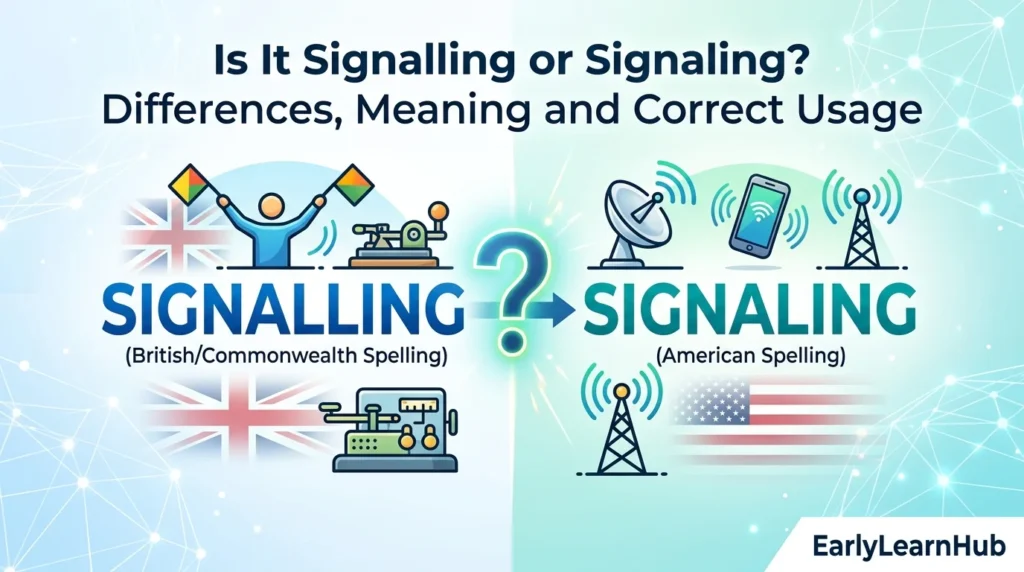
Both signalling and signaling are correct English spellings. The difference is mainly regional: signalling is the standard spelling in British English, while signaling is the standard spelling in American English. They have the same meaning and grammatical function.
Signalling or Signaling: Which Is Correct?
The correct spelling depends on which variety of English you are using:
- Signalling is preferred in British English.
- Signaling is preferred in American English.
- Both forms are the present participle and gerund of the verb signal.
- Neither spelling is inherently more correct than the other.
Oxford lists signalling as the standard -ing form and signaling as the US English form.
For example:
British English: The driver was signalling before turning left.
American English: The driver was signaling before turning left.
The meaning remains exactly the same.
What Does Signalling or Signaling Mean?
Signalling/signaling means giving or communicating information, an instruction, a warning, or an intention through a movement, sound, light, action, or other type of signal.
The verb signal can describe communicating something directly, such as using a hand gesture, or indicating that something is likely to happen. Cambridge defines the verb as making a movement, sound, or flash that gives information or tells someone what to do.
Signalling as a Verb
Signalling is the British English form of the present participle of signal.
Examples:
- She was signalling for help.
- The driver was signalling before making the turn.
- The flashing light was signalling danger.
- The announcement was signalling a change in policy.
Signaling as a Verb
Signaling is the American English form of the same present participle.
Examples:
- She was signaling for help.
- The driver was signaling before making the turn.
- The flashing light was signaling danger.
- The announcement was signaling a change in policy.
There is no difference in meaning between these examples. Only the regional spelling changes.
Why Does Signalling Have Two Ls?
The difference comes from a broader spelling convention used in British English.
When a verb ends in a single consonant after a stressed short vowel, British English commonly doubles the final consonant before adding -ing or -ed. American English often does not double the consonant in cases such as signal.
This produces:
| British English | American English |
| signalling | signaling |
| signalled | signaled |
Oxford specifically gives signalled and signalling as the British forms, with signaled and signaling as the US forms.
Signalling vs. Signaling Examples
Examples with Signalling
- The driver was signalling before turning right.
- The officer was signalling for the traffic to stop.
- The flashing lights were signalling a warning.
- The company was signalling its intention to expand.
- She was signalling to her friend from across the room.
Examples with Signaling
- The driver was signaling before turning right.
- The officer was signaling for the traffic to stop.
- The flashing lights were signaling a warning.
- The company was signaling its intention to expand.
- She was signaling to her friend from across the room.
These sentences communicate the same ideas. The choice between the two spellings depends on the English variety being used.
Signalling or Signaling in British English
Use signalling when writing in British English.
British English is commonly used in the United Kingdom and in many other contexts where British spelling conventions are followed.
Examples:
- The driver was signalling before changing lanes.
- The government was signalling a change in its policy.
- The train operator was signalling the driver to proceed.
Cambridge identifies signalling as the mainly UK form and signaling as the US form.
Signalling or Signaling in American English
Use signaling when following American English spelling conventions.
Examples:
- The driver was signaling before changing lanes.
- The company was signaling its plans to expand.
- The officer was signaling the driver to stop.
American English generally uses the single l in signaling.
Is Signalling a Noun or a Verb?
Signalling can function as a verb form and, depending on the sentence, as a gerund.
As a verb form:
The driver was signalling before turning.
Here, signalling forms part of the past continuous verb phrase was signalling.
As a gerund:
Signalling before turning is an important part of safe driving.
Here, signalling functions as a noun-like form because it refers to the activity itself.
The same distinction applies to American English signaling.
What Is the Difference Between Signalling and Signaling?
There is no difference in meaning. The difference is spelling and regional usage.
Signalling = British English
Signaling = American English
Both come from the verb signal, which can mean to communicate information through a gesture, movement, sound, light, or other indication. It can also mean to indicate that something is happening or is likely to happen.
Signalling and Signaling with Other Forms
The same British-American spelling distinction appears in related forms of signal:
- British: signalled
- American: signaled
- British: signalling
- American: signaling
The base verb remains signal in both varieties.
For consistency, choose one spelling system and use it throughout your writing. If your article follows British English, use signalling and signalled. If it follows American English, use signaling and signaled.
Quick Comparison
| Word | English Variety | Correct? | Meaning |
| signalling | British English | Yes | Giving or communicating a signal |
| signaling | American English | Yes | Giving or communicating a signal |
| signalled | British English | Yes | Past tense/past participle |
| signaled | American English | Yes | Past tense/past participle |
Summary
Signalling and signaling are both correct. The main difference is regional spelling. Signalling is the British English form, while signaling is the American English form. Both are forms of the verb signal and mean giving information, communicating an instruction or warning, or indicating that something is happening or likely to happen.
If you are writing for a British English audience, choose signalling. If you are writing for an American English audience, choose signaling. The most important rule is to remain consistent with the spelling convention used throughout your text.
Frequently Asked Questions
Is signalling or signaling correct?
Both signalling and signaling are correct. Signalling is the British English spelling, while signaling is the American English spelling.
Is signalling British or American English?
Signalling is the British English spelling. American English normally uses signaling.
Is signaling British English?
Signaling is primarily the American English spelling. British English normally uses signalling.
Do signalling and signaling have different meanings?
No. They have the same meaning. The difference is only the spelling convention used in British and American English.
Why does British English use signalling?
British English commonly doubles the final l in this type of verb form, producing signalling. American English uses signaling.
What is the past tense of signalling?
The British English past tense is signalled. In American English, it is signaled.
Is signalling a verb?
Yes. Signalling is the present participle and gerund form of the verb signal.
Which spelling should I use in an American English article?
Use signaling if you are following American English spelling conventions.
Which spelling should I use in a British English article?
Use signalling if you are following British English spelling conventions.
Is signalling more correct than signaling?
No. Neither is universally more correct. Each is the standard spelling for a different variety of English.

Grace Holloway is a Creative Learning Designer with more than 9 years of experience producing visually engaging educational resources for preschool and kindergarten children. She specializes in combining educational principles with creative design to develop worksheets that encourage learning through play, exploration, and creativity.
3 thoughts on “Is It Signalling or Signaling? Differences, Meaning and Correct Usage”