
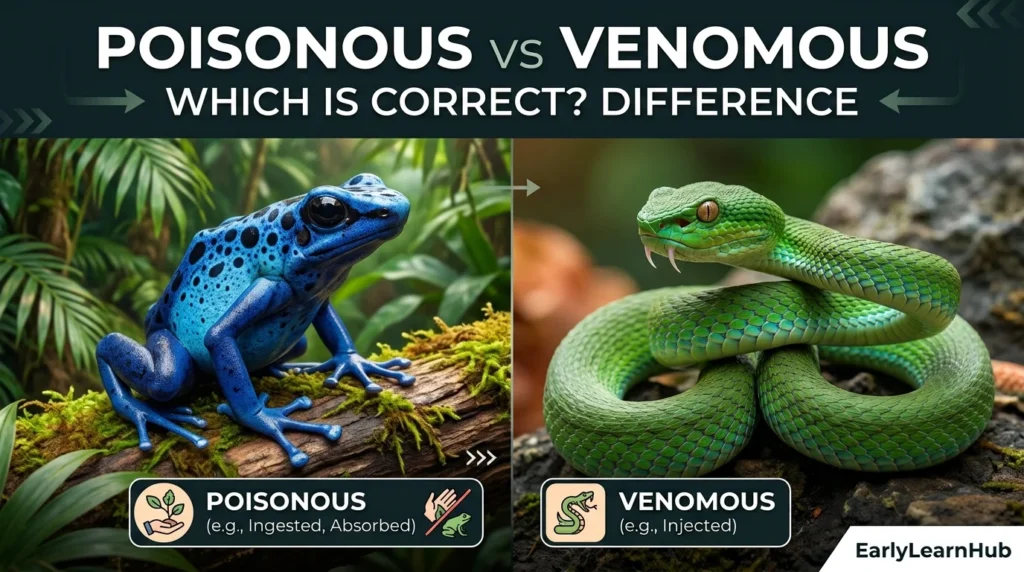
“Poisonous” and “venomous” are often used interchangeably, but they describe different ways toxins affect another organism. The key difference is how the toxin is delivered. A poisonous animal is harmful when its toxin is eaten, touched, or otherwise absorbed, while a venomous animal actively delivers venom through a bite, sting, spine, or similar mechanism.
Clarify common grammar confusion with Their vs There usage and learn when each word belongs in a sentence.
What Is the Difference Between Poisonous and Venomous?
The simplest distinction is:
- Poisonous means an organism contains or produces a toxin that causes harm when it is consumed, touched, or absorbed.
- Venomous means an organism actively delivers its toxin into another organism, usually through a bite, sting, fang, spine, or another specialized structure.
A useful way to remember it is:
If you eat it and it harms you, think “poisonous.” If it bites or stings you and delivers the toxin, think “venomous.”
This is a useful rule of thumb, although real biological systems can be more complicated. Some organisms can use both poisonous and venomous defenses.
Poisonous Meaning
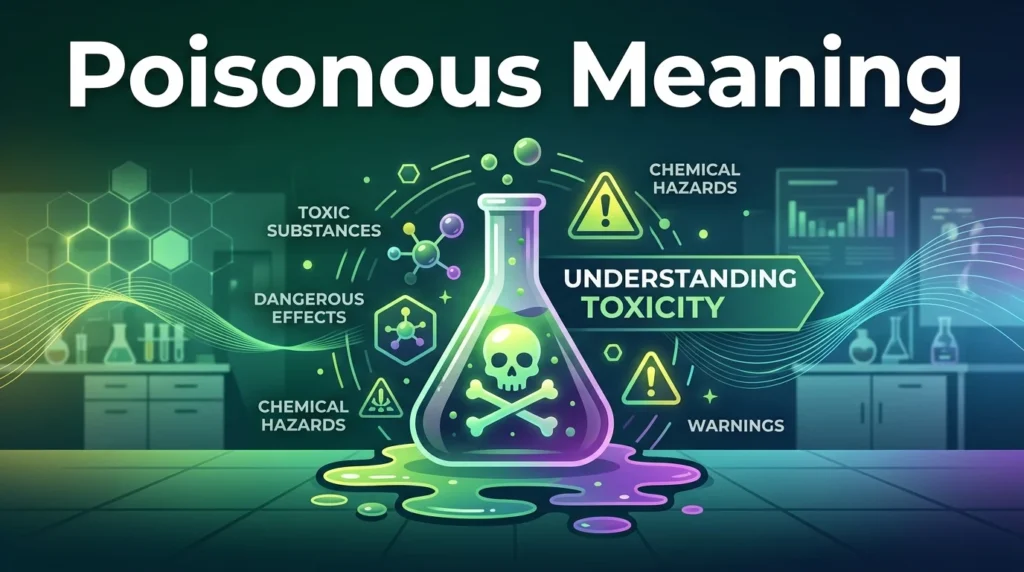
Poisonous is an adjective used for something that contains or produces a poison capable of causing harm when it enters the body through an appropriate route.
In animals, poisonous defenses are often passive. For example, a poisonous animal may have toxins in its skin or tissues. A predator can be harmed by eating or sometimes touching the animal.
Examples include:
- Poison dart frogs
- Some pufferfish
- Certain poisonous insects
- Some toxic plants
Poisonous organisms can obtain their toxins from their diet rather than producing all of them themselves. Some poison dart frogs, for example, acquire defensive chemicals through their food.
Examples of Poisonous in a Sentence
- The poisonous frog has toxins in its skin.
- Some poisonous mushrooms can cause serious illness if eaten.
- The pufferfish can be poisonous because of toxins in its tissues.
- You should never eat an unfamiliar poisonous plant.
Venomous Meaning
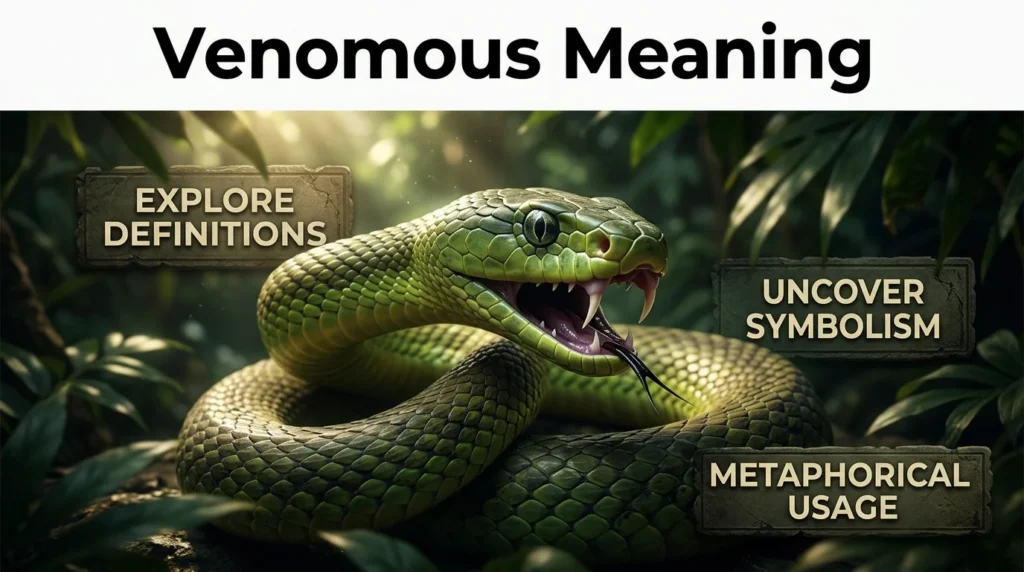
Venomous describes an animal that actively delivers venom into another organism.
Venom is commonly delivered through specialized structures such as:
- Fangs
- Stingers
- Spines
- Teeth
- Other specialized body parts
Snakes, spiders, scorpions, wasps, and some fish are examples of animals that can be venomous.
Examples of Venomous in a Sentence
- A cobra is a venomous snake.
- Some spiders are venomous and deliver venom through their bites.
- The scorpion is a venomous animal.
- The lionfish has venomous spines.
Poisonous vs Venomous Examples
| Word | Meaning | How the toxin is delivered | Example |
| Poisonous | Contains or produces poison | Usually through eating, touching, or absorption | Poison dart frog |
| Venomous | Delivers venom actively | Bite, sting, spine, or similar mechanism | Snake |
| Both | Can have both types of toxic defense | Depends on the species and mechanism | Some keelback snakes |
The distinction is primarily about delivery, not simply how dangerous the toxin is. A poisonous organism is not automatically less dangerous than a venomous one. The toxicity of both poisons and venoms varies considerably among species.
Is a Snake Poisonous or Venomous?
A snake that delivers venom through its fangs is generally described as venomous, not poisonous.
For example:
Correct: The cobra is a venomous snake.
Less precise: The cobra is a poisonous snake.
However, the distinction can become more complicated because some snakes can acquire toxins from their prey and use them defensively. In rare cases, an animal can be both poisonous and venomous.
Is a Spider Poisonous or Venomous?
Spiders that inject venom through their fangs are venomous.
For example:
Correct: Some spiders are venomous.
A spider would generally be called poisonous if its body or secretions contain toxins that cause harm through contact or ingestion rather than active injection.
Is a Frog Poisonous or Venomous?
It depends on the species.
Many toxic frogs are poisonous because their skin contains toxins that can harm a predator that eats or contacts them. However, scientists have also identified frogs that are venomous because they can actively deliver toxins using specialized structures.
Therefore, saying that every toxic frog is poisonous would be too broad.
Clarify common grammar confusion by understanding when to use To or Too in everyday sentences.
A Simple Trick to Remember the Difference
A common memory trick is:
Poisonous = you have to get the poison into yourself.
Venomous = the animal delivers the venom to you.
Think of it this way:
- Poisonous mushroom: You eat it.
- Poison dart frog: A predator eats or contacts it.
- Venomous snake: It bites you.
- Venomous bee: It stings you.
- Venomous scorpion: It injects venom with its stinger.
This distinction focuses on the route of delivery, which is the central difference between the terms.
Poison vs Venom
The nouns poison and venom follow the same basic distinction.
Poison refers to a toxic substance that causes harm when it is introduced into the body through routes such as ingestion, contact, or absorption.
Venom is a toxic substance that an animal actively delivers into another organism, typically through a bite, sting, spine, or another specialized mechanism.
The two substances can have similar harmful effects once they enter the body, but their delivery mechanisms are different.
Poisonous vs Venomous: Which Word Should You Use?
Use poisonous when you are describing something that contains or produces poison that causes harm through ingestion, contact, or absorption.
Use venomous when you are describing an animal that actively delivers venom through a bite, sting, fang, spine, or similar structure.
For example:
- Poisonous mushroom ✔️
- Poisonous plant ✔️
- Poison dart frog ✔️
- Venomous snake ✔️
- Venomous spider ✔️
- Venomous scorpion ✔️
- Venomous wasp ✔️
In everyday speech, people sometimes use “poisonous” broadly for anything toxic, but venomous is the more precise term for animals that actively inject or deliver venom.
Summary
Poisonous and venomous are not interchangeable in precise scientific usage. Poisonous generally describes something that causes harm when its toxin is consumed, touched, or absorbed, while venomous describes an animal that actively delivers venom through a bite, sting, fang, spine, or similar mechanism.
The easiest rule is “poison is delivered passively, venom is delivered actively.” However, nature includes exceptions, and some animals can have both poisonous and venomous characteristics.
Is a snake poisonous or venomous?
A snake that actively delivers venom through its fangs is venomous. Some unusual species may also have poisonous characteristics.
Is a poison dart frog poisonous or venomous?
Poison dart frogs are generally described as poisonous because their skin contains defensive toxins. However, not every toxic frog uses the same mechanism.
Are spiders poisonous or venomous?
Spiders that inject venom through their fangs are venomous.
Are bees poisonous or venomous?
Bees are venomous because they deliver venom through their stingers.
What is the easiest way to remember poisonous vs venomous?
Remember: If you bite it and it harms you, it is poisonous. If it bites you and delivers the toxin, it is venomous.
Can an animal be both poisonous and venomous?
Yes. Some animals can possess both types of toxic defenses. Certain snakes, for example, can combine venomous bites with toxins acquired from poisonous prey.
Is “poisonous snake” grammatically correct?
Yes, “poisonous snake” is grammatically correct, but venomous snake is generally the more precise expression when referring to a snake that actively delivers venom through a bite.

Sophia Reed is an accomplished Fact-Checking Editor with more than 11 years of experience ensuring the accuracy, credibility, and integrity of digital content. She specializes in verifying facts, reviewing sources, assessing editorial reliability, and maintaining high publishing standards across a wide range of online publications.