
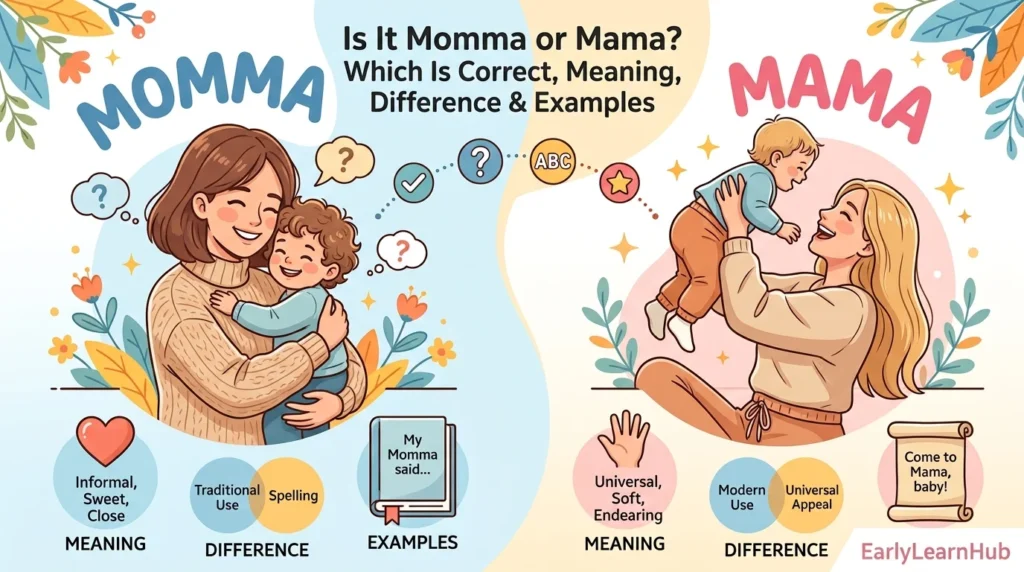
If you are unsure whether to write “momma” or “mama,” you are not alone. Both forms are used in English to refer to a mother, but they differ slightly in spelling, usage, and tone. Mama is a widely recognized informal form, while momma is an established informal variant, particularly associated with U.S. English.
Learn when to use Too Many correctly when describing quantities in everyday English.
Momma or Mama: Which Is Correct?
Both “mama” and “momma” are correct.
The two words have essentially the same basic meaning, “mother.” The main difference is their spelling and stylistic use.
Mama is the shorter and broadly recognized form.
Momma is a recognized informal variant of mama.
Mama is generally the more versatile choice for a broad English-speaking audience.
Momma can sound more conversational, affectionate, or regionally marked.
In formal writing, mother is usually more appropriate than either informal form.
Cambridge Dictionary defines momma as an informal U.S. word for mother and lists mama among related informal family terms. Dictionary.com likewise identifies momma as a variant of mama.
What Is the Difference Between Momma and Mama?
The primary difference between momma and mama is not their meaning. Both can mean mother.
The distinction is mainly related to spelling, register, regional usage, and personal preference.
Word Meaning Usage Tone
Mama Mother Informal and affectionate Familiar, simple
Momma Mother Informal, especially in U.S. English Conversational, affectionate
Mother Female parent Formal and general Neutral, formal
For example:
My mama taught me how to cook.
My momma taught me how to cook.
Both sentences are grammatically acceptable. The choice depends largely on the writer’s preferred style and the voice they want to convey.
What Does Mama Mean?
Mama is an informal word for mother. It is often associated with children’s speech, family language, and affectionate ways of addressing or referring to a mother. Adults may also use it when speaking about their mothers.
Examples of Mama
My mama makes the best cookies.
I called my mama after work.
Mama, can you help me?
My mama always encouraged me.
Happy birthday, Mama!
When mama is used as a name or direct form of address, it is commonly capitalized:
Mama, I need your help.
When it is simply a common noun, lowercase is generally appropriate:
My mama lives nearby.
What Does Momma Mean?
Momma is an informal variant of mama and means mother. Cambridge specifically labels it as informal U.S. English.
It can be used when referring to a mother or addressing her.
Examples of Momma
My momma taught me to be kind.
I called my momma last night.
Momma, can you come here?
Her momma made dinner.
My momma always supported me.
The spelling may be particularly suitable in personal writing, dialogue, stories, or situations where the writer wants to preserve a conversational or regional voice.
Is Mama More Common Than Momma?
Generally, mama is the more broadly recognized form. It is concise and familiar across different varieties of English.
Momma is also an established word, but its use is more informal and can be more strongly associated with American English. Dictionary sources do not treat it simply as a spelling mistake.
Therefore, if you are writing for a general audience and have no particular reason to choose momma, mama is a straightforward choice.
Is Momma a Southern Word?
Momma can be associated with Southern and regional American speech, but it is not exclusively a Southern word.
People in different parts of the United States may use momma because of family preference, dialect, personal style, or cultural background. It is more accurate to describe it as an informal American form rather than saying that it belongs only to the Southern United States.
In fiction or dialogue, writers may deliberately use momma to represent a character’s natural speech or regional voice.
Learn when to use If Time Permits or If Time Allows in different English contexts.
Mama vs. Momma in Formal Writing
Both mama and momma are informal terms. If you are writing an academic paper, business document, professional report, or other formal text, mother will normally be the more appropriate word.
For example:
Informal:
My mama helped me with the project.
Informal, more conversational:
My momma helped me with the project.
Formal:
My mother helped me with the project.
The informal forms are not necessarily grammatically wrong. They simply belong to a different register.
When Should You Use Mama?
Use mama when you want a familiar and widely recognized informal term for mother.
It works naturally in:
Family conversations
Personal messages
Children’s writing
Social media
Stories
Songs
Informal correspondence
Affectionate expressions
For example:
I miss my mama every day.
When Should You Use Momma?
Use momma when it fits the speaker’s or writer’s personal style, family vocabulary, or regional voice.
It can work particularly well in:
Informal conversations
Fictional dialogue
Personal stories
Memoirs
Creative writing
Family-related writing
Regional American dialogue
For example:
“My momma always told me to be honest.”
Here, momma helps create a conversational and personal voice.
Mama or Momma: Examples
Using Mama
My mama taught me how to bake.
Mama, where are my shoes?
I bought flowers for my mama.
My mama always believed in me.
Mama is coming home soon.
Using Momma
My momma taught me how to bake.
Momma, where are my shoes?
I bought flowers for my momma.
My momma always believed in me.
Momma is coming home soon.
The basic meaning remains the same in these examples. The difference is primarily stylistic.
Mama or Momma: Which One Should You Use?
If you simply need an informal word for mother, either mama or momma can be correct.
Choose mama when you want a broadly recognizable, concise form. Choose momma when it better reflects personal, conversational, family, or regional usage.
If the writing is formal, use mother instead.
The important point is that momma is not simply an incorrect spelling of mama. Major dictionary sources recognize it as an established informal variant.
Summary
Mama and momma are both correct informal words for “mother.” Mama is the shorter and more broadly recognized form, while momma is an established informal variant, particularly in U.S. English. The difference is mainly one of spelling, style, and regional or personal usage rather than meaning. Use mama for a generally familiar informal form, momma when it suits a personal or conversational voice, and mother when formal English is required.
Frequently Asked Questions
Is Mama or Momma correct?
Both mama and momma are correct informal forms meaning “mother.” Momma is recognized as a variant of mama by dictionary sources.
Is Momma a real word?
Yes. Momma is a real English word meaning mother. Cambridge Dictionary identifies it as an informal U.S. term for mother.
What is the difference between Mama and Momma?
Both words generally mean mother. The main difference is spelling and usage. Mama is more broadly recognized, while momma is an informal variant that can have a more conversational or regional feel.
Is Momma a misspelling of Mama?
No. Momma is not automatically a misspelling. It is an established variant of mama and is recognized by dictionaries.
Is Mama formal or informal?
Mama is informal. In formal writing, mother is generally more appropriate.
Is Momma formal or informal?
Momma is informal. It is particularly suitable for family speech, personal writing, dialogue, and other casual contexts.
Should Mama be capitalized?
Capitalize Mama when it is used as a name or direct form of address, such as “Mama, can you help me?” Use lowercase when it functions as a common noun, such as “My mama lives nearby.”
Which is better, Mama or Momma?
There is no universal correctness difference. Mama is generally the more broadly recognizable choice, while momma can be chosen for personal, conversational, or regional style.
Can I use Mama in a sentence?
Yes. For example: “My mama always encouraged me to work hard.”
Can I use Momma in a sentence?
Yes. For example: “My momma always encouraged me to work hard.”

Sophia Reed is an accomplished Fact-Checking Editor with more than 11 years of experience ensuring the accuracy, credibility, and integrity of digital content. She specializes in verifying facts, reviewing sources, assessing editorial reliability, and maintaining high publishing standards across a wide range of online publications.