
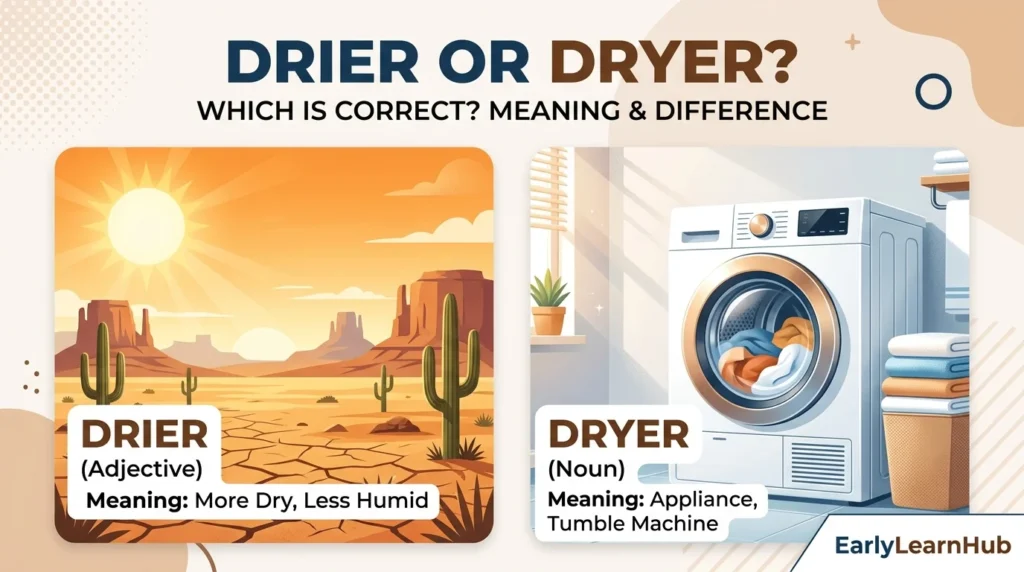
If you are unsure whether to write drier or dryer, both words are correct, but they usually have different meanings and grammatical functions. Drier is normally the comparative form of dry, while dryer is commonly a noun for a machine or device that dries something.
To clarify which form fits your sentence, understand the difference between Focuses and Foci in everyday English.
Drier or Dryer: Which Is Correct?
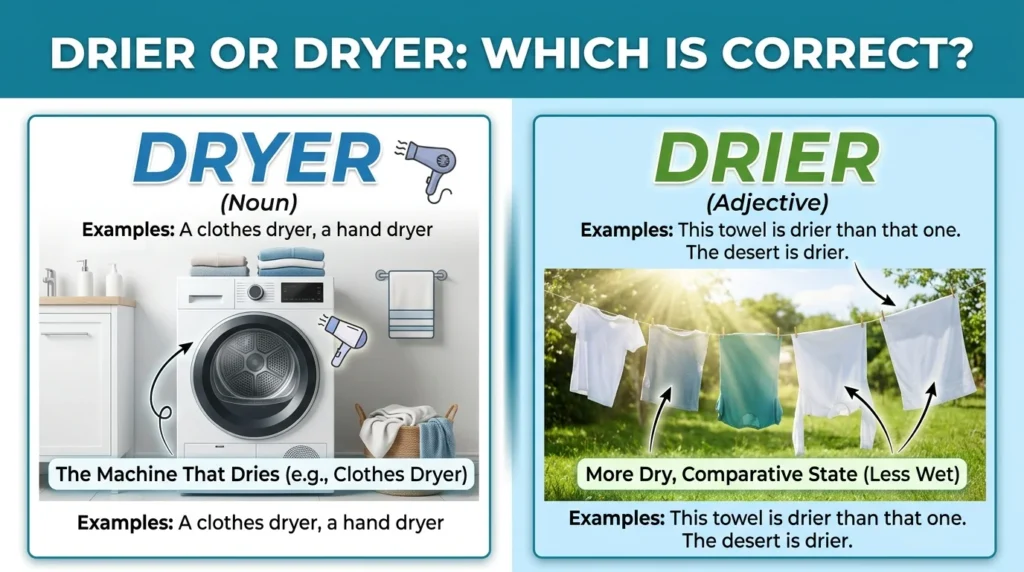
The correct spelling depends on what you mean.
- Drier means more dry and is usually the comparative form of the adjective dry.
- Dryer usually refers to a machine or device that dries something, such as a clothes dryer or hair dryer.
For example:
- The weather is drier today.
- Put the clothes in the dryer.
Both spellings are legitimate English words. Major dictionaries also recognize some overlapping noun uses, so the simple distinction is a practical usage rule rather than an absolute rule.
What Is the Difference Between Drier and Dryer?
The main difference is their usual grammatical role and meaning.
| Word | Usual meaning | Part of speech | Example |
| Drier | More dry | Comparative adjective | The air is drier today. |
| Dryer | A machine or device that dries | Noun | The dryer is running. |
The easiest way to remember the difference is:
Drier = more dry
Dryer = something that dries
Cambridge lists drier as the comparative form of dry, while Oxford defines dryer as a machine for drying something.
What Does Drier Mean?
Drier is the comparative form of dry. It means that something has less moisture or is more dry than something else.
The spelling follows the usual English pattern:
dry → drier → driest
When -er is added to dry, the y changes to i.
Examples of Drier
- This towel is drier than that one.
- The climate is drier in the summer.
- The ground is drier after several sunny days.
- My skin feels drier during winter.
- This room is drier than the kitchen.
- The soil becomes drier without rain.
In each example, drier describes a greater degree of dryness.
What Does Dryer Mean?
Dryer is most commonly a noun meaning a machine or device used to remove moisture.
Common examples include:
- clothes dryer
- hair dryer
- hand dryer
- tumble dryer
- spin dryer
Oxford lists dryer as a noun meaning a machine for drying something and gives examples such as hair dryer and tumble dryer.
Examples of Dryer
- The clothes are in the dryer.
- I need to buy a new hair dryer.
- The dryer stopped working this morning.
- Please take the clothes out of the dryer.
- The bathroom has an automatic hand dryer.
Here, dryer does not mean “more dry.” It identifies something that performs the drying.
Clarify the grammar difference with the correct usage of A Couple of Times in everyday sentences.
Drier vs Dryer Examples
Seeing the words in complete sentences makes the distinction easier.
Examples With Drier
- The desert is drier than the forest.
- Today’s air feels drier than yesterday’s.
- This towel is drier than the other one.
- The soil becomes drier during the summer.
- My hands get drier in cold weather.
Examples With Dryer
- The clothes are inside the dryer.
- She bought a new hair dryer.
- The dryer uses a lot of electricity.
- The hotel provides a hair dryer.
- The dryer stopped working yesterday.
Why Is Drier the Correct Comparative Form?
The adjective dry changes to drier when forming its comparative.
The pattern is:
- dry → drier
- easy → easier
- happy → happier
- noisy → noisier
Therefore, when you want to say “more dry,” the standard spelling is drier.
For example:
Correct: The weather is drier this year.
Incorrect in standard edited usage: The weather is dryer this year.
Dictionary sources identify drier as the comparative form of dry.
Can Drier Also Be a Noun?
Yes. This is an important exception to the simple rule.
Although dryer is the familiar spelling for a drying appliance, dictionaries also record drier as a noun. Cambridge, for example, lists drier as a noun meaning a dryer, while Collins records drier as a variant spelling of dryer.
American Heritage likewise recognizes drier as a noun for something that dries and dryer as an appliance that removes moisture.
So it is better not to say that drier can only be an adjective. In ordinary modern writing, however, the clearest practical distinction is:
- Use drier for the comparative of dry.
- Use dryer for a drying machine or appliance.
Drier or Dryer for Weather?
Use drier when talking about weather or climate.
Examples:
- This year’s weather is drier than last year’s.
- The region has drier conditions in summer.
- The forecast predicts drier weather next week.
Here, drier means more dry, so it is the comparative form of dry.
Drier or Dryer for Clothes?
Use dryer when referring to the appliance used to dry clothes.
Examples:
- Put the clothes in the dryer.
- The dryer is full.
- Our clothes dryer needs to be repaired.
In this context, dryer is a noun referring to a machine. Oxford specifically lists dryer as a machine for drying things.
Drier or Dryer for Hair?
The standard everyday expression is hair dryer.
For example:
- I need a new hair dryer.
- She used a hair dryer after washing her hair.
- The hair dryer is in the bathroom.
Oxford and American Heritage both use hair dryer as an example of the noun dryer.
Is It Drier Weather or Dryer Weather?
The standard choice is drier weather.
Drier weather means weather that is more dry or has less moisture.
For example:
We are expecting drier weather next week.
Using drier makes sense because you are comparing the level of dryness, not naming a machine.
Is It Clothes Drier or Clothes Dryer?
Clothes dryer is the usual spelling for the appliance, particularly in American English.
For example:
The clothes dryer is not working.
However, drier is also recorded as a noun and can appear as a variant of dryer in dictionaries.
British and American English
The distinction between the two words is broadly similar in British and American English.
Drier is used as the comparative form of dry in both varieties:
- The climate is drier.
- The soil is drier.
Dryer is widely used for drying machines:
- clothes dryer
- hair dryer
- tumble dryer
Oxford notes that drier is also a variant noun form of dryer, showing that some overlap exists in English usage.
Drier or Dryer: Easy Memory Trick
Use this simple rule:
Drier = more dry
Dryer = machine that dries
For example:
- Drier weather = more dry weather
- Clothes dryer = machine that dries clothes
- Drier skin = skin that is more dry
- Hair dryer = device that dries hair
If you can replace the word with “more dry,” choose drier. If you are talking about a device that performs the drying, dryer is usually the appropriate choice.
Common Mistakes With Drier and Dryer
Mistake 1: Using Dryer for a Comparison
Incorrect:
The weather is dryer today.
Standard choice:
The weather is drier today.
The intended meaning is “more dry,” so drier is appropriate.
Mistake 2: Using Drier for a Clothes Appliance
Less usual:
Put the clothes in the drier.
Standard choice:
Put the clothes in the dryer.
Dryer is the familiar spelling for the appliance.
Mistake 3: Thinking One Spelling Is Always Wrong
Neither word is simply a misspelling of the other. Both are established English words. Their most common uses are different, but dictionaries also record some overlap, particularly for drier as a noun.
Summary
Drier and dryer are both correct words, but they usually serve different purposes.
- Drier is normally the comparative form of dry, meaning more dry.
- Dryer is commonly a noun for a machine or device that dries something.
- Use drier weather when comparing levels of dryness.
- Use clothes dryer for the laundry appliance.
- Use hair dryer for the device used to dry hair.
- Dictionaries also recognize drier as a noun or variant of dryer, so the distinction is not completely absolute.
The easiest rule is: drier means “more dry,” while dryer usually means “something that dries.”
FAQs
Is drier or dryer correct?
Both are correct. Drier is normally the comparative form of dry, while dryer is commonly used for a machine or device that dries something.
Is it drier or dryer weather?
The standard choice is drier weather because drier means “more dry.”
Is it clothes drier or clothes dryer?
Clothes dryer is the usual spelling for the appliance, although dictionaries also recognize drier as a noun variant in some contexts.
Is it hair drier or hair dryer?
Hair dryer is the standard and widely recognized spelling for the appliance.
What is the difference between drier and dryer?
Drier usually means “more dry,” while dryer usually refers to something that dries, especially a machine or appliance.
Why is dry spelled drier?
When the comparative suffix -er is added to dry, the final y changes to i, producing drier.
Can drier be a noun?
Yes. Dictionaries record drier as a noun meaning a person or thing that dries and, in some usage, as a variant of dryer.
Are drier and dryer pronounced the same?
They are commonly pronounced the same or very similarly, which contributes to the confusion. The spelling and context distinguish their usual meanings.
Is “dryer than” correct?
When making a comparison meaning “more dry,” drier than is the standard choice in edited English.
What is the easiest way to remember drier vs dryer?
Remember drier = more dry and dryer = drying machine. For example, “The air is drier” but “The clothes are in the dryer.”

Sophia Reed is an accomplished Fact-Checking Editor with more than 11 years of experience ensuring the accuracy, credibility, and integrity of digital content. She specializes in verifying facts, reviewing sources, assessing editorial reliability, and maintaining high publishing standards across a wide range of online publications.