
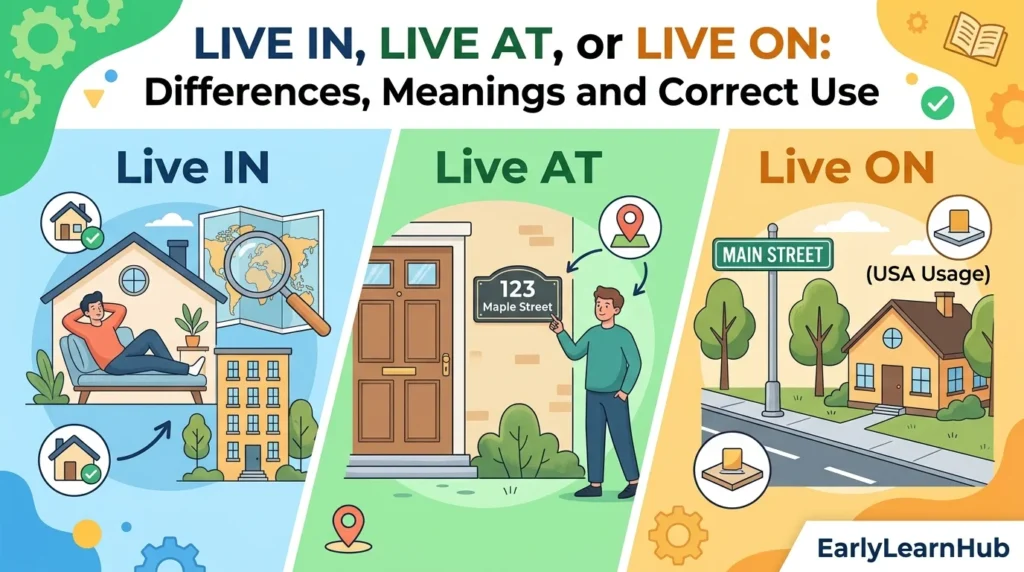
“Live in,” “live at,” and “live on” are all correct expressions, but they are not normally interchangeable. The preposition depends on the type of place you are talking about. In general, live in is used for cities, countries, and enclosed or larger areas, live at is used for a specific address or particular location, and live on is commonly used with streets, roads, islands, and some surfaces or levels.
Understanding focuses or foci meaning and correct plural usage can help clarify which form belongs in formal writing.
Is “Live In,” “Live At,” or “Live On” Correct?
All three can be grammatically correct:
- I live in London.
- I live at 25 King Street.
- I live on King Street.
The correct choice depends on what follows the preposition. English uses in, at, and on to express different relationships with places. Cambridge Dictionary, for example, uses “live in” for having your home in a particular place and gives examples such as “We live in Kingston.” It also gives “live on” with a road.
A useful rule is:
| Expression | Typical use | Example |
| Live in | City, country, town, area, building, room | I live in Chicago. |
| Live at | Specific address or particular point/location | I live at 25 King Street. |
| Live on | Street, road, avenue, island, floor, or surface | I live on King Street. |
What Does “Live In” Mean?
Live in means to have your home or usual residence within a particular area, place, or enclosed space.
It is commonly used with:
- Countries
- Cities
- Towns
- States and provinces
- Neighborhoods
- Regions
- Buildings
- Houses
- Apartments
- Rooms
- Areas
Cambridge Dictionary defines live in this context as having your home somewhere or having a place where you stay or return, especially to sleep.
Examples of “Live In”
- I live in Pakistan.
- She lives in Lahore.
- They live in a small village.
- We live in a large apartment.
- He lives in an old house.
- My grandparents live in the countryside.
- She lives in a quiet neighborhood.
- They live in New York.
“Live In” With a Building or Home
You can use live in when emphasizing the building or enclosed place where someone resides.
- We live in a three-bedroom house.
- She lives in an apartment downtown.
- They live in a large building.
- He lives in a dormitory.
There is also a separate expression, live in, meaning to reside at the place where you work or study. Cambridge specifically identifies this use, such as a person living at their workplace.
These examples clarify if time permits vs if time allows usage across formal and conversational contexts.
What Does “Live At” Mean?
Live at is generally used when you identify a particular location or specific address.
It treats the place more like a specific point rather than a broad area.
Examples of “Live At”
- I live at 25 King Street.
- She lives at 14 Park Avenue.
- He lives at 1600 Pennsylvania Avenue.
- They live at the university.
- She lives at home with her parents.
- We live at the same address.
A university grammar resource from Gallaudet gives numbered addresses as a typical use of at, such as “I live at 241 Fifth Avenue.”
“Live At” vs. “Live In” an Address
Compare these sentences:
- I live in New York.
- I live at 125 Main Street.
The first sentence gives the larger area, while the second gives the exact address.
You can also combine the information:
I live at 125 Main Street in New York.
Here, at identifies the exact address and in identifies the city.
What Does “Live On” Mean?
Live on is commonly used when talking about a street, road, avenue, island, floor, or certain surfaces.
For example:
- I live on Main Street.
- She lives on Fifth Avenue.
- They live on a quiet road.
- He lives on Long Island.
- We live on the fourth floor.
Gallaudet’s English grammar resource specifically lists street names, island names, and floors among common uses of on, including “I live on Fifth Avenue” and “I live on Long Island.”
“Live In” vs. “Live At”
The main difference is generality versus specificity.
Live In
Use live in for a larger area or a place considered as an area.
I live in London.
She lives in Canada.
They live in a small town.
Live At
Use live at for a particular address or specific location.
I live at 42 Green Street.
She lives at 10 Park Road.
He lives at the university.
A simple way to remember the difference is:
in = area
at = specific point
“Live In” vs. “Live On”
These two are particularly easy to confuse when talking about places.
Use in for the city, town, country, or larger area:
I live in Boston.
Use on for the street or road:
I live on Beacon Street.
You can therefore use both in the same sentence:
I live on Beacon Street in Boston.
This pattern clearly shows the difference between the street and the city.
“Live At” vs. “Live On”
The difference becomes especially clear with addresses and streets.
Specific Address: “Live At”
I live at 125 Oak Street.
Street Name: “Live On”
I live on Oak Street.
The address identifies a particular location on the street, while the street name identifies the road itself.
For example:
She lives on Main Street.
She lives at 45 Main Street.
Both sentences can be correct because they provide different levels of detail.
Do You Say “Live In a Street” or “Live On a Street”?
The standard choice is live on a street.
I live on Green Street.
They live on a quiet road.
She lives on Oak Avenue.
This follows the common use of on with street and road names.
However, in is appropriate when the noun refers to an enclosed space or area:
I live in a house.
I live in an apartment.
Do You Say “Live In a City” or “Live At a City”?
Use live in with a city.
Correct:
I live in London.
She lives in Karachi.
They live in New York.
Incorrect in standard usage:
I live at London.
The reason is that a city is treated as an area rather than a single point.
Do You Say “Live In a Country” or “Live At a Country”?
Use live in with a country.
I live in Pakistan.
She lives in Canada.
They live in Australia.
You would not normally say:
I live at Pakistan.
The correct preposition is in.
Do You Say “Live In an Address” or “Live At an Address”?
Use live at when giving an exact address.
I live at 45 Green Street.
She lives at 18 King Road.
However, in can be used when referring to the broader place represented by an address:
He lives in the building at 45 Green Street.
Here, in refers to the building, while at introduces the exact address.
Special Uses of “Live On”
“Live on” has meanings beyond physical location.
It can mean continue to exist or be remembered:
Her memory will live on.
His work will live on for generations.
Cambridge Dictionary lists live on as a phrasal verb meaning to continue to exist.
It can also mean to survive by using a particular source of food or money:
They live on a small income.
Some animals live on plants.
So, the meaning of live on depends on the context.
Quick Comparison of “Live In,” “Live At,” and “Live On”
| Expression | Main meaning | Example |
| Live in | Reside within a city, country, area, building, or enclosed place | I live in London. |
| Live at | Reside at a particular address or specific location | I live at 25 King Street. |
| Live on | Reside on a street, road, island, or floor | I live on King Street. |
The easiest rule is to think about the size or specificity of the location:
City/country/area → in
Exact address → at
Street/road/island/floor → on
Common Mistakes
Incorrect: I live at London.
Correct:
I live in London.
Incorrect: I live in Main Street.
Correct:
I live on Main Street.
Incorrect: I live on 25 Main Street.
Correct:
I live at 25 Main Street.
Incorrect: She lives at Canada.
Correct:
She lives in Canada.
These errors happen because the three prepositions can all be associated with locations, but they describe different relationships with those locations.
Examples in Everyday English
Here are some natural examples:
- I live in a small town.
- She lives in California.
- We live in a two-story house.
- He lives at 18 King Street.
- They live at the university.
- I live on Park Road.
- She lives on the third floor.
- We live on Long Island.
- He lives in Manchester but works in Liverpool.
- She lives at 22 Baker Street in London.
Summary
Live in, live at, and live on are all correct, but they are used in different situations. Use live in for cities, countries, towns, regions, neighborhoods, buildings, and other areas. Use live at for a specific address or particular location. Use live on for streets, roads, avenues, islands, and floors.
For example:
I live in London.
I live on Oxford Street.
I live at 25 Oxford Street.
Remembering in = area, on = street/surface/level, at = specific point or address will help you choose the correct preposition in most everyday situations.
FAQs
Is “live in” correct?
Yes. Live in is correct when talking about living within a city, country, town, region, neighborhood, building, or other area. For example, “I live in Lahore.”
Is “live at” correct?
Yes. Live at is commonly used with a specific address or particular location. For example, “She lives at 25 King Street.”
Is “live on” correct?
Yes. Live on is commonly used with streets, roads, avenues, islands, and floors. For example, “I live on Main Street.”
Should I say “I live in a city” or “I live at a city”?
Say “I live in a city.” Cities are normally treated as areas, so in is the appropriate preposition.
Should I say “I live in a street” or “I live on a street”?
Use “I live on a street.” For example, “I live on King Street.”
Should I say “I live at an address” or “I live on an address”?
Use at with a specific address: “I live at 15 Main Street.”
What is the difference between “live in” and “live at”?
Live in generally identifies an area or larger place, while live at identifies a specific location or address. “I live in London” is general, whereas “I live at 25 King Street” is specific.
What is the difference between “live at” and “live on”?
Use at for an exact address and on for a street or road. For example, “I live at 25 King Street” but “I live on King Street.”
Can “live in” and “live on” be used together?
Yes. They can identify different levels of location: “I live on King Street in London.” On identifies the street, while in identifies the city.
Is “live on” only used for streets?
No. Live on can also be used with islands and floors, and it has other meanings. For example, “She lives on the fourth floor” and “His memory lives on.”

Ethan Richardson is an Educational Content Editor with more than 10 years of experience reviewing and developing educational materials for young learners. His expertise includes improving worksheet accuracy, readability, and instructional quality while ensuring learning resources meet modern educational standards.