
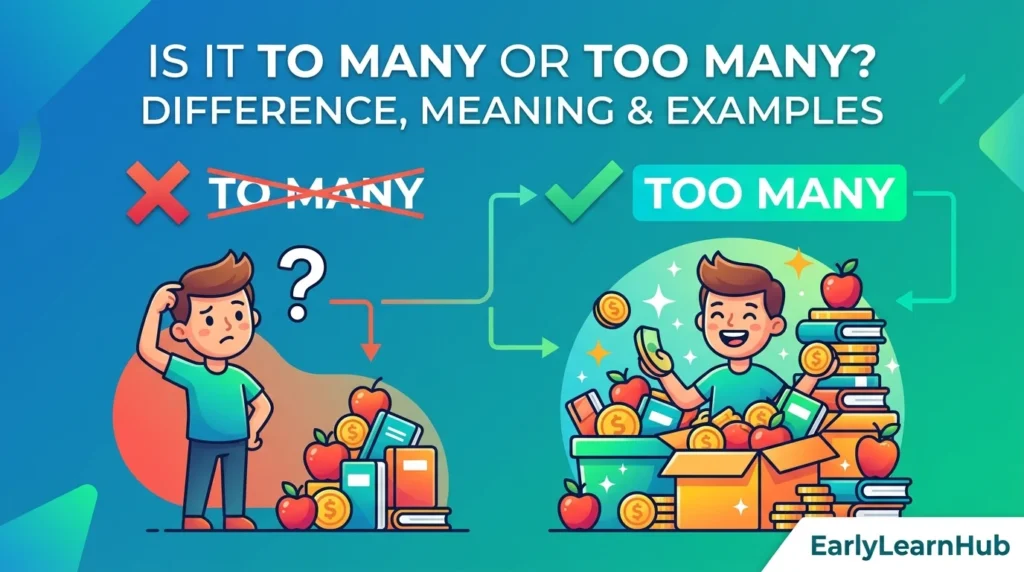
If you are unsure whether to write “to many” or “too many,” the correct choice depends on the meaning of the sentence. Use too many when you mean an excessive number of people or things. Use to many when to functions as a preposition, such as in “I spoke to many students.”
Is It “To Many” or “Too Many”?
When you mean more than necessary, wanted, suitable, or acceptable, the correct expression is too many.
- There are too many people in the room.
- I made too many mistakes.
- She bought too many books.
Cambridge Dictionary explains that too can mean “more than is needed or wanted,” while Cambridge Grammar specifically uses too many with countable nouns.
However, to many can also be grammatically correct when to is functioning as a preposition.
- I spoke to many students.
- The message was sent to many customers.
- The news was surprising to many people.
So, “to many” is not always incorrect. The two expressions have different grammatical functions and meanings.
To clarify the difference, learn how to use Wear and Where correctly in everyday English.
What Does “Too Many” Mean?
Too many means more than is needed, wanted, appropriate, or manageable.
The phrase is normally used before a plural countable noun:
- too many cars
- too many questions
- too many emails
- too many students
- too many problems
Oxford Learner’s Dictionaries explains that too many + noun means more of something than we want or need, and that too many is used with countable nouns.
For example:
There are too many cars on this street.
This means the number of cars is excessive for the situation.
What Does “To Many” Mean?
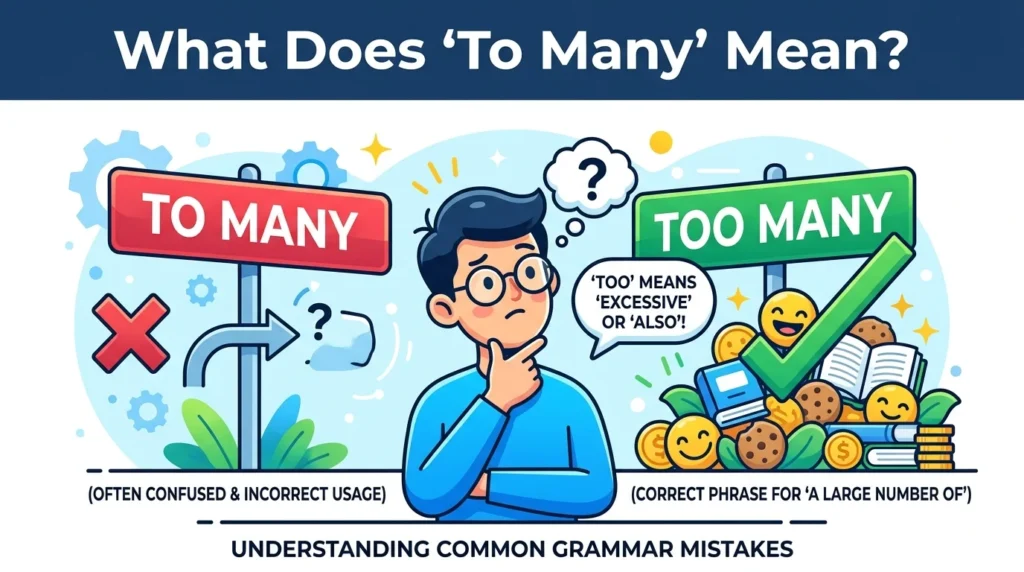
To many does not have the meaning “an excessive number.” Instead, to keeps its normal grammatical function, usually as a preposition.
For example:
I talked to many people at the conference.
Here, to indicates the people with whom the speaker talked. It does not mean “excessively.”
Other examples include:
- She gave the instructions to many employees.
- The announcement was important to many families.
- We sent invitations to many guests.
- The decision came as a surprise to many people.
In these sentences, replacing to with too would change the meaning or make the sentence incorrect.
Difference Between “To Many” and “Too Many”
The main difference is the grammatical role and meaning of to and too.
| Expression | Meaning | Example |
| too many | More than necessary or desirable | There are too many advertisements. |
| to many | To a large number of people or things | We sent the notice to many customers. |
Too is an adverb that can express excess. To commonly works as a preposition or as part of an infinitive.
A simple way to remember the difference is:
Too many = excessive number
To many = to + many
When to Use “Too Many”
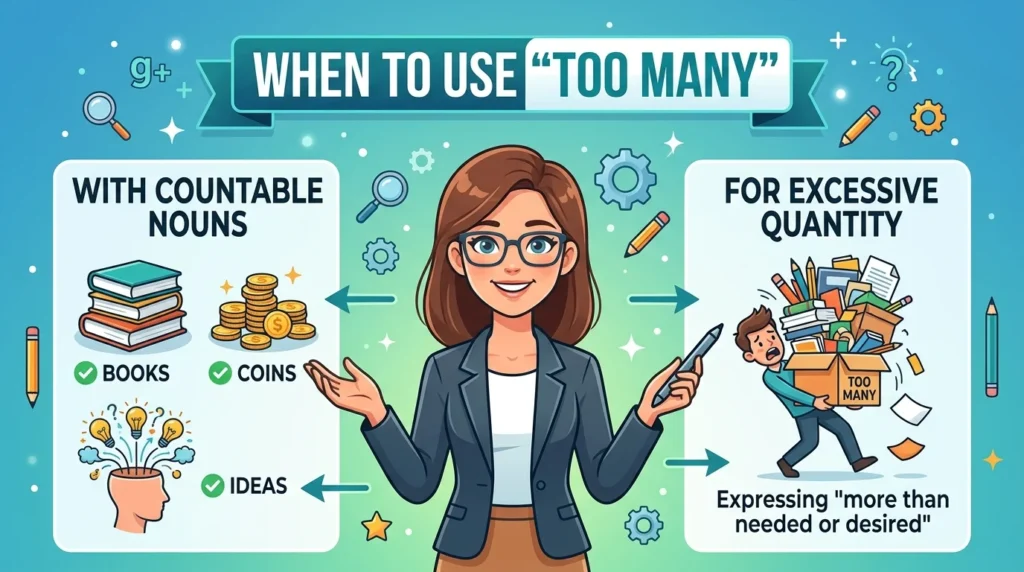
Use too many when you want to say that there is an excessive number of countable things or people.
Too Many People
There are too many people in the waiting room.
The sentence means the number of people is greater than is appropriate or manageable.
Too Many Questions
You are asking too many questions at once.
The number of questions is considered excessive.
Too Many Mistakes
The report contains too many mistakes.
The number of mistakes is greater than acceptable.
Too Many Emails
I receive too many emails every morning.
The speaker considers the number of emails excessive.
When to Use “To Many”
Use to many when to introduces a person, group, or thing connected with an action, feeling, statement, or relationship.
Examples:
She spoke to many students.
We sent the invitations to many families.
The change was confusing to many people.
He explained the problem to many customers.
In each example, to has a grammatical function independent of many.
This is why saying that “to many” is always wrong would be inaccurate. The expression can be perfectly grammatical when the sentence requires the preposition to.
Improve your vocabulary by learning how to spell Gases correctly in different English contexts.
“Too Many” With Countable Nouns
One important grammar rule is that many is used with countable nouns.
For example:
- too many books
- too many chairs
- too many students
- too many questions
- too many problems
Oxford notes that many is used with countable nouns and specifically gives examples such as “too many mistakes.”
For uncountable nouns, use too much instead:
- too much water
- too much money
- too much time
- too much information
Compare:
There are too many bottles on the table.
There is too much water in the bottle.
“Too Many” vs. “Too Much”
Both expressions indicate excess, but they are used with different types of nouns.
| Phrase | Used With | Example |
| too many | Countable nouns | too many books |
| too much | Uncountable nouns | too much information |
Cambridge and Oxford both distinguish too many for countable nouns from too much for uncountable nouns.
“To Many People” vs. “Too Many People”
These two expressions can look almost identical, but they communicate different ideas.
Too many people means the number of people is excessive:
There are too many people in the room.
To many people normally appears as part of a larger sentence where to introduces the people affected by something:
The decision was unexpected to many people.
Another example:
I explained the new policy to many people.
A useful test is to ask whether the sentence means “more than necessary.” If it does, use too many.
Common Mistakes With “To Many” and “Too Many”
Because to and too can sound alike, they are easily confused in writing.
Incorrect for Excess
There are to many students in the class.
Correct
There are too many students in the class.
Incorrect for Excess
I have to many assignments.
Correct
I have too many assignments.
Correct Use of “To Many”
The teacher spoke to many students.
Here, to is correct because it identifies the people the teacher spoke with.
How to Remember “To” vs. “Too”
Use this simple memory trick:
Too = extra
The extra o in too can remind you of something extra or excessive.
too many = more than needed
To = relationship or direction
speak to someone
give something to someone
go to a place
So:
There are too many cars.
But:
I spoke to many drivers.
The context tells you which spelling is required.
Examples of “Too Many” in Sentences
- There are too many people waiting outside.
- I have too many emails to answer.
- She bought too many clothes.
- We made too many changes to the document.
- There are too many cars on the road.
- He asked too many questions.
- The child ate too many cookies.
- We have too many meetings this week.
- The website contains too many advertisements.
- They invited too many guests to the party.
In all these examples, too many expresses an excessive number.
Examples of “To Many” in Sentences
- I spoke to many people yesterday.
- She sent the information to many customers.
- The announcement was important to many families.
- He explained the process to many students.
- We gave the invitations to many guests.
- The new rule was confusing to many employees.
- She presented the idea to many investors.
- The message was sent to many users.
- The story was familiar to many readers.
- The decision was disappointing to many fans.
In these examples, to performs its normal grammatical role and does not express excess.
Quick Test: “To Many” or “Too Many”?
Ask yourself:
Does the sentence mean “more than needed, wanted, or acceptable”?
If yes, use:
too many
If to introduces a recipient, person, relationship, or direction, use:
to many
For example:
We have too many problems.
Here, the number of problems is excessive.
We explained the problem to many people.
Here, to introduces the people who received the explanation.
Summary
Too many is the correct expression when you mean more than necessary, wanted, suitable, or acceptable. It is normally used with plural countable nouns, such as too many books, too many people, and too many mistakes.
To many can also be grammatically correct, but it has a different function. In phrases such as “speak to many people” or “send the message to many customers,” to acts as a preposition.
The easiest rule is:
Too many = an excessive number
To many = to + many
Therefore, if you are asking whether to write “to many” or “too many” when describing an excessive number, choose “too many.”
FAQs
Is “to many” or “too many” correct?
Both can be correct depending on the sentence. Use too many for an excessive number, while to many is correct when to functions as a preposition, as in “I spoke to many people.”
Is “too many” one word?
No. Too many consists of two separate words. Too expresses excess, while many refers to a large number of countable things or people.
Is “to many” grammatically incorrect?
No. To many can be grammatically correct when to has its normal function. For example, “The news was surprising to many people” is correct.
Is it “too many people” or “to many people”?
Use too many people when you mean an excessive number of people. Use to many people when to introduces the people affected by an action or statement.
Is it “too many times” or “to many times”?
Use too many times when something has happened more often than desired.
I have told him too many times.
Why are “to” and “too” confused?
They can have the same pronunciation in many contexts, even though they have different meanings and grammatical functions. This makes the mistake particularly common in writing.
Can “too many” be used without a noun?
Yes. The noun can sometimes be understood from context.
I ordered ten, but that was too many.
Here, the omitted noun might be “items,” “tickets,” “books,” or something else understood from the context.
What is the opposite of “too many”?
Depending on the context, the opposite can be too few or not enough. For example, “There are too many chairs” contrasts with “There are too few chairs” or “There are not enough chairs.” Cambridge specifically distinguishes too many, too few, too much, and too little for quantities.

Grace Holloway is a Creative Learning Designer with more than 9 years of experience producing visually engaging educational resources for preschool and kindergarten children. She specializes in combining educational principles with creative design to develop worksheets that encourage learning through play, exploration, and creativity.