
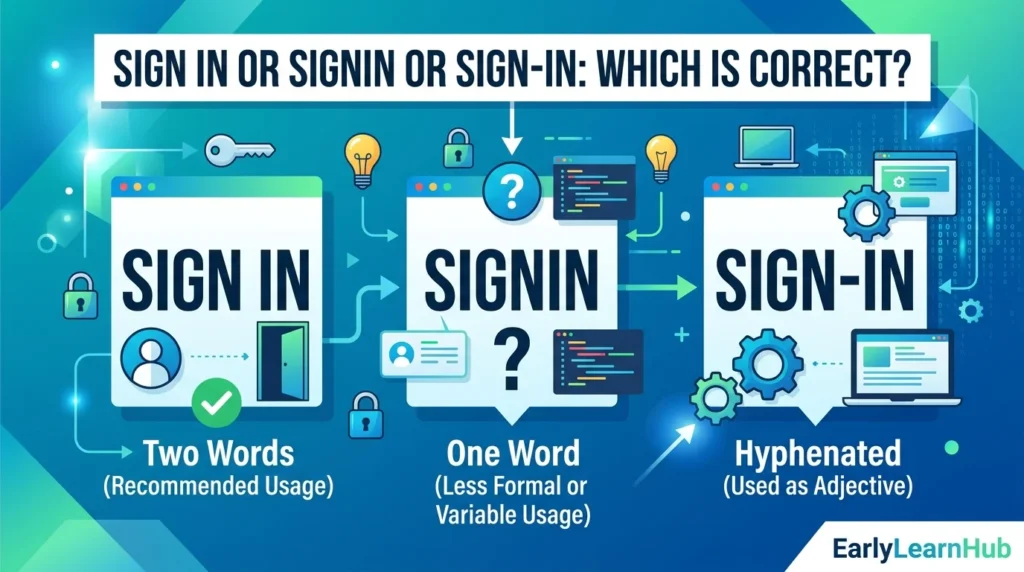
If you are unsure whether to write sign in, signin, or sign-in, the correct choice depends on how the expression is being used. In standard English, sign in is the correct form when it functions as a verb, while sign-in is commonly used as a noun or adjective. Signin as one word is generally not recommended in standard English. Major technical style guides, including Microsoft and Google, distinguish between the verb sign in and the hyphenated noun or adjective sign-in.
Is “Sign In” Correct?
Yes, sign in is correct when you are using it as a verb. It means to enter an account, computer, website, application, network, or other system by providing the required credentials.
For example:
- Please sign in to your account.
- I need to sign in before I can view the document.
- You must sign in with your username and password.
- She forgot to sign in to the application.
- Click here to sign in.
Microsoft’s style guidance specifically recommends sign in as the two-word verb form. Google similarly recommends sign in as the verb and sign-in as a noun or adjective.
What Does “Sign In” Mean?
Sign in means to enter or access a system, account, website, application, device, or network, usually by providing identifying information such as a username, email address, password, PIN, or other credentials.
The expression can also have a more traditional meaning. For example, visitors may sign in by writing their names in a register when they arrive at a building.
In modern technology-related English, however, sign in most often refers to accessing an online account or digital service.
Examples of “Sign In” as a Verb
- Please sign in to continue.
- I cannot sign in to my email account.
- You need to sign in before downloading the file.
- Did you sign in to the website?
- Remember to sign in when you arrive at work.
Is “Signin” Correct?
Signin is generally not the standard form in ordinary English. When you mean the verb, write sign in as two separate words.
For example:
- Correct: Please sign in to your account.
- Incorrect: Please signin to your account.
The form signin may sometimes appear in software interfaces, product names, URLs, code, or other technical contexts because organizations can create their own labels and identifiers. However, that does not make signin the preferred standard spelling in normal prose. Microsoft’s style guide explicitly says not to use signin, while Google’s documentation style guide also recommends sign-in for the noun or adjective and sign in for the verb.
Is “Sign-In” Correct?
Yes, sign-in is correct when it functions as a noun or adjective.
As a noun, sign-in refers to the act or process of signing in. Dictionary.com defines sign-in as an act, instance, or time of signing in.
Examples:
- The sign-in was quick and easy.
- We recorded every sign-in.
- The system keeps a record of each sign-in.
- There was a problem with my sign-in.
As an adjective, sign-in describes something associated with the process of accessing an account or system.
Examples:
- sign-in page
- sign-in screen
- sign-in process
- sign-in details
- sign-in form
- sign-in instructions
Google’s style guide explicitly gives sign-in as the noun or adjective form and sign in as the verb.
Sign In vs. Sign-In vs. Signin
The easiest way to remember the difference is to identify the grammatical function.
| Form | Main use | Example |
| sign in | Verb | Please sign in to your account. |
| sign-in | Noun | The sign-in was successful. |
| sign-in | Adjective | Open the sign-in page. |
| signin | Generally avoid | Please sign in to continue. |
Therefore, if you are describing an action, use sign in. If you are describing the process, event, or something related to signing in, sign-in may be appropriate.
When to Use “Sign In”
Use sign in when the phrase is functioning as a verb.
A useful test is to see whether you can put a subject before it and describe an action.
For example:
- I sign in every morning.
- She signed in at 9:00.
- They need to sign in first.
- We will sign in after opening the app.
Here, sign in describes an action, so it should remain two words.
More Examples
- Sign in to access your profile.
- I cannot sign in with my old password.
- Please sign in before starting the test.
- He signed in using his Google account.
- You can sign in from any device.
When to Use “Sign-In”
Use sign-in when it functions as a noun or modifies another noun.
Sign-In as a Noun
- The sign-in took less than a minute.
- Your sign-in was unsuccessful.
- The system recorded the sign-in.
- We need to verify your sign-in.
- There were several failed sign-ins.
Sign-In as an Adjective
- Visit the sign-in page.
- The sign-in screen is not loading.
- Check the sign-in instructions.
- Enter your information on the sign-in form.
- The website has a new sign-in process.
Sign In or Sign Into?
A common related question is whether you should write sign in to or sign into.
For standard technical writing, sign in to is the preferred construction when to introduces the destination or account.
For example:
- Correct: Sign in to your account.
- Correct: Please sign in to the website.
- Correct: I need to sign in to Gmail.
- Avoid in formal style: Sign into your account.
Microsoft and Google both recommend sign in to rather than sign into in their style guidance.
The distinction is easier to see when you separate the verb from the preposition:
sign in + to + account
Please sign in to your account.
Sign In vs. Login
Sign in and login are closely related, but they have different grammatical patterns.
Sign in is normally written as two words when it is a verb:
Please sign in to your account.
Login is commonly used as a noun:
I forgot my login.
Dictionary.com defines login as the act of logging into a computer system and can also use it for the username and password that provide access.
Different organizations may choose different terminology in their interfaces. Therefore, if a particular website or application labels its button Login, Log In, or Sign In, follow that product’s established terminology for the interface.
Sign In or Sign-In in Titles
When writing a title or heading, capitalization depends on the style being used.
For example:
- Sign In or Sign-In: Which Is Correct?
- How to Sign In to Your Account
- Sign-In Instructions
- Sign-In Page Problems
In a title using title case, Sign In can appear with both words capitalized because it is a verb phrase. For the hyphenated adjective, Sign-In is also commonly capitalized in title case.
Common Mistakes With Sign In
Mistake 1: Using “signin” as a verb
Incorrect:
Please signin to your account.
Correct:
Please sign in to your account.
Mistake 2: Using “sign-in” as the verb
Incorrect:
I need to sign-in now.
Correct:
I need to sign in now.
Mistake 3: Using “sign into” in formal technical writing
Less preferred:
Sign into your account.
Preferred:
Sign in to your account.
Mistake 4: Writing “sign in page”
When the phrase modifies another noun, the hyphen can make the relationship clearer.
Preferred:
sign-in page
Preferred:
sign-in form
Preferred:
sign-in screen
Google’s style guidance specifically identifies sign-in as the noun or adjective form.
Quick Rule to Remember
Use this simple rule:
Sign in = verb
Please sign in.
Sign-in = noun or adjective
The sign-in failed.
Open the sign-in page.
Signin = generally avoid in standard prose
Avoid signin when writing the ordinary English term.
This distinction is supported by major technology writing guides. Microsoft recommends sign in for the verb and advises against signin, while Google recommends sign-in for noun and adjective uses.
Summary
Sign in is the correct two-word form when the phrase is used as a verb.
Use sign-in when it functions as a noun or adjective, such as sign-in process, sign-in page, or the sign-in was successful.
Signin is generally not recommended in standard English prose, although it can appear in specific software interfaces, technical identifiers, or product terminology.
The simplest rule is: use “sign in” for the action and “sign-in” for a noun or modifier.
Frequently Asked Questions
Is “sign in” one word or two words?
Sign in is two words when it functions as a verb. For example, “Please sign in to your account.”
Is “signin” grammatically correct?
Signin is generally not the preferred standard form in English prose. Use sign in as a verb and sign-in as a noun or adjective.
Is “sign-in” hyphenated?
Yes. Sign-in is commonly hyphenated when used as a noun or adjective, such as sign-in page or the sign-in was successful.
Should I write “sign in to” or “sign into”?
For standard technical writing, sign in to is preferred. For example, “Sign in to your account.”
Is “sign in” a verb?
Yes. Sign in is a phrasal verb meaning to access a system, account, website, or other service, often by providing credentials.
Is “sign-in” a noun?
Yes. Sign-in can be a noun referring to the act or process of signing in.
Which is correct, “sign in page” or “sign-in page”?
Sign-in page is the clearer standard form because sign-in functions as an adjective modifying page.
Which is correct, “I need to sign in” or “I need to sign-in”?
The correct form is “I need to sign in.” The verb is written as two words.
Is “Sign In” correct for a website button?
Yes. Sign In is a standard and widely understood label for a button that lets users access an existing account. Interface terminology can vary by product, so consistency with the site’s established terminology is also important.
Is “sign-in” the same as “login”?
They have essentially the same general function in modern technology contexts, but their grammatical forms differ. Sign in is normally the verb, while login is commonly used as a noun.

Ethan Richardson is an Educational Content Editor with more than 10 years of experience reviewing and developing educational materials for young learners. His expertise includes improving worksheet accuracy, readability, and instructional quality while ensuring learning resources meet modern educational standards.