
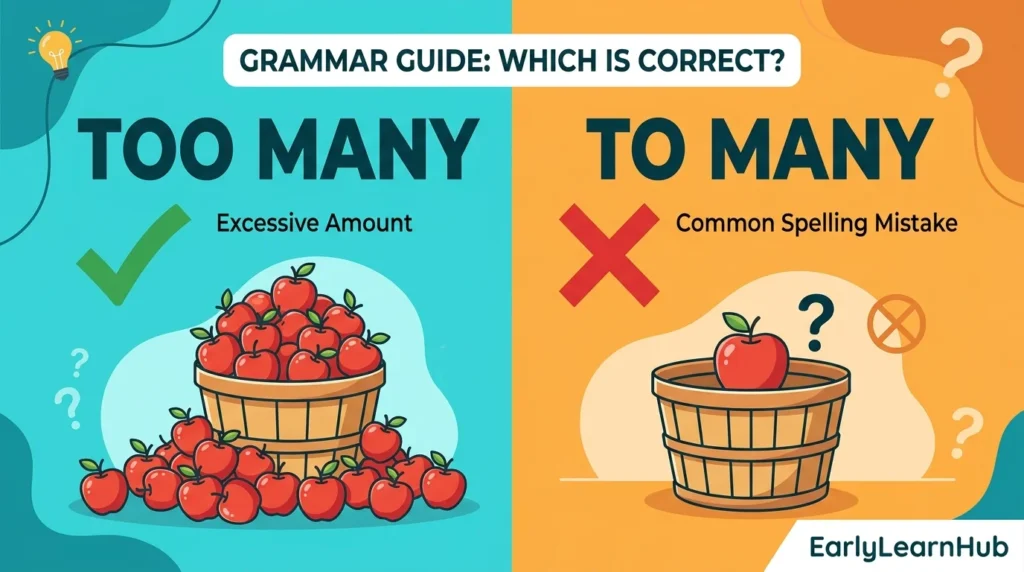
vvvvIf you are trying to express the idea of more people or things than are needed, wanted, or suitable, the correct phrase is “too many.” The phrase “to many” is not interchangeable with it, although “to many” can be grammatically correct when to functions as a preposition. Cambridge Dictionary defines “too many” as meaning more of something than is needed, wanted, or suitable.
Is “Too Many” or “To Many” Correct?
“Too many” is correct when you mean an excessive number.
For example:
- There are too many people in this room.
- I have too many emails to answer.
- She bought too many books.
- We made too many mistakes.
In these sentences, too expresses excess, while many refers to a countable number.
“To many” can also be grammatically correct, but it has a different meaning. Here, to normally functions as a preposition.
For example:
- I sent the invitations to many people.
- The announcement was important to many employees.
- She spoke to many students.
The Canadian government’s language guidance explains that to, too, and two are homophones, meaning they sound alike but have different spellings and meanings.
Understanding Focuses or Foci differences in English can help you choose the correct plural form in academic writing.
What Does “Too Many” Mean?
Too many means more than is needed, wanted, appropriate, or suitable.
The word too is an adverb that can express an excessive degree. Cambridge specifically explains that too many is used for quantities that are more than enough and that it normally comes before a countable noun.
For example:
There are too many cars on this road.
This means there are more cars than the speaker considers appropriate or manageable.
Other examples include:
- There are too many students in the classroom.
- I received too many messages today.
- We have too many assignments this week.
- He made too many mistakes.
- She owns too many shoes.
Merriam-Webster also gives examples such as “You gave me too many cards,” demonstrating the standard use of too many to describe an excessive quantity.
What Does “To Many” Mean?
To many is not an alternative spelling of too many.
It can be correct when to acts as a preposition and many refers to a group of people or things.
For example:
The teacher gave the worksheets to many students.
Here, to introduces the recipients of the worksheets. The sentence does not say that the number of students was excessive.
Other examples:
- The news was surprising to many people.
- We sent the information to many customers.
- She spoke to many visitors.
- This problem is familiar to many students.
- The decision was important to many families.
Compare:
There were too many students in the classroom.
This means the number of students was excessive.
The teacher spoke to many students.
This simply means the teacher spoke with a large number of students.
Difference Between “Too Many” and “To Many”
The easiest way to understand the difference is to focus on the function of too and to.
| Phrase | Meaning | Example |
| too many | More than needed or suitable | There are too many people here. |
| to many | To a large number of people or things | She explained the rule to many students. |
“Too Many” Expresses Excess
Use too many when the quantity is greater than what is wanted, needed, allowed, or suitable.
Examples:
- We have too many meetings this week.
- There are too many advertisements on this website.
- He asked too many questions.
- I ate too many cookies.
- They bought too many tickets.
“To Many” Shows a Relationship or Recipient

Use to many when to introduces people or things connected to an action or idea.
Examples:
- She sent the message to many friends.
- The rule is confusing to many students.
- The offer appealed to many customers.
- He explained the problem to many people.
- The change was unexpected to many employees.
Knowing the correct usage of If Time Permits and If Time Allows helps prevent common mistakes in professional writing.
“Too Many” With Countable Nouns
Too many is generally used with plural countable nouns.
Countable nouns are things that can be counted individually, such as:
- books
- people
- cars
- students
- questions
- emails
- mistakes
- chairs
Examples:
- There are too many books on the table.
- She asked too many questions.
- We received too many emails.
- There are too many cars outside.
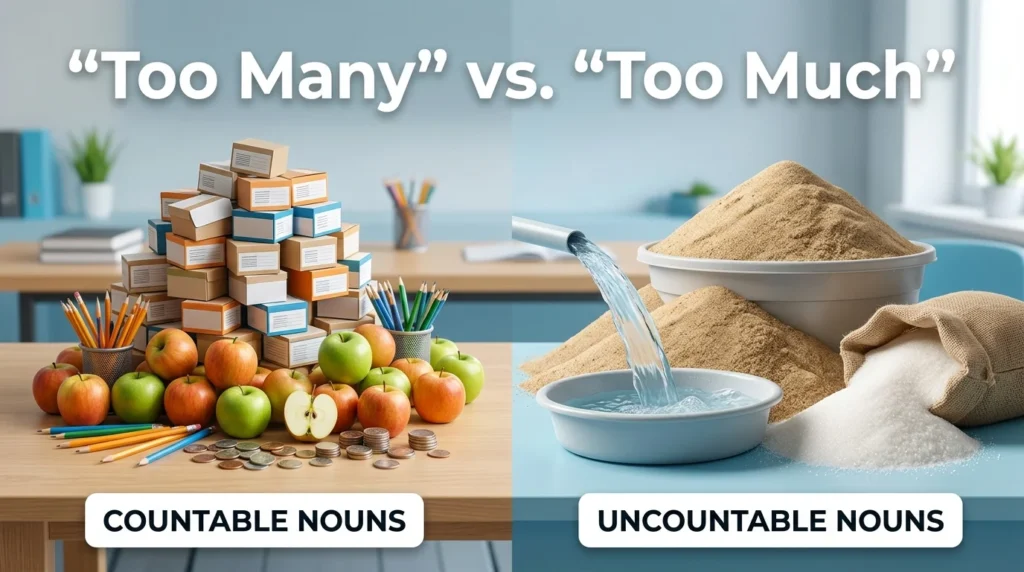
Cambridge distinguishes too many from too much, explaining that too many is used with countable nouns, while too much is used with uncountable nouns.
“Too Many” vs. “Too Much”
These expressions are related, but they are used differently.
Too many is used with plural countable nouns:
There are too many chairs.
Too much is used with uncountable nouns:
There is too much water.
More examples:
- Too many books
- Too many people
- Too many questions
- Too much information
- Too much traffic
- Too much noise
The choice depends on whether the noun can normally be counted as individual items.
Examples of “Too Many” in Sentences
Here are some natural examples:
- There are too many people waiting outside.
- I have too many things to do today.
- She made too many mistakes on the test.
- We bought too many apples.
- There are too many advertisements on this page.
- He spends too many hours playing video games.
- The teacher gave us too many assignments.
- I received too many messages this morning.
- They invited too many guests to the party.
- There are too many choices on the menu.
Examples of “To Many” in Sentences
“To many” is correct when to has its normal grammatical function.
- She spoke to many people at the event.
- The message was confusing to many readers.
- We sent invitations to many families.
- The new rule is unfamiliar to many students.
- He explained the situation to many customers.
- The decision came as a surprise to many employees.
- This book is useful to many teachers.
- The program provides assistance to many families.
- She introduced herself to many guests.
- The announcement was important to many members.
“Too Many People” vs. “To Many People”
This is one of the clearest ways to see the difference.
Too many people means an excessive number of people:
There are too many people in the room.
To many people means something applies, is communicated, or is directed toward many people:
The announcement was important to many people.
The two phrases sound similar, but their grammatical functions are completely different.
Common Mistakes With “Too Many” and “To Many”
Incorrect: There are to many students here.
Correct: There are too many students here.
The sentence expresses excess, so too is required.
Incorrect: She sent the email too many customers.
Correct: She sent the email to many customers.
Here, to introduces the recipients.
Incorrect: I have to many books.
Correct: I have too many books.
The intended meaning is that the number of books is excessive.
Incorrect: The information is important too many people.
Correct: The information is important to many people.
Here, to connects “important” with the people affected by the statement.
How to Remember “Too Many”
A simple memory trick is to associate the extra o in too with something extra.
Too many = an extra or excessive number.
For example:
Too many emails = more emails than you want.
Too many meetings = more meetings than you need.
Too many questions = more questions than are appropriate.
This is consistent with the meaning of too as “more than enough” or excessive.
Is “To Many” Always Wrong?
No. Saying that to many is always incorrect would be misleading.
It is perfectly grammatical when to functions as a preposition.
For example:
I gave the documents to many employees.
The change was beneficial to many people.
She talked to many customers.
However, if you are trying to say “more than necessary”, then too many is the correct form.
Quick Rule
Use too many when you mean:
more than needed, wanted, suitable, or acceptable
There are too many cars.
Use to many when to introduces a recipient, group, relationship, or destination:
I spoke to many people.
A useful test is to replace the phrase with “more than enough.” If that meaning works, use too many.
There are more than enough people here.
There are too many people here. ✅
But:
I spoke more than enough people.
This does not have the same grammatical structure as “I spoke to many people,” so to many is needed there.
Summary
Too many is the correct choice when you mean an excessive number of people or things. It is normally used before plural countable nouns, such as too many books, too many students, and too many mistakes. Cambridge Dictionary defines it as more of something than is needed, wanted, or suitable.
To many is also grammatically possible, but it has a different function. In expressions such as “to many people” or “to many students,” the word to acts as a preposition.
The easiest rule is:
Too many = an excessive number.
To many = to a large number of people or things.
Therefore, if you are asking whether the phrase meaning “more than necessary” should be spelled “too many” or “to many,” the answer is too many.
Is “too many” correct?
Yes. Too many is correct when you mean more people or things than are needed, wanted, or suitable.
Is “to many” grammatically correct?
Yes, in certain sentence structures. For example, “The message was sent to many people.” Here, to is a preposition.
Is it “too many people” or “to many people”?
Both can be correct, but they have different meanings. Too many people means an excessive number of people. To many people means to or for a large number of people.
Is it “too many times” or “to many times”?
Use too many times when you mean something happened more often than desired.
I have told him too many times.
What is the difference between “too” and “to”?
Too can express excess, as in “too many,” while to commonly functions as a preposition or as part of an infinitive. The words are pronounced alike in many contexts but have different meanings and spellings.
Can I say “too many” without a noun?
Yes. When the noun is understood, too many can stand alone.
We ordered ten pizzas, but that was too many.
Is “too many” used with countable nouns?
Yes. Use too many with plural countable nouns.
too many books
too many students
too many questions
Should I use “too much” instead of “too many”?
Use too much with uncountable nouns and too many with plural countable nouns.
too much water
too many bottles
Why do people confuse “too many” and “to many”?
The words to and too are homophones in many contexts, so they sound alike even though their meanings and grammatical functions differ.
What is the easiest way to remember “too many”?
Remember the extra o in too as representing something extra. If you mean more than needed, choose too many.

Ethan Richardson is an Educational Content Editor with more than 10 years of experience reviewing and developing educational materials for young learners. His expertise includes improving worksheet accuracy, readability, and instructional quality while ensuring learning resources meet modern educational standards.