
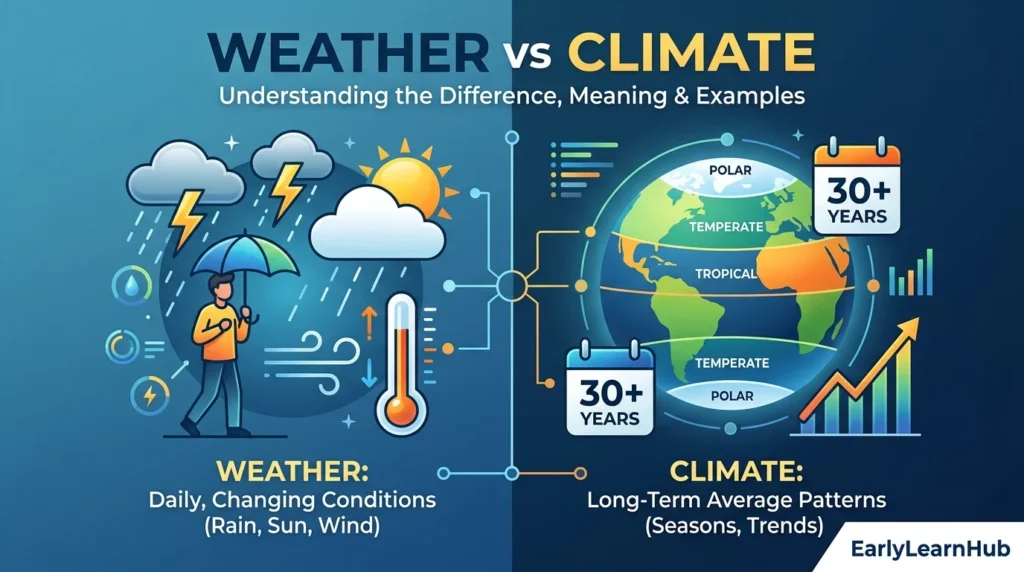
Weather and climate are related terms, but they describe different aspects of Earth’s atmosphere. Weather refers to short-term atmospheric conditions, while climate describes typical weather patterns over a much longer period. Understanding the difference helps you use both terms correctly in everyday and scientific contexts.
Is It Weather or Climate?
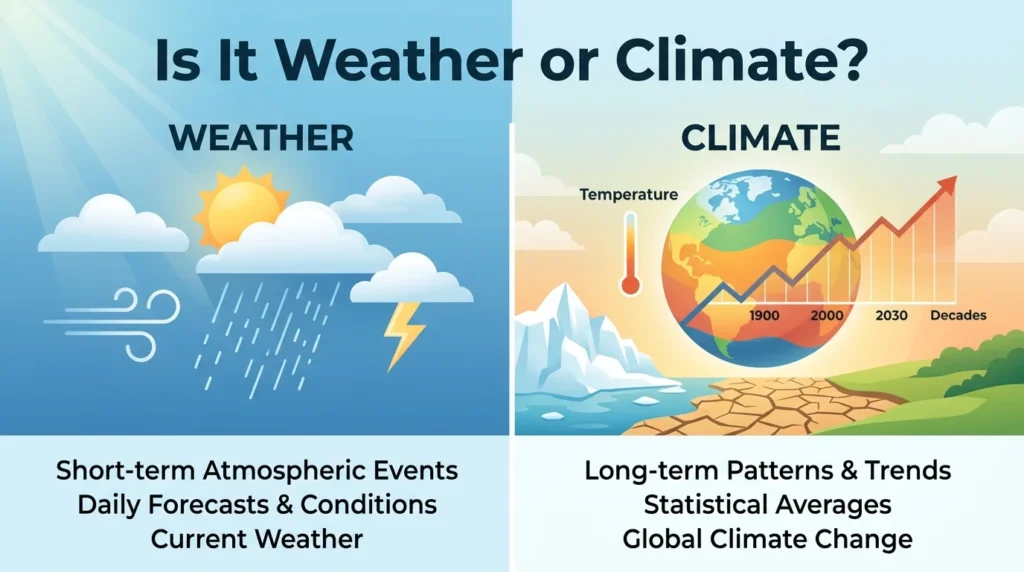
Both weather and climate are correct words, but they are not interchangeable. The correct choice depends on whether you are talking about short-term atmospheric conditions or long-term patterns.
Use weather when referring to what is happening or expected to happen over a short period, such as today’s temperature, tomorrow’s rain, or a thunderstorm.
Use climate when discussing the usual or average weather conditions of a place over many years, commonly using a 30-year period for climate normals.
Clarify the commonly confused words with Latter or Ladder and learn when each term is appropriate.
What Is the Difference Between Weather and Climate?
The main difference between weather and climate is time scale.
Weather describes atmospheric conditions at a particular time and place. It can change within minutes, hours, days, or weeks.
Climate describes the long-term pattern or average of weather conditions in a particular region. Scientists commonly examine periods of about 30 years or more when describing climate.
A simple way to remember the distinction is:
Weather is what you get; climate is what you generally expect.
What Does Weather Mean?
Weather means the condition of the atmosphere at a specific time and location. It includes factors such as temperature, precipitation, humidity, wind, cloud cover, and atmospheric pressure.
Weather can change quickly. A morning can be sunny, followed by rain in the afternoon and thunderstorms in the evening.
Examples of Weather
- It is raining heavily today.
- The temperature is 35°C this afternoon.
- A thunderstorm is moving through the area.
- Strong winds are expected tonight.
- Snow fell overnight.
- Tomorrow will be cloudy and cool.
Each example describes a short-term atmospheric condition.
What Does Climate Mean?
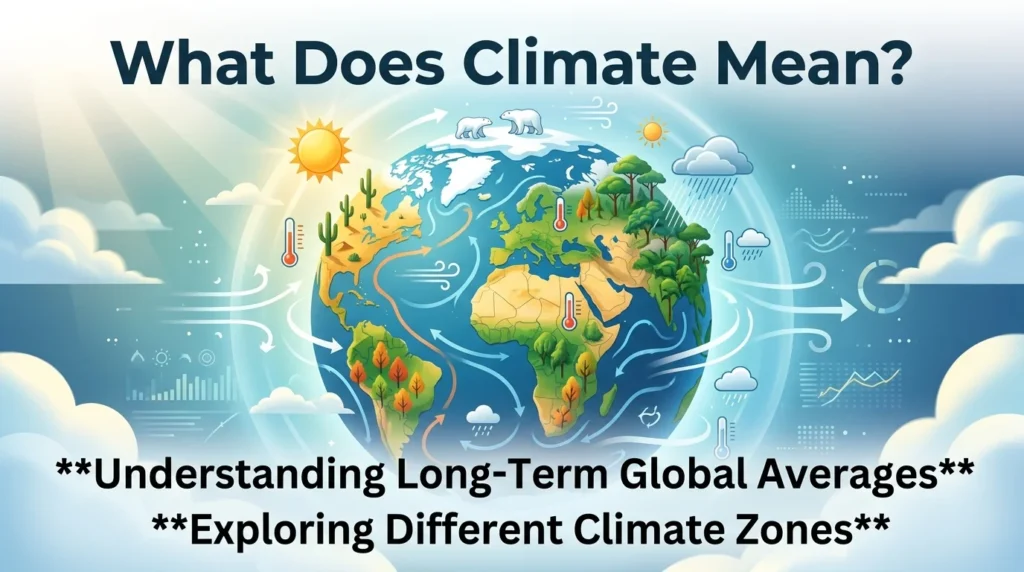
Climate means the typical pattern of weather in a particular place over a long period. It can describe average temperature, precipitation, humidity, wind patterns, and other atmospheric characteristics.
Climate can be described for a city, region, continent, or the entire planet. For example, deserts generally have dry climates, while tropical regions tend to have warm conditions and substantial rainfall.
Examples of Climate
- The Sahara has a hot, dry climate.
- Tropical regions generally have warm conditions throughout much of the year.
- Antarctica has an extremely cold climate.
- A region may have hot, humid summers and cold winters.
- A place may typically receive heavy rainfall during a particular season.
These statements describe long-term patterns rather than conditions on one particular day.
Learn to avoid spelling confusion by understanding Suing or Sueing and identifying the correct form.
Weather vs Climate Examples
Consider these examples:
| Statement | Correct Term | Why? |
| It is raining today. | Weather | It describes current conditions. |
| Tomorrow will be very hot. | Weather | It refers to a short-term forecast. |
| This region usually has dry summers. | Climate | It describes a recurring seasonal pattern. |
| Winters here are generally cold and snowy. | Climate | It describes typical conditions over many years. |
| A hurricane is approaching the coast. | Weather | It describes a specific atmospheric event. |
| This area has a tropical climate. | Climate | It describes the area’s long-term conditions. |
Weather can provide individual observations that, when collected over many years, contribute to our understanding of climate.
Weather and Climate in a Sentence
Here are some natural examples showing how to use both words correctly:
Weather:
- “The weather is rainy today.”
- “We checked the weather before leaving home.”
- “The weather forecast says temperatures will drop tonight.”
Climate:
- “The region has a warm climate.”
- “The country’s climate varies from north to south.”
- “Farmers consider the local climate when choosing crops.”
You can also use both terms in one sentence:
“Although the weather is unusually cold today, the region has a generally warm climate.”
This sentence demonstrates the key distinction: today’s cold conditions are weather, while the region’s long-term pattern is its climate.
Weather vs Climate: Which One Should You Use?
Ask yourself how long the situation lasts.
If you are describing what is happening now, today, this week, or in the near future, use weather.
If you are describing what is typical or expected over many years, use climate.
For example:
- “What is the weather like today?”
- “What is the climate like in this region?”
Both questions are grammatically correct, but they ask for different types of information.
Does Weather Affect Climate?
Weather observations help scientists understand climate because climate is determined from long-term observations and statistical patterns of weather.
A single unusually hot day does not, by itself, establish a change in climate. Scientists examine weather measurements over much longer periods to identify changes in averages, patterns, variability, and extremes.
This is why a short-term weather event and a long-term climate trend should not be treated as the same thing.
Weather vs Climate and Climate Change
Climate change refers to long-term changes in climate patterns, rather than a single unusual weather event. NASA describes climate as long-term averages and patterns of temperature, rainfall, and other atmospheric conditions, while weather occurs over much shorter periods.
For example, one unusually cold day is a weather event. A persistent change in long-term temperature or precipitation patterns is relevant to climate.
This distinction is important because individual weather events and long-term climate trends operate on different time scales.
Summary
Weather and climate are both correct terms, but they have different meanings. Weather describes short-term atmospheric conditions at a particular place and time, while climate describes long-term patterns and averages. Weather can change from hour to hour or day to day, whereas climate is evaluated over much longer periods, commonly around 30 years.
The easiest way to remember the difference is: weather describes what is happening, while climate describes what is typical over time.
Is weather and climate the same thing?
No. Weather describes short-term atmospheric conditions, while climate describes long-term patterns and averages of weather.
What is the main difference between weather and climate?
The main difference is the time scale. Weather changes over short periods, while climate describes conditions and patterns over many years.
Is rain weather or climate?
Rain occurring today or this week is weather. A region’s typical rainfall pattern over many years is part of its climate.
Is temperature weather or climate?
Temperature can describe either weather or climate. Today’s temperature is weather, while the long-term average temperature of a region is part of its climate.
Can weather change climate?
Individual weather events do not by themselves define climate. Long-term observations of weather help scientists identify climate patterns and changes.
What is an easy way to remember weather vs climate?
Think of weather as what you get and climate as what you expect based on long-term patterns.

Ethan Richardson is an Educational Content Editor with more than 10 years of experience reviewing and developing educational materials for young learners. His expertise includes improving worksheet accuracy, readability, and instructional quality while ensuring learning resources meet modern educational standards.