
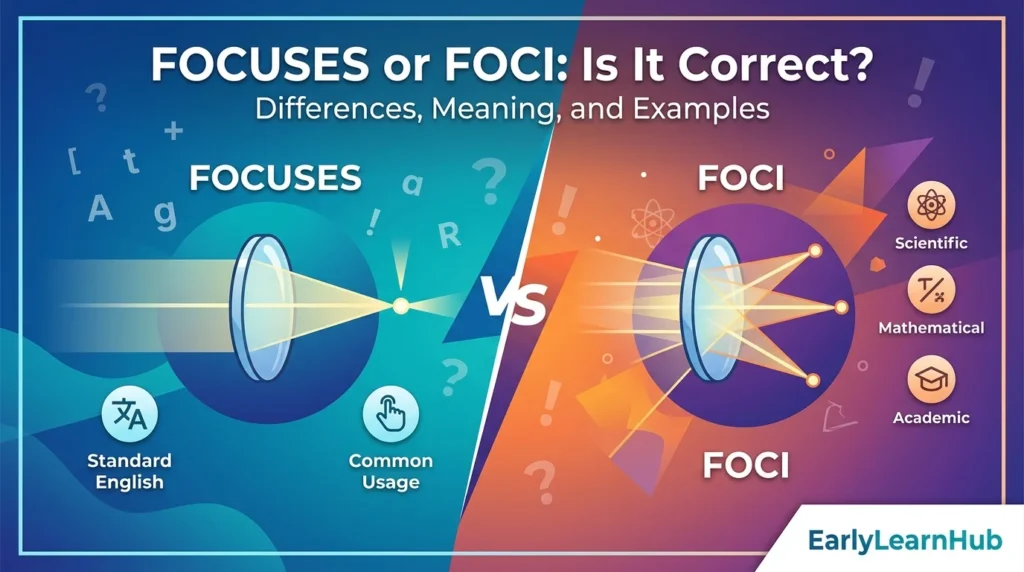
Both focuses and foci are correct plural forms of focus. The choice depends largely on context and style. Foci is the traditional plural and is especially common in formal, scientific, mathematical, and technical writing, while focuses is widely accepted in general English. Major dictionaries, including Merriam-Webster, Cambridge, and Oxford, recognize both forms.
Focuses or Foci: Which Is Correct?
Both are correct.
- Focus = singular
- Focuses = plural
- Foci = plural
For example:
- The main focus of the meeting was education.
- The main focuses of the meeting were education and healthcare.
- The researchers identified several foci of interest.
Cambridge specifically lists focuses as the ordinary plural and foci as the formal plural. Oxford also gives both focuses and foci as plural forms.
What Does Focus Mean?
The noun focus refers to a central point, main subject, area of attention, or point of concentration. It can also have specialized meanings in fields such as optics, mathematics, medicine, and physics.
For example:
The focus of the discussion was climate change.
Here, focus means the main subject of the discussion.
In a scientific context, focus can refer to a specific point where light, heat, or other rays converge or appear to diverge.
What Does Focuses Mean?
Focuses has two possible grammatical uses.
Focuses as a plural noun
As a noun, focuses means more than one focus.
Examples:
- The report identifies several focuses for future research.
- The project has three main focuses.
- The conference has different focuses each year.
Although grammatically correct, focuses can sometimes sound less formal than foci, particularly in academic or scientific writing.
Focuses as a verb
Focuses is also the third-person singular present form of the verb focus.
Examples:
- She focuses on improving her writing.
- The camera focuses automatically.
- The company focuses on customer service.
Cambridge provides examples of focuses functioning as a verb, such as “The study focuses on…”
Therefore, context is important. Focuses does not always mean the plural noun.
What Does Foci Mean?
Foci is a plural noun meaning more than one focus. It is the traditional plural form derived from Latin and is particularly common in formal and specialized English. Cambridge explicitly labels foci as formal.
Examples:
- The researchers examined several foci of infection.
- The ellipse has two foci.
- The study identified several research foci.
- The treatment targeted multiple foci within the affected area.
Merriam-Webster also lists foci as the plural of focus, while noting that focuses is also used.
Focuses vs Foci: Main Differences
| Word | Grammatical use | Meaning | Typical context |
| Focus | Singular noun | One central point or subject | General English |
| Focuses | Plural noun | More than one focus | General English |
| Focuses | Verb | Directs attention | Everyday and formal English |
| Foci | Plural noun | More than one focus | Formal, scientific, mathematical, technical writing |
The most important distinction is that foci can only function as the plural noun, whereas focuses can be either a plural noun or a verb.
When Should You Use Foci?
Use foci when writing in a formal or specialized context, particularly when discussing multiple technical points or centers.
For example:
- The study examined three major research foci.
- The ellipse contains two foci.
- The scientists identified multiple foci of infection.
- The paper discusses several theoretical foci.
The word is especially natural in mathematics. In geometry, for example, an ellipse is commonly described as having two foci.
When Should You Use Focuses?
Use focuses when writing general English or when the word is being used as a verb.
Examples:
- The course has several main focuses.
- The organization has two primary focuses.
- She focuses on grammar and vocabulary.
- The article focuses on common spelling mistakes.
In everyday writing, focuses is often easier for readers to understand because it follows the familiar English plural pattern.
Is Foci More Correct Than Focuses?
No. Foci is not more grammatically correct than focuses.
Both are accepted plural forms. Merriam-Webster lists foci and focuses, while Oxford lists both as plural forms. Cambridge similarly gives focuses as the standard plural and foci as a formal alternative.
The difference is primarily one of usage, register, and context.
For general readers, focuses is often the clearer choice. For technical or academic contexts, foci may sound more conventional.
Examples of Focuses and Foci
Examples of focuses as a plural noun
- The program has three main focuses.
- The organization has several focuses for the coming year.
- The conference brings together different research focuses.
- The course has two primary focuses.
Examples of focuses as a verb
- The teacher focuses on practical grammar.
- The study focuses on language development.
- She focuses carefully on each detail.
- The camera focuses on the subject automatically.
Examples of foci as a plural noun
- The researchers identified several foci of infection.
- The ellipse has two foci.
- The paper examines different research foci.
- The scientists studied multiple foci within the sample.
Focuses or Foci in Academic Writing
Both forms can appear in academic writing, but foci is often preferred when referring to several distinct areas of research or specialized points.
For example:
The researchers identified three major research foci.
However, there is nothing grammatically wrong with:
The researchers identified three major research focuses.
The best choice depends on the discipline, audience, and house style. Cambridge describes foci as formal, which helps explain why it appears more frequently in specialized contexts.
Focuses or Foci in Mathematics
In mathematics, foci is the conventional plural of focus.
For example:
An ellipse has two foci.
This is a specialized mathematical meaning, so foci is the natural choice.
Merriam-Webster defines foci in geometry as the two points associated with an ellipse, reinforcing its established technical use.
Focuses or Foci in Science and Medicine
In scientific and medical writing, foci is also common when referring to multiple specific locations or points.
Examples include:
- multiple foci of infection
- several foci of abnormal activity
- different foci of inflammation
This specialized usage is reflected in dictionary examples and medical definitions of focus.
A Simple Way to Remember the Difference
Think of it this way:
Focus → one
Focuses → more than one, or a verb
Foci → more than one, formal or technical
For ordinary writing, focuses is usually straightforward:
The project has several focuses.
For technical writing:
The project has several research foci.
Both sentences can be grammatically correct.
Common Mistakes
A common mistake is assuming that foci is the only correct plural because focus comes from Latin.
That is not true in modern English. English has accepted focuses as a regular plural alongside the traditional foci. Major dictionaries explicitly recognize both.
Another mistake is confusing the noun focuses with the verb focuses.
Compare:
- The report has several focuses.
Here, focuses is a plural noun. - The report focuses on education.
Here, focuses is a verb.
Summary
Focuses and foci are both correct plural forms of focus. Use focuses for general English and when the word is functioning as a verb. Use foci when a formal, scientific, mathematical, or technical style is appropriate. Dictionaries such as Merriam-Webster, Cambridge, and Oxford all recognize the two plural forms.
The simplest rule is: focus is singular, focuses and foci are plural, but focuses can also be a verb.
Is “focuses” correct?
Yes. Focuses is a correct plural noun and is also the third-person singular form of the verb focus.
Is “foci” correct?
Yes. Foci is the traditional and formal plural of focus. It is especially common in scientific, mathematical, and technical contexts.
What is the plural of focus?
The plural can be focuses or foci. Both forms are recognized by major English dictionaries.
Is foci more formal than focuses?
Yes. Foci is generally regarded as the more formal or specialized form, while focuses is common in general English. Cambridge specifically labels foci as formal.
What is the difference between focuses and foci?
When both are nouns, they have the same basic plural meaning. Foci is more formal and technical, while focuses is more common in general English. Focuses can also be a verb, but foci cannot.
Which is better in academic writing, focuses or foci?
Either can be correct, but foci may be preferable in highly formal or specialized academic contexts. Focuses is also grammatically acceptable.
What is the singular of foci?
The singular of foci is focus.
Can focuses be a verb?
Yes. For example, “The study focuses on language development.” Here, focuses is the third-person singular present form of the verb focus.
Which should I use, focuses or foci?
Use focuses for most general writing. Choose foci when writing in a formal, scientific, mathematical, or technical context where that traditional plural is more natural.

Olivia Bennett is an Early Childhood Curriculum Specialist with more than 11 years of experience creating educational resources for preschool and kindergarten learners. She specializes in developing engaging worksheets that strengthen early literacy, numeracy, handwriting, fine motor skills, and problem solving through age appropriate activities.
4 thoughts on “Focuses or Foci: Is It Correct? Differences, Meaning, and Examples”