
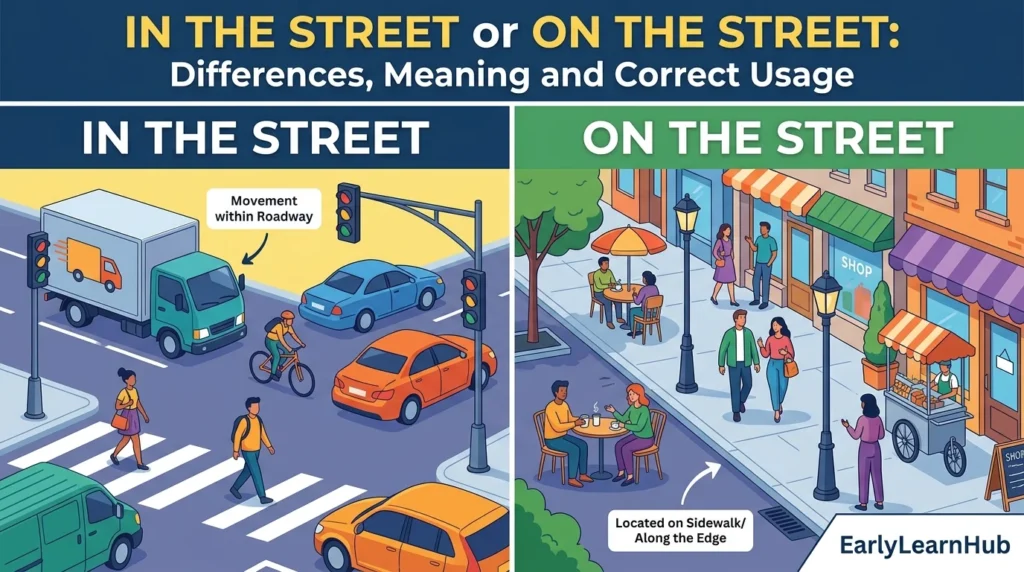
Both “in the street” and “on the street” are grammatically correct. The better choice depends on what you mean and, in some cases, which variety of English you are using.
In general, on the street is the usual choice in American English for a street location, address, or general presence along a street. In the street can emphasize being within the roadway itself. However, British English uses in the street more broadly for ordinary street locations, so regional usage matters.
Is “In the Street” or “On the Street” Correct?
Both expressions are correct, but they are not always interchangeable.
Use on the street when you are talking about a location along a street, a street address, or something generally situated on or beside the street.
- I live on Oak Street.
- There is a new restaurant on this street.
- I met Sarah on the street.
Use in the street when you want to emphasize that someone or something is physically within the street or roadway.
- The children were playing in the street.
- A dog was running in the street.
- There was an accident in the street.
Oxford’s dictionary evidence also shows that on is firmly established in common street expressions, including “on the streets” and “the man in the street,” demonstrating that preposition choice depends heavily on the particular expression.
What Does “In the Street” Mean?
In the street is a prepositional phrase. Here, in presents the street as an area or space in which someone or something is located.
It often suggests that a person or object is actually within the roadway rather than simply being somewhere along the street.
Examples of “In the Street”
- The children were playing in the street.
- A cyclist was lying in the street.
- Someone left a box in the street.
- The protesters gathered in the street.
- A car stopped in the street.
The phrase can therefore create a stronger sense of physical presence within the street area.
“In the Street” in British English
There is an important regional difference. British English commonly uses in the street for general street location, including situations where American English would normally use on the street.
For example, a British speaker may naturally say:
We were talking in the street.
This does not necessarily mean that the speakers were standing in the traffic lane. It can simply mean that they were outside on the street.
What Does “On the Street” Mean?
On the street is also a prepositional phrase. It commonly identifies a person’s or thing’s location along a street.
It is especially common in American English for addresses and general locations.
Students can better understand Signalling and Signaling spelling variations by comparing their regional English conventions.
Examples of “On the Street”
- I live on Main Street.
- The bank is on this street.
- I saw him on the street.
- There are several shops on the street.
- She met her friend on the street.
- A car is parked on the street.
The phrase is also used in established idioms and expressions. For example, on the street can mean without a home, while the word on the street refers to information or a rumor circulating among ordinary people.
In the Street vs. On the Street: Key Differences
| Expression | Typical meaning | Example |
| in the street | Within the street or roadway, or general street location in British English | The children were playing in the street. |
| on the street | Along a street, at a street location, or on its surface | The shop is on the street. |
| on the street | Standard choice for many addresses | She lives on King Street. |
| in the street | Commoner for general street location in British English | They were chatting in the street. |
The distinction is therefore not simply a strict rule of “in means inside and on means surface.” English usage varies according to meaning, dialect, and established expressions.
When Should You Use “In the Street”?
Choose in the street when the context emphasizes the street as a physical area or roadway.
1. Someone Is Actually in the Road
- The child ran in the street.
- The ball rolled in the street.
- A cyclist fell in the street.
Here, in helps emphasize that the person or object is within the roadway.
2. An Activity Is Happening Within the Street
- The protesters gathered in the street.
- People were dancing in the street.
- The parade moved through the street.
3. British English Uses “In” More Broadly
In British English, in the street can simply describe being outside in a street environment.
- The children are playing in the street.
- I saw Tom in the street.
- We met our neighbors in the street.
This broader British usage means that in the street should not automatically be treated as incorrect when it does not literally mean “inside the traffic lane.”
When Should You Use “On the Street”?
Choose on the street when referring to a street as a location, address, or general area.
1. Giving an Address
This is particularly important in American English.
- I live on Pine Street.
- Her office is on Fifth Avenue.
- The hotel is on Market Street.
Saying “I live in Pine Street” is generally unnatural in American English. “I live on Pine Street” is the standard form.
2. Describing a General Location
- There is a pharmacy on the street.
- I saw a man on the street.
- We found a small café on the street.
3. Talking About Things Located Along the Road
- Several cars were parked on the street.
- There are many houses on the street.
- A new store has opened on the street.
4. Using Common Idioms
On the street appears in several established expressions:
- on the street = without a home or shelter
- on the streets = in public street life, often referring to homelessness
- the word on the street = common rumor or public opinion
- the man in the street = an ordinary person
These expressions should generally be learned as fixed phrases rather than changed according to the literal meaning of in and on. Oxford lists these as established idiomatic uses.
In the Street or On the Street for Addresses
For an address, on the street is normally the safest choice, particularly in American English.
Correct
- She lives on Main Street.
- Our office is on Washington Avenue.
- They have a house on King Street.
Usually Incorrect in American English
- She lives in Main Street.
- Our office is in Washington Avenue.
- They have a house in King Street.
However, British English can differ. Some British speakers use in with a street name in ordinary location statements, such as “They live in Baker Street.” This is one reason regional English should be considered when discussing prepositions.
In the Street or On the Street for “Playing”
Both can occur, but the regional difference is important.
American English:
The children were playing in the street.
This often suggests that the children are actually in the roadway.
British English:
The children were playing in the street.
This is also a very natural British expression for children playing outside in the street.
On the street can also be used when the emphasis is on the street surface or general street environment, but in the street is particularly natural when the activity is understood as taking place within the street itself.
In the Street or On the Street for Walking
The correct choice depends on the intended meaning.
- I met him on the street.
- The protesters were walking in the street.
- She was walking on the street in an American-English context.
- They were walking in the street in a British-English context.
If you want to emphasize that people are occupying the roadway, in the street is clearer.
If you simply mean that you encountered someone while outside in a street area, on the street is often natural, especially in American English.
Common Mistakes
“I Live in Main Street”
In American English, this is generally not the natural form.
Better:
I live on Main Street.
British usage can differ, so the regional variety matters.
“The Children Are Playing on the Street”
This sentence is understandable and can be correct. However, if you specifically mean that the children are playing in the roadway, in the street makes that meaning clearer.
The children are playing in the street.
“He Is Homeless and Lives in the Street”
For the idiomatic meaning of homelessness, use on the street or on the streets.
He has been living on the street.
Many people are forced to live on the streets.
Oxford recognizes on/onto the street(s) in this sense.
A Simple Way to Remember the Difference
Think about the intended picture.
In the street often makes you imagine someone or something within the street area or roadway.
A child is playing in the street.
On the street often makes you imagine a person or thing located along the street or at a street location.
She lives on the street.
For an address, remember:
I live on Main Street.
For a physical roadway situation, remember:
The car stopped in the street.
This is a useful guideline, but it should not be treated as an absolute rule because British and American English do not always use these prepositions in exactly the same way.
Which Is More Common: “In the Street” or “On the Street”?
There is no single answer for every variety of English.
On the street is especially common in American English when referring to general location and addresses. In the street is also standard English, particularly when someone or something is physically within the roadway. British English uses in the street more broadly for ordinary street locations.
Therefore, neither expression is universally “more correct.” The meaning and variety of English determine the best choice.
In the Street or On the Street: Example Sentences
Examples With “In the Street”
- The children were playing in the street.
- A dog was running in the street.
- The protesters gathered in the street.
- He dropped his wallet in the street.
- A car broke down in the street.
Examples With “On the Street”
- I live on Green Street.
- The supermarket is on the street.
- I met an old friend on the street.
- There are several restaurants on the street.
- Her car was parked on the street.
British and American Comparison
British English:
We met in the street.
American English:
We met on the street.
Both can be correct. The difference is largely one of regional convention and context.
Summary
“In the street” and “on the street” are both correct English expressions. The important difference is how the street is being viewed and which variety of English you are using.
Use in the street when you want to emphasize being within the street or roadway, especially in traffic-related situations. It is also common for ordinary street locations in British English.
Use on the street for general street locations, street addresses, and many common expressions, particularly in American English.
The easiest examples to remember are:
- I live on Main Street.
- The children are playing in the street.
- The shop is on the street.
- There was an accident in the street.
- He ended up on the street.
When writing for an international audience, consider whether you are following American or British English conventions.
FAQs
Is “in the street” correct English?
Yes. In the street is grammatically correct. It can describe someone or something physically within a roadway or, particularly in British English, simply being in a street area.
Is “on the street” correct?
Yes. On the street is completely correct and is especially common in American English for general locations, addresses, and established expressions.
What is the main difference between “in the street” and “on the street”?
In the street can emphasize being within the street or roadway, while on the street commonly refers to a location along a street or a street address. Regional usage can change the distinction.
Should I say “I live in Main Street” or “I live on Main Street”?
In American English, say “I live on Main Street.” British English may use in with street names in some contexts.
Is “playing in the street” correct?
Yes. Playing in the street is a standard expression. It can suggest that children are playing within the roadway, and it is also especially common in British English for children playing outside.
Is “playing on the street” correct?
Yes, but the meaning and regional preference can vary. In American English, on the street may describe a general street location, while in the street more clearly emphasizes the roadway.
Which is correct, “on the street” or “in the street”?
Both are correct. Choose according to context. On the street is usually preferred for addresses and general locations in American English, while in the street is appropriate for physical presence within the roadway and is more broadly used in British English.
Can “on the street” mean homeless?
Yes. On the street can mean without a home or shelter. For example, “He was left on the street.” The plural on the streets is also common.
What does “the word on the street” mean?
The word on the street is an idiom meaning information, rumor, or public opinion circulating among ordinary people. It is a fixed expression and does not mean information literally located on a street.
Is “at the street” correct?
At the street is not normally used as the standard alternative to in the street or on the street. For a particular point, English more naturally uses expressions such as at the street corner or at the intersection.
Final Answer
If you need a simple rule, remember:
On the street = a street location, address, or general presence along a street.
In the street = within the street or roadway, with broader everyday use in British English.
So, “I live on Main Street” and “The children are playing in the street” are both natural examples, each using the preposition that best fits its context.

Grace Holloway is a Creative Learning Designer with more than 9 years of experience producing visually engaging educational resources for preschool and kindergarten children. She specializes in combining educational principles with creative design to develop worksheets that encourage learning through play, exploration, and creativity.
5 thoughts on “In the Street or On the Street: Differences, Meaning”