
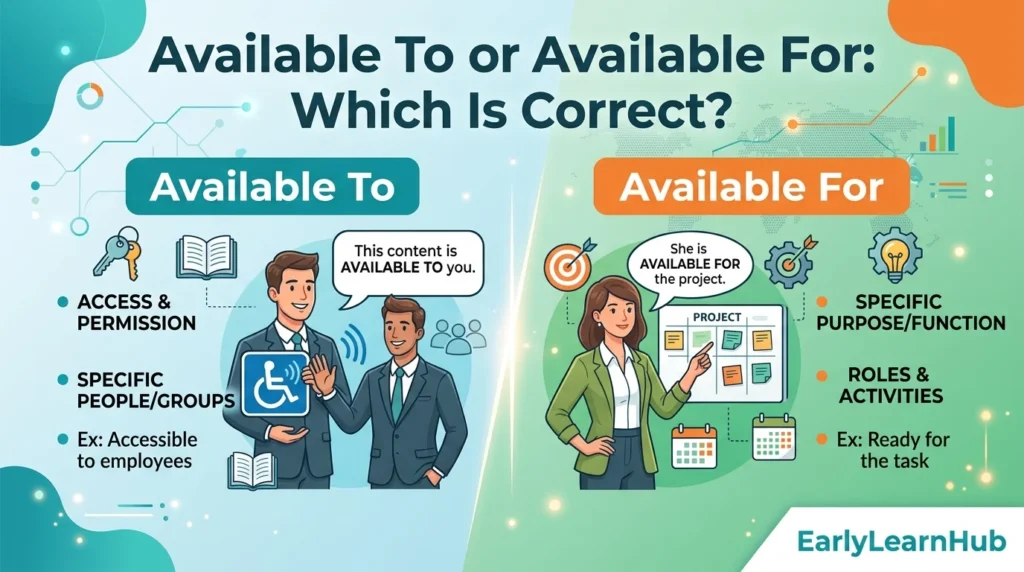
Both “available to” and “available for” are correct English expressions. The difference depends mainly on what follows the word available and what you want to emphasize.
In general, available to is used to identify a person or group who can access, use, receive, or benefit from something. Available for is commonly used to describe a purpose, activity, use, or occasion. Both patterns are supported by major dictionaries, including Cambridge and Oxford.
Is “Available To” or “Available For” Correct?
Both “available to” and “available for” are grammatically correct. Neither preposition is universally correct or incorrect.
Use available to when you are focusing on who can use, access, receive, or obtain something.
- The information is available to all students.
- The service is available to registered users.
- The report is available to the public.
- This discount is available to members.
Use available for when you are focusing on what something is intended or ready to be used for.
- The room is available for meetings.
- The software is available for download.
- The money is available for educational purposes.
- The car is available for rent.
Cambridge specifically gives patterns such as available to somebody, available for something, and available to do something. Oxford likewise lists available for something and available to somebody as standard constructions.
What Does “Available To” Mean?
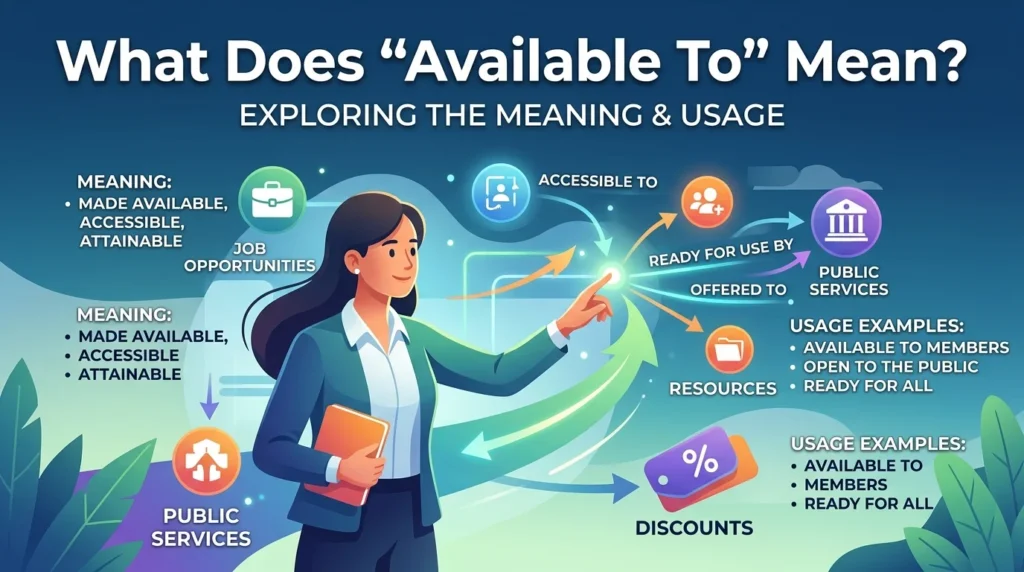
Available to means that something can be accessed, used, obtained, or received by a particular person, group, or organization.
The structure is usually:
available + to + person/group
Understanding in the street or on the street meaning can help clarify which preposition fits different situations.
Examples of “Available To”
- The scholarship is available to international students.
- These resources are available to teachers.
- The new feature is available to all users.
- The information is available to the public.
- Free support is available to customers.
In these sentences, to identifies the people who have access to or can benefit from something.
For example:
The course is available to all employees.
This means all employees can access or take the course.
What Does “Available For” Mean?
Available for commonly indicates the purpose, activity, use, or occasion for which something can be used.
The structure is often:
available + for + noun
Examples of “Available For”
- The conference room is available for meetings.
- The equipment is available for public use.
- The funds are available for research.
- The car is available for rent.
- The document is available for download.
- The room is available for a private event.
Here, for explains the purpose or intended use.
For example:
The room is available for meetings.
The focus is not on who can use the room. The focus is on the purpose for which it can be used.
Oxford provides examples such as data being available for download and products being available for purchase.
What Is the Difference Between “Available To” and “Available For”?
The easiest way to remember the difference is to ask what comes after available.
| Expression | Main focus | Example |
| available to | Person, group, or recipient | The service is available to students. |
| available for | Purpose, activity, or use | The room is available for meetings. |
| available to + verb | Action someone can perform | I am available to help. |
| available for + noun | Purpose or activity | I am available for a meeting. |
So:
Available to = who can access or use it
Available for = what it can be used for
This distinction is useful, but it is not an absolute rule. Some expressions can use either construction without a meaningful difference in practical meaning. For example, both available for purchase and available to purchase occur in English.
“Available To” With People or Groups
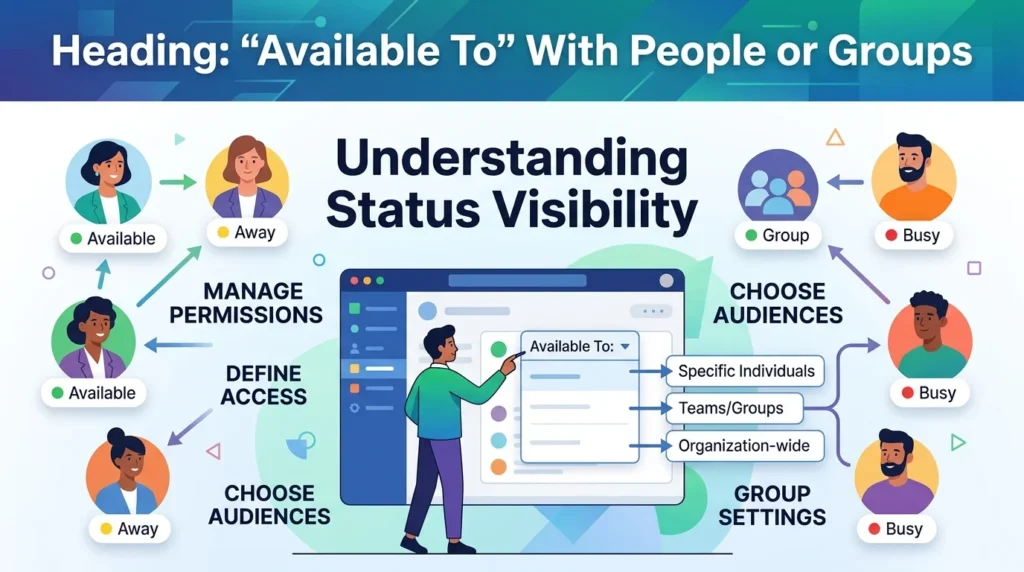
Use available to when you want to identify the people who can access or receive something.
Examples
- The program is available to children under six.
- The service is available to all customers.
- The information is available to registered members.
- These scholarships are available to qualified students.
- The new feature is available to premium users.
Compare:
The resources are available to teachers.
This tells us who can access the resources.
“Available For” With Purposes and Activities
Use available for when the following noun describes a purpose, activity, or intended use.
Examples
- The room is available for training.
- The equipment is available for classroom use.
- The funds are available for emergency expenses.
- The computer is available for student use.
- The hall is available for private events.
In each example, for introduces the purpose or activity.
“Available To” Before a Verb
Another important pattern is:
available + to + base verb
Here, to is part of the infinitive.
Examples
- I am available to help you.
- She is available to answer your questions.
- We are available to discuss the issue.
- The team is available to assist customers.
- He will be available to meet tomorrow.
Cambridge gives the pattern available to do something, with examples such as being available to meet someone.
This is different from available to someone, where to is a preposition identifying the person who has access.
“Available For” Before a Noun or Activity
Available for is commonly followed by a noun or noun phrase.
Examples
- I am available for a meeting.
- She is available for an interview.
- The room is available for rent.
- The equipment is available for use.
- The document is available for download.
Oxford lists available for something as a standard construction, including examples involving download and purchase.
“Available To Help” vs. “Available For Help”
Both structures can be grammatical, but they are constructed differently.
Available to help
Available to help uses an infinitive:
I am available to help you.
It means that I am free or ready to perform the action of helping.
Available for help
Available for help uses for + noun:
I am available for help if you need it.
This construction is possible, although available to help is often the more natural choice when describing a person’s readiness to perform an action.
“Available To Download” vs. “Available For Download”
Both expressions are used in English.
- The report is available to download.
- The report is available for download.
The first uses to download, an infinitive construction. The second uses for download, where download functions as a noun.
In many contexts, available for download is especially common and idiomatic. Oxford gives “available for download” as a standard example.
“Available To Purchase” vs. “Available For Purchase”
Both forms are possible:
- The product is available to purchase online.
- The product is available for purchase online.
However, available for purchase is a particularly established and natural expression.
For example:
The new textbook is available for purchase online.
Here, for purchase identifies the purpose or transaction for which the textbook is available.
“Available To” vs. “Available For” With People
This is one of the most common sources of confusion.
Consider these two sentences:
The service is available to customers.
The service is available for customers.
The first clearly emphasizes who can access the service. The second can be understood as saying that the service is intended or provided for customers, but available to customers is usually the clearer choice when access is the intended meaning.
Therefore, when you mean accessible by someone, choose available to.
Examples
- The website is available to everyone.
- The benefits are available to employees.
- The documents are available to members.
- The resources are available to students.
“Available To” vs. “Available For” With a Purpose
When the emphasis is on a purpose, available for is usually the natural choice.
Examples
- The money is available for research.
- The room is available for meetings.
- The equipment is available for public use.
- The grant is available for educational projects.
The distinction becomes clearer when the sentences are compared:
The room is available to students.
This focuses on who can use the room.
The room is available for study.
This focuses on what the room can be used for.
Writers often question the spelling of Any Time After or Anytime After in English when describing times following an event.
Can “Available To” and “Available For” Be Interchangeable?
Sometimes, yes. However, they are not always interchangeable without changing the emphasis or meaning.
For example:
The information is available to the public.
This means the public can access the information.
Compare:
The information is available for the public.
This can suggest that the information is intended for the public, rather than simply emphasizing access.
Similarly:
I am available to meet tomorrow.
focuses on the action I am ready to perform.
I am available for a meeting tomorrow.
focuses on the scheduled activity.
The two sentences can describe essentially the same situation, but their grammatical structures and emphasis differ.
Common Mistakes With “Available To” and “Available For”
Mistake 1: Using “for” when identifying the user
Incorrect or less natural:
The software is available for registered users.
Better when you mean access:
The software is available to registered users.
Mistake 2: Using “to” before a purpose noun
Less natural:
The room is available to meetings.
Correct:
The room is available for meetings.
Mistake 3: Using “for” before a base verb
Incorrect:
I am available for help you.
Correct:
I am available to help you.
Or:
I am available for help if you need it.
Mistake 4: Assuming “to” always means a person
Not necessarily. In available to download, to introduces an infinitive verb.
The file is available to download.
Here, to download means the action that can be performed.
Quick Rule for Choosing “To” or “For”
Use this simple test:
Ask “Who can use or access it?”
Use available to.
The course is available to teachers.
Ask “What is it intended or available to be used for?”
Use available for.
The course material is available for classroom use.
Ask “What action can someone perform?”
Use available to + verb.
The teacher is available to answer questions.
Ask “What activity or event is involved?”
Use available for + noun.
The teacher is available for a meeting.
Context often determines the correct choice between To Me and For Me usage in everyday sentences and conversations.
More Examples of “Available To”
- The scholarship is available to eligible students.
- The information is available to the public.
- The service is available to all members.
- The discount is available to new customers.
- The software is available to download.
- The teacher is available to answer questions.
- The manager is available to discuss the problem.
- The resources are available to employees.
- The facility is available to local residents.
- The database is available to authorized users.
More Examples of “Available For”
- The room is available for meetings.
- The car is available for rent.
- The product is available for purchase.
- The report is available for download.
- The funds are available for research.
- The equipment is available for public use.
- She is available for an interview.
- The hall is available for private events.
- The space is available for classroom activities.
- The service is available for emergency situations.
Available To or Available For: Side-by-Side Examples
Access
Available to:
The database is available to all employees.
Available for:
The database is available for research purposes.
The first identifies who can access it. The second identifies why it is available.
People
Available to:
The program is available to children.
Available for:
The program is available for children.
Both can be possible depending on the intended meaning. Available to children emphasizes access, while available for children emphasizes that the program is intended or designed for them.
Activities
Available to:
The instructor is available to help students.
Available for:
The instructor is available for a meeting.
The first uses to + verb. The second uses for + noun.
Summary
Both “available to” and “available for” are correct, but they serve different grammatical and semantic purposes.
Use available to when you want to show who can access, use, receive, or benefit from something:
The service is available to all customers.
Use available for when you want to show the purpose, activity, use, or occasion:
The room is available for meetings.
Use available to + verb when describing an action someone is ready or able to perform:
I am available to help.
Use available for + noun when describing an activity or purpose:
I am available for a meeting.
The key distinction is simple: to often identifies the user or an action, while for often identifies the purpose or activity. Cambridge and Oxford both recognize these patterns as standard English usage.
FAQs
Is “available to” grammatically correct?
Yes. Available to is grammatically correct when identifying someone who can access, use, receive, or benefit from something, such as “The service is available to all customers.”
Is “available for” grammatically correct?
Yes. Available for is correct when describing a purpose, activity, use, or occasion, such as “The room is available for meetings.”
What is the difference between “available to” and “available for”?
Available to generally focuses on the person or group who can access something, while available for generally focuses on its purpose, activity, or intended use.
Should I say “available to help” or “available for help”?
Available to help is the natural choice when you mean someone is ready to perform the action of helping. Available for help is also possible when help is treated as a noun.
Is “available to download” correct?
Yes. Available to download is grammatically correct because to download is an infinitive construction. Available for download is also correct and very common.
Is “available for download” correct?
Yes. Available for download is a standard English expression. Oxford lists it as an example of the available for something construction.
Is “available to purchase” correct?
Yes. Available to purchase is grammatically possible. However, available for purchase is also very common and often sounds more natural in formal or commercial writing.
Is “available to the public” correct?
Yes. Available to the public is the standard expression when you mean that the public can access or obtain something. Cambridge gives made available to as a standard construction.
Should I say “available for students” or “available to students”?
Usually, use available to students when you mean students can access or receive something. Use available for students when emphasizing that something is intended or designed for students.
Which is more common, “available to” or “available for”?
Both are widely used. Available to is especially common when identifying people or groups with access, while available for is common with purposes and activities. The correct choice depends on the meaning and grammatical structure.

Ethan Richardson is an Educational Content Editor with more than 10 years of experience reviewing and developing educational materials for young learners. His expertise includes improving worksheet accuracy, readability, and instructional quality while ensuring learning resources meet modern educational standards.
1 thought on “Available To or Available For: Which Is Correct?”