
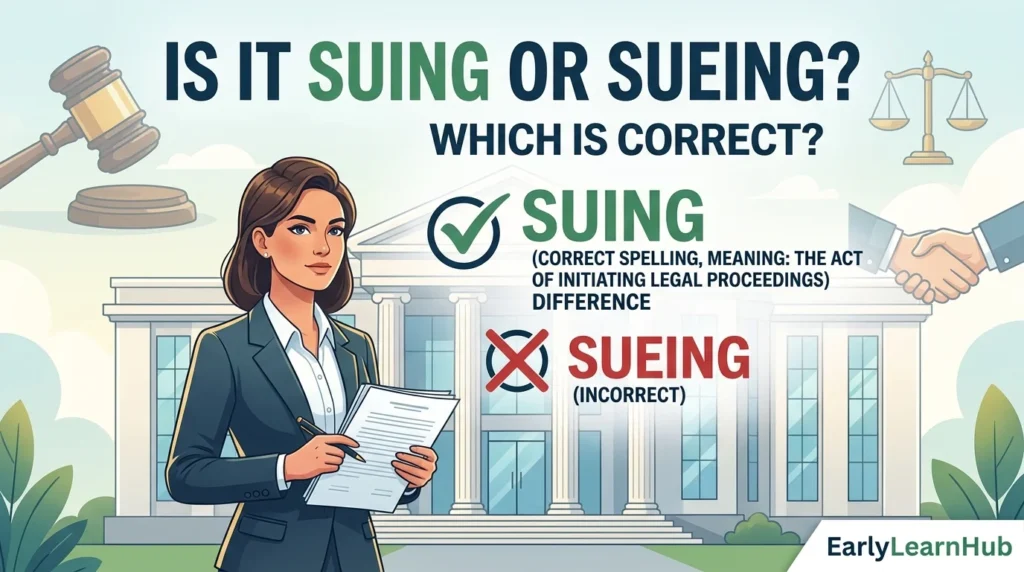
If you are unsure whether “suing” or “sueing” is the correct spelling, the answer is straightforward: suing is the standard English form. It is the present participle and gerund of sue, meaning to take legal action against a person or organization.
Avoid common mistakes when writing formal English with who and whom usage rules explained clearly.
Suing or Sueing: Which Is Correct?
Suing is correct, while sueing is an incorrect spelling in standard English.
| Word | Correct? | Meaning |
| Suing | ✅ Correct | Taking legal action against someone |
| Sueing | ❌ Incorrect | Nonstandard spelling of “suing” |
Examples:
- Correct: She is suing the company for damages.
- Incorrect: She is sueing the company for damages.
Major dictionary sources identify suing as the present participle of sue. Cambridge defines sue as taking legal action against a person or organization, while Dictionary.com identifies suing as the present participle of sue.
What Is the Difference Between Suing and Sueing?
The main difference is correctness and spelling, not meaning.
Suing is the standard spelling used when the verb sue takes the -ing form.
Sueing is a common misspelling. It does not have a separate meaning or grammatical function.
For example:
The customer is suing the manufacturer.
Here, suing describes the action of taking legal action.
Writing:
The customer is sueing the manufacturer.
would be considered a spelling error.
Why Is Suing Correct?
The word sue ends with a silent e. When a verb ending in a silent e takes the -ing suffix, the final e is generally removed.
The formation is:
sue → su + ing → suing
The same pattern appears in words such as:
- make → making
- write → writing
- use → using
- move → moving
- dance → dancing
- sue → suing
The spelling rule explains why sueing is not the standard form. English spelling has exceptions, but sue follows the usual pattern here.
Learn to choose the right form by exploring Toward or Towards in everyday English.
What Does Suing Mean?
Suing means taking legal action against a person, company, organization, or another party.
It is the present participle of the verb sue and can also function as a gerund. Cambridge lists suing as the present participle of sue and defines sue as taking legal action, particularly through a legal claim.
For example:
- She is suing her former employer.
- The company is suing its competitor.
- They are considering suing for damages.
- The family is suing the manufacturer.
The exact legal claim depends on the circumstances, but the word itself simply describes the act of pursuing legal action.
Suing as a Present Participle
Suing commonly appears after forms of be to create continuous verb constructions.
Examples:
- I am suing the company.
- She is suing her landlord.
- They are suing the manufacturer.
- He was suing the newspaper.
- The organization is suing for damages.
In these sentences, suing describes an ongoing legal action.
Suing as a Gerund
Suing can also function as a gerund, meaning the -ing form acts like a noun.
Examples:
- Suing should be considered carefully.
- They discussed suing the company.
- Suing can be expensive.
- She avoided suing because the dispute was resolved.
- The possibility of suing remained under discussion.
Here, suing refers to the activity or process of taking legal action.
Examples of Suing in Sentences
Here are some correct examples of suing:
- The customer is suing the company for damages.
- She is suing her former employer.
- They are considering suing the contractor.
- The business is suing its supplier over the contract.
- He threatened to start suing if the dispute continued.
- The family is suing the manufacturer.
- The newspaper is being accused of wrongdoing, and the individual is considering suing.
- They discussed suing the company during the meeting.
- She decided against suing after receiving compensation.
- The organization is suing over the disputed decision.
These examples demonstrate both the continuous-verb and gerund uses of suing.
Incorrect Examples With Sueing
The spelling sueing should not be used as the standard -ing form of sue.
Incorrect:
- ❌ She is sueing the company.
- ❌ They are sueing their landlord.
- ❌ He considered sueing for damages.
- ❌ The customer threatened to start sueing.
- ❌ We discussed sueing the manufacturer.
Correct:
- ✅ She is suing the company.
- ✅ They are suing their landlord.
- ✅ He considered suing for damages.
- ✅ The customer threatened to start suing.
- ✅ We discussed suing the manufacturer.
Suing vs. Sued vs. Sue
It is also useful to distinguish sue, sued, and suing.
| Form | Function | Example |
| Sue | Base form | They plan to sue the company. |
| Sued | Past tense/past participle | They sued the company last year. |
| Suing | Present participle/gerund | They are suing the company. |
Use sue for the base form, sued for a completed past action, and suing for the -ing form.
How Do You Remember the Correct Spelling?
A simple way to remember it is:
Sue + ing = Suing
Remove the final e before adding -ing.
Think of these similar patterns:
- use → using
- make → making
- write → writing
- drive → driving
- sue → suing
Do not write sueing when you mean the -ing form of sue.
Another useful point is that the pronunciation does not require the extra e in the spelling. Cambridge gives sue as /suː/, and suing is the corresponding -ing form.
Is Suing Used in American and British English?
Yes. Suing is the standard spelling in both American and British English.
There is no standard British-versus-American spelling difference between suing and sueing. If you are writing an email, school assignment, business document, article, or legal-related text, use suing.
Common Mistake: Sueing or Suing
The mistake happens because writers may apply the simple formula:
sue + ing = sueing
However, the final silent e is removed before -ing is added:
sue → suing
This is similar to:
- take → taking
- give → giving
- hope → hoping
- save → saving
- sue → suing
Therefore, suing is the spelling to use in standard English.
Summary
Suing is the correct spelling, while sueing is an incorrect spelling in standard English. Suing is the present participle and gerund form of sue, which means to take legal action against someone or an organization.
The spelling follows the common pattern of dropping a final silent e before adding -ing:
Sue → Suing
So, whenever you need the -ing form of sue, use suing, not sueing.
Is “suing” the correct spelling?
Yes. Suing is the standard and correct spelling of the present participle and gerund form of sue.
Is “sueing” a word?
Sueing is not the standard spelling of the -ing form of sue. Use suing instead.
What does suing mean?
Suing means taking legal action against a person or organization, usually by bringing a legal claim.
Why is it spelled “suing” instead of “sueing”?
The final silent e in sue is removed before the -ing suffix is added, producing suing.
Is “suing” a verb?
Yes. Suing is the present participle of the verb sue and can also function as a gerund.
What is the difference between suing and sued?
Suing refers to the -ing form, while sued is the past tense and past participle of sue.
- They are suing the company.
- They sued the company last year.
Can I use “sueing” in formal writing?
No. In standard formal English, use suing rather than sueing.
What is the pronunciation of suing?
Suing is pronounced approximately SOO-ing. Cambridge lists the base verb sue as /suː/.

Grace Holloway is a Creative Learning Designer with more than 9 years of experience producing visually engaging educational resources for preschool and kindergarten children. She specializes in combining educational principles with creative design to develop worksheets that encourage learning through play, exploration, and creativity.