
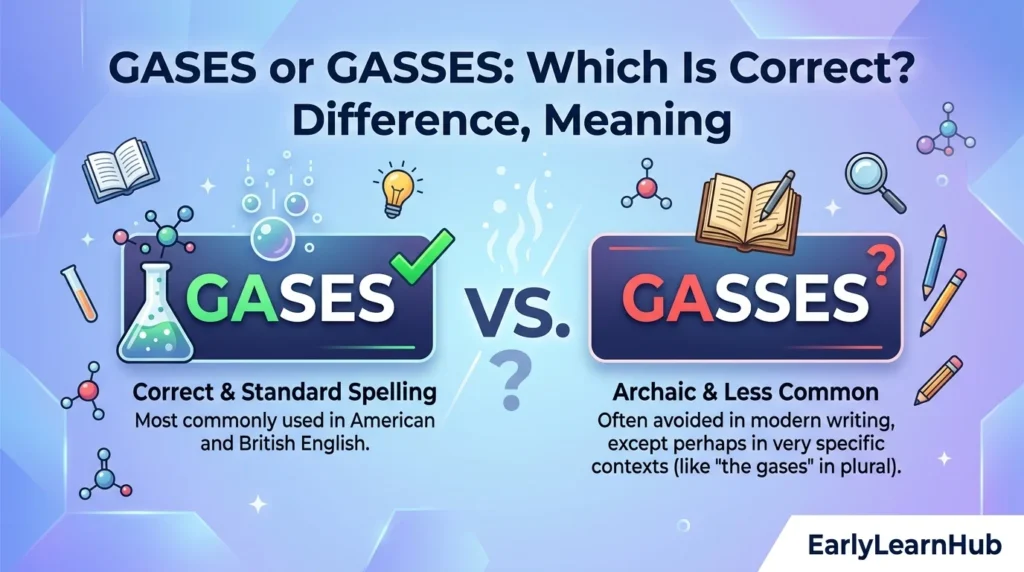
If you are unsure whether the plural of gas should be spelled gases or gasses, you are not alone. Both spellings exist in English, but they are not equally common or used in exactly the same way. Gases is the standard and more common plural noun, while gasses is also used as a verb and can occur as a less frequent plural variant.
Improve your English usage with practical guidance on the difference between Then and Than and common mistakes.
Gases or Gasses: Which Is Correct?
Gases is the preferred spelling when you mean more than one gas.
For example:
- Oxygen and nitrogen are gases.
- Several gases were detected in the laboratory.
- Greenhouse gases can affect the climate.
- Different gases have different properties.
However, gasses is not simply a misspelling. Dictionaries recognize it as a less frequent plural form, and it is also the third-person singular form of the verb gas. Oxford lists gases as the plural and gasses as a less frequent alternative, while Cambridge gives both plural forms.
For normal academic, scientific, educational, and professional writing, gases is the safest choice.
What Is the Difference Between Gases and Gasses?
The main difference is usage and grammatical function.
| Word | Common Function | Meaning | Example |
| Gases | Plural noun | More than one gas | Different gases react differently. |
| Gasses | Verb | Performs an action involving gas | The machine gasses the chamber. |
| Sight vs Site | Less frequent plural noun | More than one gas | The text refers to several gasses. |
So, when you are naming multiple substances, use gases.
When gas is being used as a verb, gasses can be the correct form for he, she, it, or a singular noun. Cambridge lists gas as a verb with meanings including exposing someone to poisonous gas and, in informal older usage, talking for a long time.
What Does “Gases” Mean?
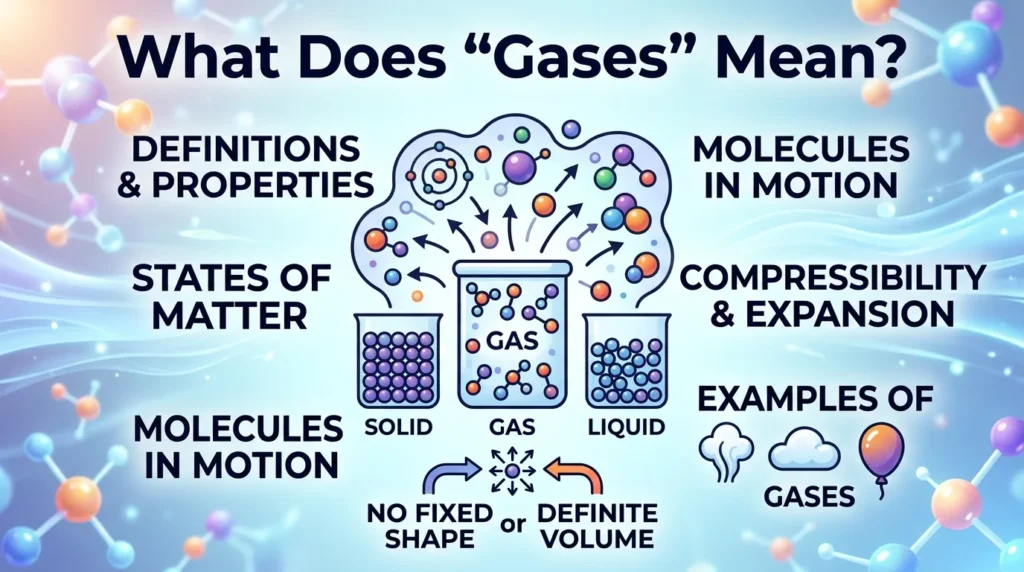
Gases is the plural form of gas. It refers to two or more gases or different types of gas.
A gas is a substance that is neither solid nor liquid and can expand to fill available space. Common examples include oxygen, hydrogen, nitrogen, carbon dioxide, and helium. Cambridge specifically uses oxygen, hydrogen, and nitrogen as examples of gases.
Examples of “Gases”
- Oxygen and hydrogen are gases.
- The atmosphere contains several different gases.
- Scientists analyzed the gases produced during the experiment.
- Some gases are highly flammable.
- The factory releases several gases into the atmosphere.
What Does “Gasses” Mean?
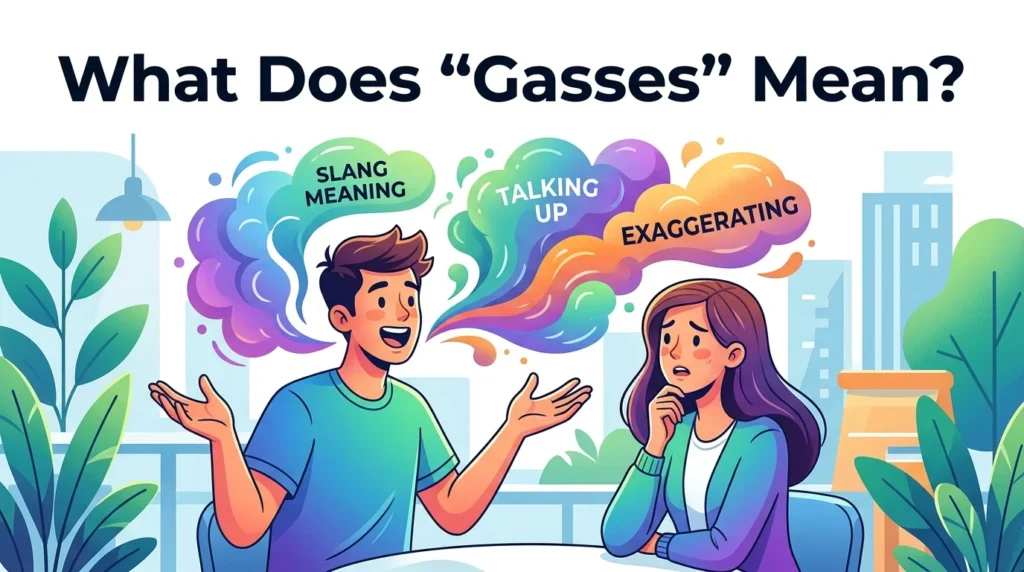
Gasses has two important uses.
First, it can be the third-person singular present-tense form of the verb “gas.”
For example:
- The machine gasses the chamber before testing.
- The process gasses the material.
- The device gasses the sample.
Second, gasses can appear as a less common plural spelling of gas. Oxford explicitly lists it as “less frequent,” while Cambridge’s Business English Dictionary gives gases or gasses as plural forms.
Because gases is much more familiar and standard in general writing, it is normally the better choice when you simply mean multiple gases.
When Should You Use “Gases”?
Use gases when gas is a plural noun.
This is especially appropriate when discussing science, chemistry, physics, the environment, or different types of fuel.
Examples
- The experiment produced several gases.
- Greenhouse gases contribute to climate change.
- Noble gases have distinctive chemical properties.
- Toxic gases can be dangerous.
- Different gases behave differently under pressure.
- The atmosphere contains many different gases.
Oxford gives examples such as “a mixture of gases,” “noxious gases,” and “toxic gases,” reinforcing gases as the normal plural form.
When Should You Use “Gasses”?
Use gasses when it functions as the verb form of gas.
The pattern is:
I gas → he/she/it gasses
For example:
- The equipment gasses the chamber.
- The machine gasses the sample.
- The process gasses the material.
The spelling becomes clearer when you compare the singular and plural verb forms:
- I gas the chamber.
- You gas the chamber.
- They gas the chamber.
- He gasses the chamber.
- She gasses the chamber.
- The machine gasses the chamber.
This is different from the noun:
- One gas
- Two gases
Gases or Gasses in Scientific Writing
For scientific writing, gases is generally the best choice when referring to multiple gaseous substances.
Consider:
Correct and natural:
The experiment produced several gases.
Less common:
The experiment produced several gasses.
The second spelling is recognized as a plural variant by some dictionaries, but gases is the conventional form readers are most likely to expect. Oxford lists gasses as less frequent, and Cambridge provides both forms while using gases in its example sentences.
This makes gases the preferred choice for school assignments, research papers, laboratory reports, and other formal contexts.
Gases or Gasses in American and British English
There is no major American-versus-British spelling difference that requires you to switch between gases and gasses.
Oxford’s American English dictionary lists gases as the plural and gasses as a less frequent alternative. Cambridge likewise lists gases or gasses as plural forms.
Therefore, in both varieties of English, gases is the normal choice when referring to multiple gases.
Common Phrases With “Gases”
You will frequently see gases in phrases such as:
- greenhouse gases
- toxic gases
- noble gases
- harmful gases
- industrial gases
- exhaust gases
- atmospheric gases
- combustible gases
- inert gases
- poisonous gases
For example:
Scientists are studying the effects of greenhouse gases.
Here, gases is clearly a plural noun.
Common Mistakes With Gases and Gasses
A common mistake is using gasses automatically because other words ending in s often take -es when pluralized.
For example:
- bus → buses
- class → classes
- gas → gases
Although gasses exists in English, it should not automatically replace gases when you mean multiple gases.
Incorrect for standard general usage
The laboratory detected several toxic gasses.
Preferred
The laboratory detected several toxic gases.
The preferred version is especially clear in scientific and formal writing.
Easy Trick to Remember Gases vs. Gasses
Use this simple rule:
More than one gas = gases
An action performed by someone or something = gasses
For example:
Oxygen and nitrogen are gases.
But:
The machine gasses the chamber.
You can remember it as:
Gases = things
Gasses = action
There is an important nuance: gasses can also be a less frequent plural noun, so calling it completely incorrect would be inaccurate. The practical recommendation is simply to use gases for the plural noun in most modern writing.
Gases or Gasses: Examples in Sentences
Examples With “Gases”
- Oxygen and nitrogen are common gases.
- The atmosphere contains several different gases.
- The laboratory tested the gases released during the reaction.
- Some gases can be dangerous when inhaled.
- Greenhouse gases are an important environmental topic.
- The scientist studied how different gases react.
- Toxic gases escaped from the damaged pipe.
- Several noble gases are used in industry.
Examples With “Gasses”
- The machine gasses the chamber before the experiment.
- The equipment gasses the sample automatically.
- The process gasses the material before treatment.
Compare the Two
The laboratory contains several gases.
Here, gases is a plural noun.
The machine gasses the laboratory chamber.
Here, gasses is a verb.
That grammatical difference makes the correct choice much easier.
Summary
Gases is the standard and preferred plural form of gas in most English writing. Use it when you are talking about two or more gases, such as oxygen, nitrogen, carbon dioxide, or helium.
Gasses is also a real English word. It can function as the third-person singular present form of the verb gas, and dictionaries also recognize it as a less frequent plural variant.
The easiest rule is:
One gas → two gases
He/she/it gasses → verb
When writing a school assignment, scientific report, article, or professional document, gases is usually the clearest and safest choice.
Is “gases” or “gasses” correct?
Gases is the standard and preferred plural form of gas. Gasses is also a recognized word, but it is less frequent as a plural and is commonly encountered as a verb.
What is the plural of gas?
The usual plural of gas is gases.
Example: The atmosphere contains several gases.
Is “gasses” a correct word?
Yes. Gasses is a valid English word. It can be the third-person singular form of the verb gas, and it is also recognized as a less frequent plural variant by dictionaries.
Should I write “greenhouse gases” or “greenhouse gasses”?
Use greenhouse gases in standard modern writing. It is the conventional and more familiar form.
Are gases and gasses pronounced the same?
Yes. Gases and gasses are generally pronounced the same, so the difference cannot be reliably identified from speech alone. Context and spelling determine which form is intended.
Is “gasses” the plural of gas?
It can be used as a less frequent plural variant, but gases is the normal and preferred plural form. Oxford specifically labels gasses as less frequent.
What is the difference between gases and gasses?
Gases is normally a plural noun meaning more than one gas. Gasses is commonly the third-person singular verb form of gas, although it can also function as a less frequent plural noun.
Which is correct in a science essay, gases or gasses?
Use gases. It is the standard and most widely expected plural spelling in scientific and academic writing.

Ethan Richardson is an Educational Content Editor with more than 10 years of experience reviewing and developing educational materials for young learners. His expertise includes improving worksheet accuracy, readability, and instructional quality while ensuring learning resources meet modern educational standards.
1 thought on “Gases or Gasses: Which Is Correct? Difference, Meaning”