
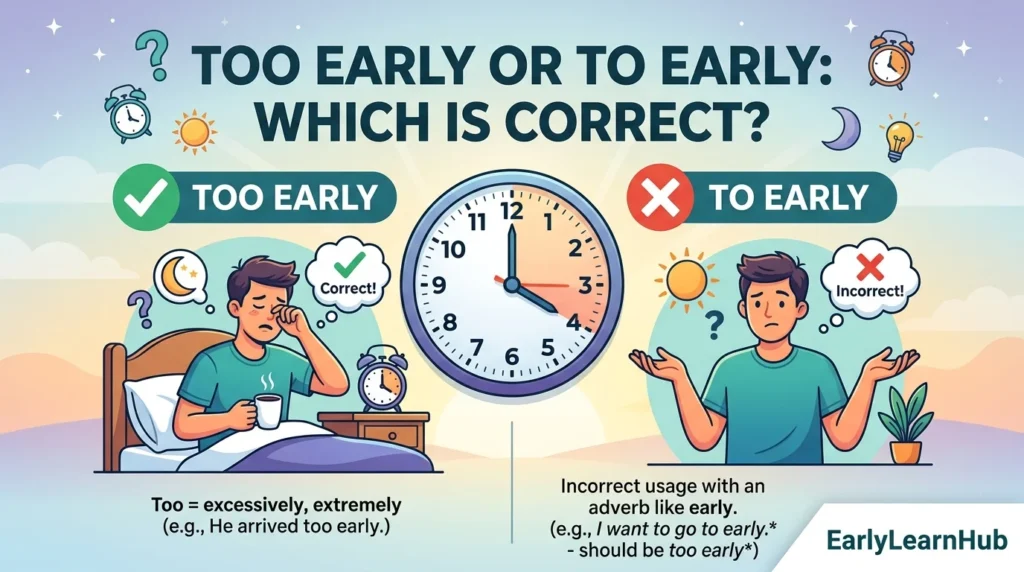
“Too early” is correct. “To early” is incorrect when you mean that something happens before the appropriate, expected, or desired time. The confusion comes from the fact that too and to sound alike in many varieties of English, but they have different grammatical functions.
Cambridge Dictionary explains that too is an adverb meaning “more than is needed,” “more than is suitable,” or “more than is enough.” It can appear directly before adjectives and adverbs, which is why too early is grammatically correct.
For clearer sentences, consider how Any Time After and Anytime After examples demonstrate each expression in context.
Is “Too Early” or “To Early” Correct?
The correct expression is “too early.”
- ✅ Too early = correct
- ❌ To early = incorrect when referring to something happening before the appropriate time
For example:
- ✅ It is too early to leave.
- ❌ It is to early to leave.
In too early, too modifies early. It tells us that something happens earlier than is appropriate, expected, necessary, or wanted.
The word to has different grammatical functions, commonly working as a preposition or as part of an infinitive, so it does not normally function as the word that modifies early in this expression. Oxford’s dictionary resources distinguish to according to these grammatical roles, while Cambridge identifies too as an adverb.
What Does “Too Early” Mean?

Too early means earlier than the appropriate, expected, convenient, or desired time.
It can refer to a specific time of day:
I woke up too early this morning.
Here, the speaker woke up earlier than they wanted or needed to.
It can also describe an action that is premature:
It is too early to make a decision.
This means there is not enough information, preparation, or time for a sensible decision yet.
“Too early” can therefore describe both clock time and readiness or timing in a broader sense. Cambridge lists too as meaning more than is suitable or enough, which explains this sense of excess.
Difference Between “Too Early” and “To Early”
The main difference is grammatical.
| Expression | Correct? | Function | Meaning |
| Too early | ✅ Yes | Too modifies early | Earlier than appropriate or desired |
| To early | ❌ Usually no | To does not work this way | Usually a spelling or word-choice error |
Common grammar questions often involve A Couple of Times and A Couple Times examples and their use in everyday sentences.
“Too” Means Excessively or More Than Appropriate
In too early, too indicates that the degree of earliness has gone beyond what is appropriate.
For example:
We arrived too early for the meeting.
The arrival happened before the suitable time.
Other examples include:
You are driving too fast.
This box is too heavy.
It is too cold outside.
She spoke too quickly.
In each case, too modifies an adjective or adverb and indicates an excessive degree. Cambridge specifically notes that too is used before adjectives and adverbs in this way.
“To” Has a Different Job
To is commonly used as a preposition or as an infinitive marker.
Examples include:
We went to school.
I want to leave.
She needs to study.
He decided to call.
Because early is not a verb, the construction to early does not normally work when you are trying to say “earlier than appropriate.”
Therefore:
❌ It is to early to call.
should be:
✅ It is too early to call.
Why Do People Write “To Early”?
The mistake is common because to and too are pronounced alike in many varieties of English. When people hear a sentence such as:
Is it too early to call?
they may accidentally write to early because the pronunciation does not clearly reveal which spelling is required.
This is a classic homophone problem. The easiest solution is to focus on the meaning and grammatical function rather than pronunciation.
How to Remember “Too Early”

A simple memory trick is the extra O rule.
Too has an extra o, and it can express something extra or excessive.
So:
too early = more early than appropriate
You can also replace too with excessively or more than appropriate.
For example:
We arrived too early.
can be understood as:
We arrived earlier than appropriate.
If that meaning fits, use too, not to.
Examples of “Too Early”
Here are several correct examples:
- I woke up too early today.
- We arrived too early for the concert.
- It is too early to go home.
- She left too early in the morning.
- You are asking that question too early.
- The store is too early to open.
- It is too early to know the result.
- They started the meeting too early.
- He went to bed too early last night.
- It is too early to celebrate.
A better version of example 7, when referring to a decision or conclusion, would often be:
It is too early to know the result.
The important point is that too early can describe both an actual time and an action that is premature.
“Too Early” in Questions
The phrase is especially common in questions about timing.
Examples:
Is it too early to call?
Is it too early to make a reservation?
Is it too early to leave?
Is it too early to talk about the results?
Is 7 a.m. too early for a meeting?
These sentences ask whether the proposed time or action occurs before an appropriate point.
“Too Early” With “To”
One reason this phrase can be confusing is that too early and to can appear together in the same sentence.
For example:
It is too early to decide.
There are two different words here:
- too = excessively or earlier than appropriate
- to = infinitive marker before the verb decide
The same pattern appears in:
It is too early to leave.
It is too early to tell.
It is too early to know.
It is too early to make a judgment.
So, “too early to” is perfectly correct. The first word is too, while the second to introduces the infinitive verb.
“Too Early” vs. “Too Soon”
Too early and too soon can sometimes have similar meanings, but they are not always interchangeable.
Too early often focuses on being before an appropriate time or stage:
It is too early to plant the flowers.
Too soon often emphasizes that not enough time has passed:
It is too soon to discuss the issue again.
Cambridge’s thesaurus lists expressions such as too soon, premature, hasty, untimely, and ill-timed as related to too early.
The distinction depends on context, so both expressions can sometimes describe the same situation.
Common Mistakes With “Too Early”
Mistake 1: Using “to early”
❌ We arrived to early.
✅ We arrived too early.
Mistake 2: Writing “to early” because it sounds right
❌ Is it to early to call?
✅ Is it too early to call?
Mistake 3: Confusing the two “to/too” words in one sentence
❌ It is to early too leave.
✅ It is too early to leave.
The correct sentence uses too to modify early and to before the verb leave.
Is “Too Early” Formal or Informal?
“Too early” is standard English and can be used in both formal and informal writing.
For example, it is appropriate in everyday conversation:
I think you’re here too early.
It is also suitable for professional or academic contexts:
It is too early to determine whether the policy has been successful.
The expression itself is not informal. The surrounding vocabulary and sentence structure determine the overall level of formality.
Synonyms for “Too Early”
Depending on the context, you can use:
- too soon
- premature
- prematurely
- ahead of schedule
- untimely
- ill-timed
- before the appropriate time
- beforehand, in some contexts
However, these alternatives do not always have exactly the same meaning. Too early is usually the most natural choice when you simply want to say that something happened earlier than appropriate.
Quick Rule for “Too Early” vs. “To Early”
Use too early when you mean:
earlier than necessary, expected, appropriate, or desired.
Use to when it introduces a destination, relationship, or infinitive verb:
go to work
give it to him
to leave
to study
Therefore:
✅ It is too early to leave.
not:
❌ It is to early to leave.
Summary
Too early is the correct phrase when you mean that something happens before the appropriate, expected, or desired time. To early is normally incorrect when used with this meaning.
The key distinction is grammatical. Too is an adverb that can modify early, while to has other functions, such as acting as a preposition or introducing an infinitive. Cambridge confirms that too is used before adjectives and adverbs to express a degree that is more than suitable or enough.
Remember the simple rule:
Too early = earlier than appropriate.
Examples such as “I woke up too early,” “It is too early to decide,” and “We arrived too early” are all correct.
Frequently Asked Questions
Is “too early” or “to early” correct?
“Too early” is correct. Use it when something happens earlier than the appropriate, expected, or desired time.
Is “to early” ever correct?
“To early” is not normally correct when you mean “earlier than appropriate.” In ordinary English, use too early instead.
What does “too early” mean?
“Too early” means before the appropriate, expected, necessary, or desired time. For example, It is too early to decide means the time is not yet appropriate for making a decision.
Why is “too early” correct?
Too is an adverb that can modify early. It indicates that something is earlier than an appropriate or acceptable point. Cambridge describes too as meaning more than is needed, suitable, or enough.
What is an example of “too early”?
I woke up too early this morning.
This means the speaker woke up earlier than they wanted or needed to.
Can I say “too early to”?
Yes. “Too early to” is a common and grammatically correct construction.
Example:
It is too early to make a decision.
Here, too modifies early, while to introduces the verb make.
Is “too early” formal English?
Yes. Too early is standard English and can be used in casual, professional, academic, and formal writing.
What is the difference between “too early” and “too soon”?
Too early often emphasizes being before an appropriate time or stage, while too soon often emphasizes that not enough time has passed. They can overlap depending on the context.
What is an easy way to remember “too early”?
Remember the extra O in too. When something is more than appropriate, use too. Therefore, too early means earlier than appropriate.
Is “It is too early to tell” correct?
Yes. “It is too early to tell” is a standard expression meaning that there is not enough information or time yet to know the answer or outcome.

Grace Holloway is a Creative Learning Designer with more than 9 years of experience producing visually engaging educational resources for preschool and kindergarten children. She specializes in combining educational principles with creative design to develop worksheets that encourage learning through play, exploration, and creativity.
2 thoughts on “Is It Too Early or To Early? Which Is Correct?”